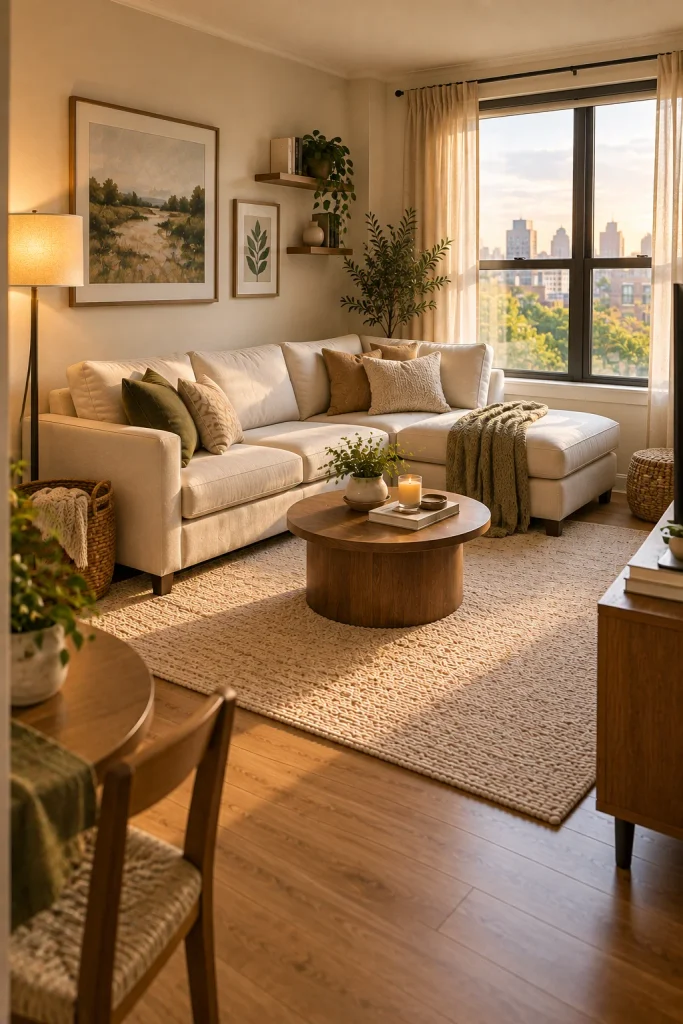
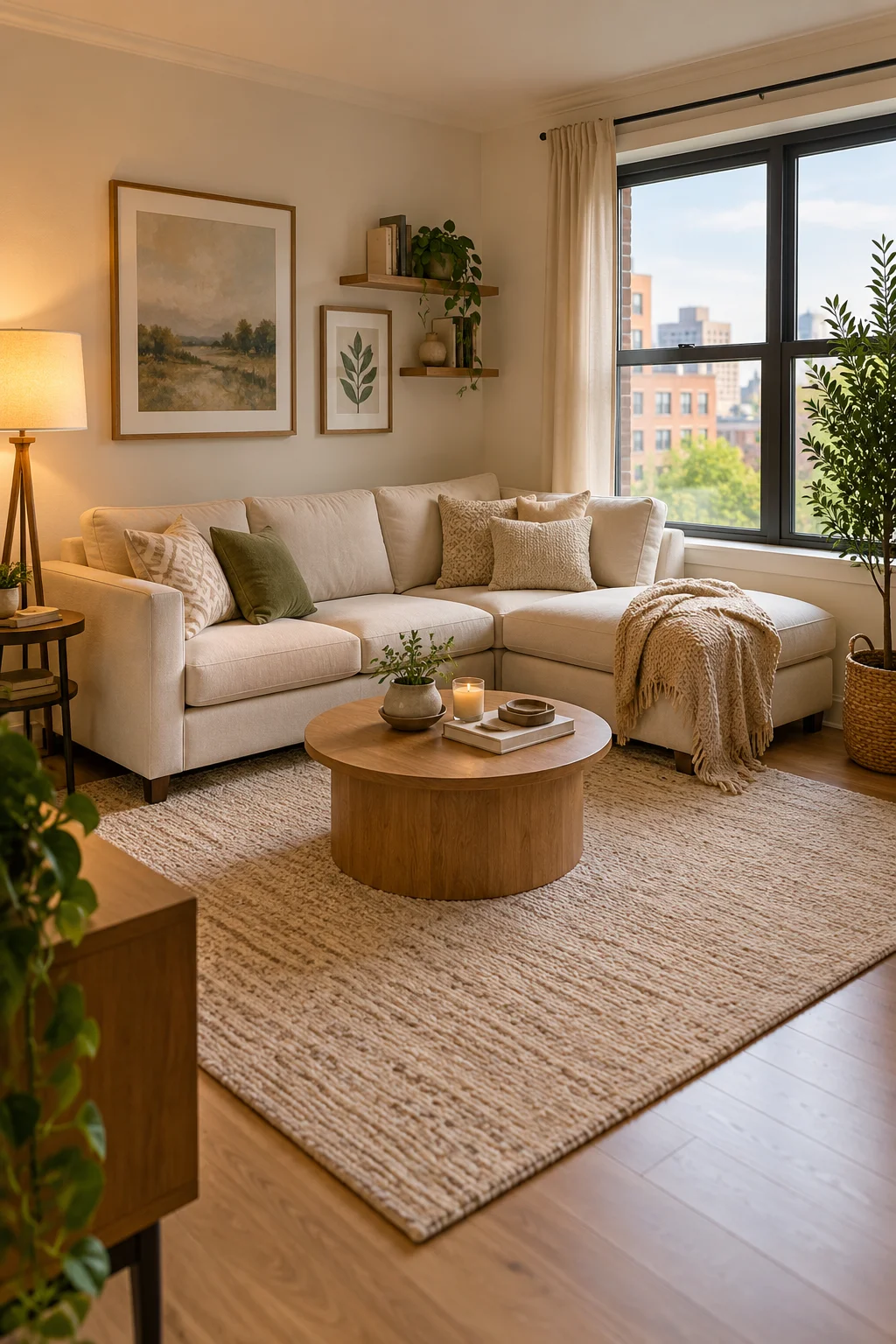
A corner sofa can either be the smartest piece of furniture in your living room—or the thing that makes the entire room feel like it has run out of space.
The difference usually isn’t the sofa itself.
It’s scale, shape, orientation, and placement.
That’s why choosing between different corner sofa designs shouldn’t start with scrolling through pretty living rooms and picking your favorite color. A sofa that looks incredible in a 400-square-foot Pinterest room may completely overwhelm a 150-square-foot apartment living room.
And that’s especially important if you’re decorating a small apartment, rental, studio, or narrow living room.
The good news is that a corner sofa can actually be excellent for small spaces. Instead of using a separate sofa, loveseat, and chair, one well-proportioned L-shaped piece can concentrate your seating into a single footprint and leave the center of the room more usable. Recent small-space design guides make the same point: the right corner sofa can improve circulation and use otherwise awkward corner space—but only if its proportions and orientation are right.
So before you buy the biggest sectional that will physically fit through your front door, let’s look at the designs that actually make sense.
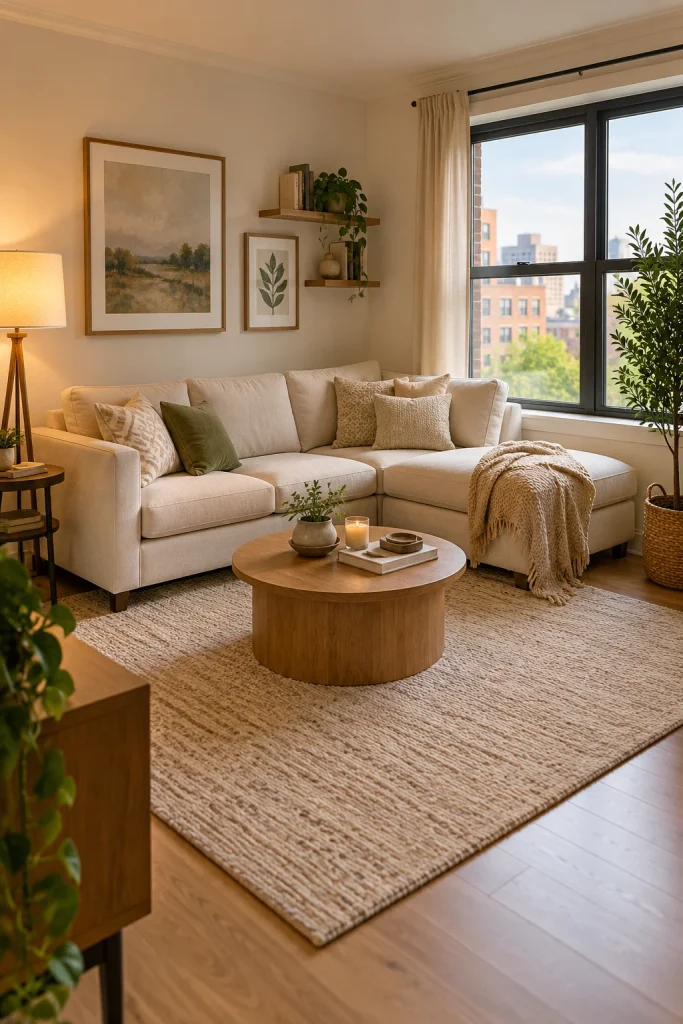
Why Corner Sofa Designs Work So Well in Small Living Rooms
At first, putting a large sectional into a small room sounds like a terrible idea.
Sometimes it is.
But a corner sofa has one major advantage: it consolidates seating.
Instead of having:
- One three-seat sofa
- Two occasional chairs
- A side table for each chair
- Extra gaps between furniture
- Multiple visual breaks
you can use one L-shaped piece to handle most of the seating.
That can create a cleaner floor plan.
A corner sofa also takes advantage of a corner that might otherwise be dead space.
The important distinction is that a corner sofa isn’t automatically space-saving.
A huge, deep sectional with oversized arms can consume the entire room.
A compact L-shaped sofa with a shallow depth, narrow arms, raised legs, and the correct chaise orientation can make the same room feel much more efficient.
That’s why we’re going to focus less on “pretty sofas” and more on which design solves which space problem.
1. Compact L-Shaped Corner Sofa
The classic L-shaped sofa is the obvious starting point—and for good reason.
It gives you substantial seating while allowing one side of the sofa to run into the corner.
For a small living room, look for:
- Narrow arms
- Moderate seat depth
- Low or medium back
- Raised legs
- Compact chaise
- Light or medium upholstery
The goal is to avoid a sofa that looks like one enormous block.
A little floor showing underneath the sofa can make a surprising difference.
Best for:
Small apartments, narrow living rooms, and square rooms where you want maximum seating without multiple chairs.
2. Slim-Arm Corner Sofa
The arms on a sofa take up more space than people realize.
A thick rolled arm on both ends can add several inches to the overall footprint while also making the sofa look heavier.
A slim-arm design solves both problems.
You still get the same basic L-shaped configuration, but the silhouette is cleaner.
This is particularly useful when you’re comparing two sofas with similar overall dimensions.
If one has 6-inch arms and another has 10-inch arms, those extra inches matter in a compact room.
More importantly, narrow arms visually reduce the amount of furniture occupying your sightline.
3. Raised-Leg Corner Sofa
This is one of my favorite tricks for making a sectional look lighter.
Instead of sitting directly on the floor, choose a corner sofa with visible legs.
The floor continues underneath the sofa, creating the illusion of more open space.
You don’t actually gain a huge amount of usable floor area, but visually, the room feels less blocked.
This principle is also recommended in established interior design coverage of compact corner sofas: exposing some floor underneath can reduce the sofa’s visual bulk.
Look for:
- Wood legs
- Slim black legs
- Metal legs
- Tapered legs
- Legs set slightly inward
Avoid enormous block bases if your primary goal is an airy small-space look.
4. Reversible Chaise Corner Sofa
If you’re renting or your layout may change, a reversible chaise is worth serious consideration.
The chaise can be configured on either side depending on the model.
That’s useful when:
- You move apartments
- Your room layout changes
- You aren’t sure which wall works best
- Your living room has awkward doors
- You want more flexibility
A fixed chaise can be beautiful.
But flexibility has real value in a small home.
Especially if you expect to move within the next few years.
5. Corner Sofa With a Long Chaise
If lounging is your priority, choose a design with a proper chaise rather than a tiny corner extension.
This creates a natural place to stretch out.
It’s excellent for:
- Movie nights
- Reading
- Afternoon naps
- Working from a laptop
- Relaxing with your feet up
But there’s a catch.
The longer the chaise, the more it can interfere with circulation.
Before buying, mark the sofa dimensions on your floor with painter’s tape.
Then physically walk around it.
Don’t trust the product photo.
6. Modular Corner Sofa
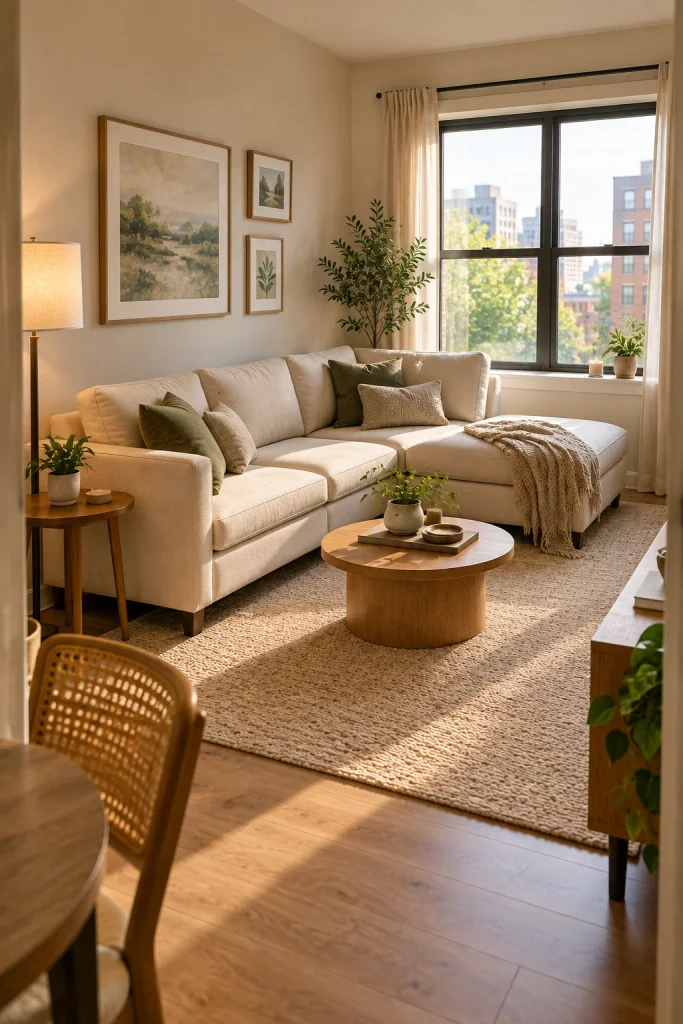
Modular sofas are becoming increasingly practical for small homes because they can be rearranged.
Instead of buying one permanently fixed configuration, you get separate sections that connect together.
That gives you options.
You might configure it as:
L-shape → chaise → separate seating → different L-shape
depending on the room.
The major advantage isn’t just aesthetics.
It’s transportation.
Getting a giant one-piece sectional into a small apartment can be a nightmare.
Modular pieces can be easier to move through:
- Apartment doors
- Narrow hallways
- Staircases
- Elevators
- Tight corners
Current small-space sofa coverage also highlights modular designs as a flexibility advantage.
7. Storage Corner Sofa
If your apartment is short on storage, look for a corner sofa with hidden compartments.
Depending on the design, storage may be located beneath:
- The chaise
- Lift-up seats
- Ottoman sections
Use that space for things you need but don’t want visible.
For example:
- Extra blankets
- Seasonal pillows
- Board games
- Throws
- Spare bedding
- Small electronics
Don’t use hidden storage as an excuse to keep useless things.
If your apartment needs more than just hidden sofa storage, see our guide to smart small apartment storage ideas for practical ways to use overlooked space.
But for genuinely useful items, it’s a very efficient feature.
8. Low-Profile Corner Sofa
A low-profile sofa has a lower back and often a lower overall silhouette.
This can work beautifully in small living rooms because it preserves sightlines.
If your sofa sits beneath a window or across from another major feature, a lower back won’t visually cut the room in half.
It’s especially useful in:
- Studio apartments
- Open-plan rooms
- Rooms with large windows
- Low-ceiling spaces
The trade-off is comfort.
Some people prefer substantial back support.
So don’t choose a low-back sofa purely because it looks good online.
Sit on it first if possible.
9. Cream or Oatmeal Corner Sofa
Light neutral upholstery is extremely versatile.
Cream, oatmeal, warm beige, and soft taupe can make a corner sofa feel less visually heavy than a dark sectional.
That doesn’t mean dark sofas are wrong.
It means they’re more visually dominant.
A cream sectional works especially well with:
- Light oak
- Walnut
- Black accents
- Olive green
- Terracotta
- Brass
- Natural woven textures
If you’re worried about stains, look for a durable, removable, or performance fabric rather than rejecting the entire idea of a light sofa.
10. Dark Corner Sofa for Contrast
Now the opposite.
A charcoal, espresso, deep green, navy, or black corner sofa can look fantastic when the room needs contrast.
This works particularly well when the rest of the room is light.
For example:
Cream walls + oak floor + white curtains + charcoal sectional
creates a strong anchor.
The mistake is using a dark sectional in an already dark, visually crowded room.
If your walls, floors, curtains, rug, and sofa are all dark, the sectional may dominate everything.
Use contrast deliberately.
11. Bouclé Corner Sofa
Bouclé adds immediate texture.
Its soft, nubby surface makes a large sectional feel more tactile and inviting.
For a cozy living room, it pairs particularly well with:
- Wood
- Linen
- Wool
- Ribbed ceramics
- Woven baskets
- Soft neutral rugs
But bouclé isn’t magic.
A massive deep bouclé sectional is still massive.
Texture doesn’t cancel out bad proportions.
If your room is tiny, choose a compact silhouette first.
Then choose the fabric.
12. Leather Corner Sofa
Leather creates a completely different mood.
Instead of soft and airy, it can feel:
- Sophisticated
- Warm
- Modern
- Classic
- Slightly masculine
- More structured
Brown leather is particularly good for warm interiors.
Pair it with:
- Cream walls
- Vintage-style rug
- Wood coffee table
- Linen curtains
- Olive cushions
- Brass or black lighting
If you have pets or children, also think practically about the specific leather and finish rather than assuming all leather behaves the same way.
13. Curved Corner Sofa
Curved sectionals are softer visually than traditional right-angle L-shaped sofas.
They can make a room feel more conversational because people aren’t sitting in a rigid 90-degree configuration.
However, this is one design where you need to be careful.
Curves can actually require more floor area.
So don’t buy a curved sofa simply because you think “rounded furniture makes small rooms bigger.”
It doesn’t.
The correct question is whether the curve improves the flow of your room.
14. Armless Corner Sofa
An armless sectional can look incredibly light.
Without bulky armrests interrupting the silhouette, the sofa occupies less visual weight.
It’s particularly effective in:
- Minimalist rooms
- Modern apartments
- Open-plan spaces
- Small studio layouts
The downside is obvious.
Armrests are comfortable.
If you love curling up against the arm of the sofa, an armless configuration might annoy you every day.
Design should serve how you actually live.
15. Corner Sofa With a Chaise Facing the Window
This is a layout idea rather than simply a sofa style, but it’s worth mentioning.
If your room has a good window, orienting the chaise toward it can create a natural lounging zone.
Instead of staring directly at a wall, you’re facing:
- Natural light
- Trees
- A balcony
- A city view
- Your garden
That can make the living room feel more open.
It also creates a natural visual destination.
Recent small-room design advice specifically highlights a chaise oriented toward natural light as an underused layout option.
16. Wall-Hugging L-Shaped Sofa
This is the safest configuration for many small living rooms.
Push the sofa into the corner where two walls meet.
That leaves the center open.
It works particularly well when your room has:
- A narrow footprint
- A doorway on one side
- Limited walking space
- A TV mounted opposite the sofa
The downside is that it can make the room feel somewhat static.
But if you’re struggling to fit everything, simplicity beats cleverness.
If you’re working with a tight living room, our guide to how to arrange a small living room without cramping it can help you plan the rest of the furniture around your sofa.
17. Floating Corner Sofa
Here’s where things get more interesting.
Instead of pushing the sofa against the wall, pull it slightly forward.
This creates a defined living zone.
It works especially well in open-plan spaces where you need the sofa to visually separate:
Living room → dining area → kitchen
You can place a slim console table behind it.
But don’t do this automatically.
Floating a sofa consumes floor space.
If you only have a narrow passage between the sofa and wall, you’re potentially making circulation worse.
Measure first.
Recent small-space guidance makes the same trade-off: floating a corner sofa can create depth and zoning, but it costs some floor area.
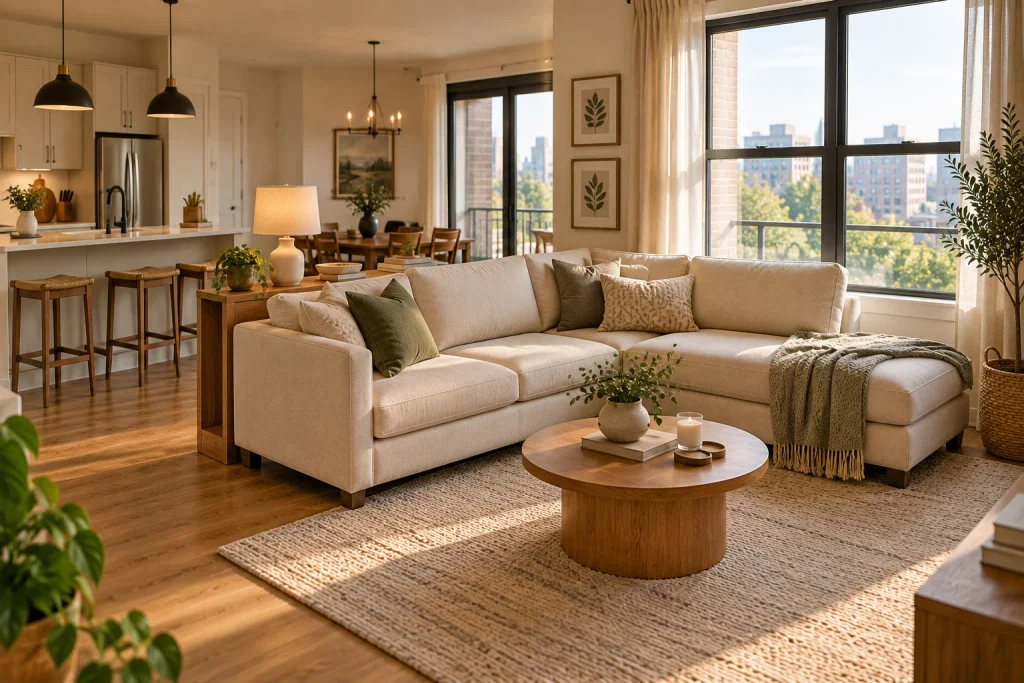
18. Corner Sofa With a Round Coffee Table
A rectangular coffee table can reinforce all the hard lines created by an L-shaped sofa.
A round coffee table introduces contrast.
It’s also easier to move around.
That matters in a small living room where you’re constantly walking around furniture.
Try:
L-shaped sofa + round wood table + round lamp + rectangular rug
The mixture of shapes keeps the room from becoming visually repetitive.
19. Corner Sofa With a Small Ottoman
Instead of a large coffee table, use a compact ottoman.
It can serve several functions:
- Footrest
- Extra seating
- Coffee table with a tray
- Blanket storage
- Visual softener
This is particularly useful if your living room is too small for a coffee table plus separate accent chair.
One piece can perform several jobs.
That’s exactly what small-space furniture should do.
20. Corner Sofa as an Open-Plan Room Divider
In an open apartment, a corner sofa doesn’t necessarily need to live against a wall.
It can define where one room ends and another begins.
For example:
Kitchen → dining → corner sofa → TV wall
The sectional establishes a boundary without requiring a physical wall.
This can make an open-plan apartment feel like it has separate zones without sacrificing openness.
Use a rug underneath the sofa to strengthen the boundary.
21. Cozy Neutral Corner Sofa With Layered Textures
Finally, one of the safest designs for a Pinterest-friendly living room:
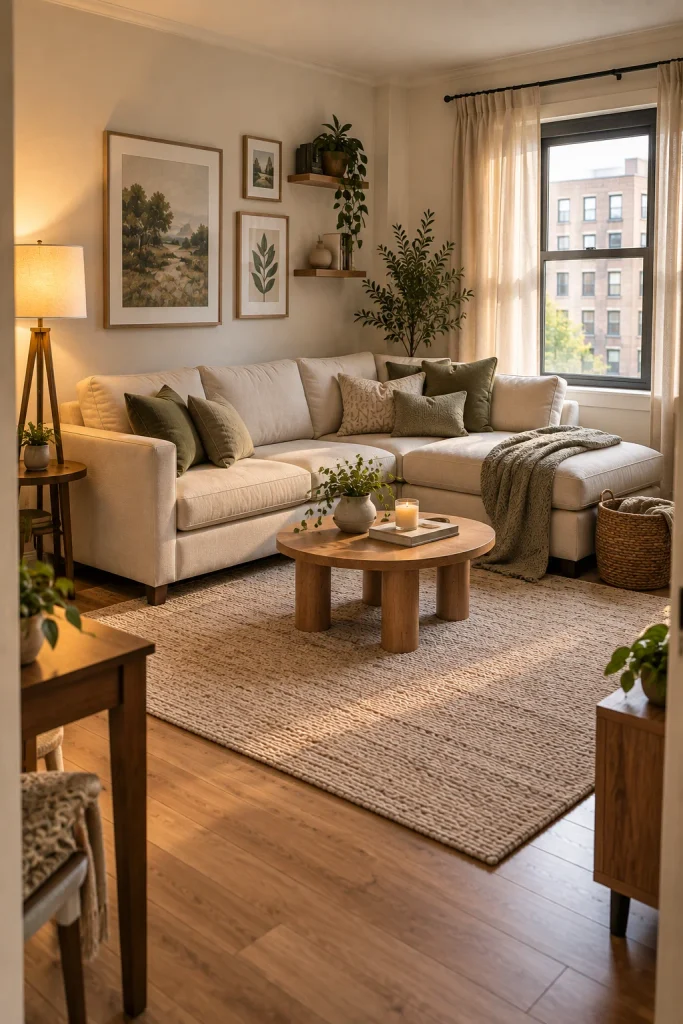
Cream corner sofa + textured neutral rug + wood coffee table + soft throw + mixed cushions + warm lighting.
It works because the furniture itself stays relatively simple while texture does the visual work.
Try combining:
- Linen
- Bouclé
- Cotton
- Wool
- Wood
- Woven fibers
- Ceramic
You don’t need bright colors.
You need variation.
Pinterest’s current home trend environment is also moving beyond sterile minimalism toward more personality and distinctive materials; Pinterest’s 2026 trend report highlights emerging décor aesthetics built around stronger character and sculptural forms.
How to Choose the Right Corner Sofa Size
This is where people screw up.
They measure the wall.
They find a sofa that is technically smaller than the wall.
They order it.
Then they realize they can’t comfortably walk around it.
Wall length is not your only measurement.
Measure:
- Sofa width
- Sofa depth
- Chaise depth
- Doorway width
- Hallway width
- Window clearance
- Radiator position
- TV distance
- Walking paths
- Coffee table clearance
A practical comparison
| Sofa Style | Space Needed | Best For | Small-Room Friendly |
|---|---|---|---|
| Slim L-shape | Low–medium | Everyday seating | ★★★★★ |
| Reversible chaise | Medium | Flexible layouts | ★★★★★ |
| Modular sectional | Medium | Renters/movers | ★★★★★ |
| Deep chaise sectional | Medium–high | Lounging | ★★★ |
| Curved sectional | High | Open layouts | ★★ |
| Large U-shaped sectional | Very high | Large family rooms | ★ |
| Armless modular | Low–medium | Minimal rooms | ★★★★ |
| Storage sectional | Medium | Small apartments | ★★★★★ |
The biggest mistake is treating the star rating as universal.
A 100-inch sectional might be perfect for one room and ridiculous in another.
Your floor plan decides.
How Much Space Should You Leave Around a Corner Sofa?
You don’t need an enormous empty gap around the sofa.
But you do need usable circulation.
The exact clearance depends on your room, doorways, and furniture arrangement.
Rather than memorizing one magic number, test the layout physically.
Use painter’s tape to mark the sofa footprint on your floor.
Then:
- Walk from the doorway to the kitchen.
- Walk from the sofa to the bathroom.
- Sit down.
- Stand up.
- Open nearby cabinets.
- Pull out drawers.
- Walk around the coffee table.
If you’re constantly squeezing sideways, the sofa is too large or badly positioned.
That’s more useful than any generic furniture rule.
Left-Hand vs Right-Hand Corner Sofa: Which One Do You Need?
This sounds simple until you order the wrong configuration.
Look at the sofa from the front.
If the chaise/extended section is on your left, it’s a left-hand configuration.
If it’s on your right, it’s a right-hand configuration.
But manufacturers don’t always describe configurations consistently.
So don’t rely only on the words “left-facing” or “right-facing.”
Look at the actual product diagram.
And measure your room.
Before ordering, check:
- Which wall has the longer usable length?
- Where is the doorway?
- Where does the TV go?
- Where is the main walking path?
- Does the chaise block anything?
- Is the configuration reversible?
If you’re unsure, reversible is safer.
How to Make a Large Corner Sofa Look Smaller
Sometimes you already own the sofa.
Or maybe the only comfortable sectional available is slightly larger than ideal.
You can reduce its visual weight.
1. Choose lighter textiles
Cream and warm beige can visually soften a large sectional.
2. Use a rug beneath it
A rug visually groups the furniture into one intentional zone.
3. Keep the coffee table light
A glass, slim wood, or open-base table can prevent the center from feeling crowded.
4. Use visible legs
If your sofa has legs, let some floor show.
5. Don’t pile on cushions
Eight oversized pillows can make a sectional look even bulkier.
6. Keep nearby furniture slim
If the sofa is substantial, don’t pair it with two giant armchairs.
Balance matters.
How to Style a Corner Sofa Without Making the Room Look Busy
A corner sofa naturally creates a lot of visual mass.
So styling it requires restraint.
Start with:
2–3 larger cushions
Then add:
1–2 smaller textured cushions
Finally:
one throw
That’s usually enough.
For a warm neutral living room, try:
- Cream
- Oatmeal
- Olive
- Camel
- Warm brown
- Muted rust
Don’t make every pillow a different color.
Repeat two or three tones throughout the room.
Common Mistakes to Avoid
1. Buying the Biggest Sofa That Fits
“Fits” isn’t the same as “works.”
A sofa can technically fit while destroying your walking space.
2. Ignoring the Chaise Direction
A chaise in the wrong direction can block doors and pathways.
3. Forgetting Delivery Measurements
Your sofa might fit the living room but fail to fit through the front door.
Measure the entire route.
4. Choosing Deep Seating for a Narrow Room
Deep sofas eat up floor space quickly.
5. Putting Every Furniture Piece Against a Wall
Sometimes floating furniture works better.
But don’t float it just because Pinterest does.
6. Using Too Many Large Pieces
A large sectional plus oversized coffee table plus accent chair plus giant floor lamp can overwhelm a compact room.
7. Matching Everything
A matching sofa, loveseat, chair, ottoman, and tables can make the room look like a showroom.
Mix textures and shapes instead.
8. Forgetting Real Life
If you have kids, pets, guests, or work from the sofa, choose fabric and configuration accordingly.
A beautiful sofa that you are afraid to sit on isn’t a successful purchase.
Corner Sofa Designs for Renters
If you’re renting, the corner sofa itself can become your biggest design tool.
You don’t need to change the walls.
Instead, let the sofa establish the room’s personality.
Pair a neutral sectional with:
- Removable artwork
- A large washable rug
- Freestanding floor lamp
- Small wood coffee table
- Woven baskets
- Soft curtains
- Plants
- Textured cushions
This creates a finished room without permanent alterations.
And if you move?
The entire look moves with you.
That’s one reason modular and reversible configurations can be particularly attractive to renters.
For more practical pieces that make a small apartment easier to live in, see our guide to small apartment essentials that save space and reduce clutter.
Corner Sofa vs Separate Sofa + Chairs
If you’re deciding whether a corner sofa is actually right for you, compare the two setups.
| Feature | Corner Sofa | Sofa + Chairs |
|---|---|---|
| Seating capacity | High | Medium–high |
| Uses corners efficiently | Excellent | Moderate |
| Flexible arrangement | Moderate–high | High |
| Easy to move | Depends on design | Usually easier |
| Small-room efficiency | Often excellent | Depends on layout |
| Conversation setup | Good | Excellent |
| Visual weight | Can be high | More distributed |
| Best for lounging | Excellent | Good |
| Best for renters | Modular versions | Very good |
| Storage options | Available | Less common |
If you mostly want to lounge and need seating for several people, a corner sofa makes a lot of sense.
If you frequently rearrange your room, separate furniture may give you more flexibility.
There is no universally superior choice.
The room—and how you actually use it—decides.
Quick Checklist Before Buying a Corner Sofa
Save this list before you order anything.
Measure the room
- Wall length
- Available depth
- Chaise direction
- Doorways
- Hallways
- Windows
- Radiators
- TV location
Check the sofa
- Overall width
- Overall depth
- Seat depth
- Arm width
- Back height
- Leg height
- Chaise length
- Configuration
- Reversible option
- Modular option
Check the room flow
- Main walkway remains clear
- Doors open properly
- Drawers open properly
- Coffee table doesn’t block movement
- Sofa doesn’t cover important vents
- You can comfortably stand up and walk around
Check delivery
- Front door
- Building entrance
- Elevator
- Staircase
- Hallway turns
This last section gets ignored constantly.
Don’t be the person measuring the living room perfectly and discovering the sofa can’t make the final turn into the apartment.
FAQ About Corner Sofa Designs
Are corner sofas good for small living rooms?
Yes, but only when properly scaled. A compact L-shaped or modular corner sofa can consolidate seating and make better use of an unused corner. Oversized, deep sectionals can have the opposite effect and make a small room feel cramped.
What is the best corner sofa design for a small living room?
A slim L-shaped sofa with narrow arms, moderate depth, and raised legs is one of the safest choices. A reversible chaise or modular configuration is even more flexible if the room layout may change.
Should a corner sofa go against the wall?
Not always. A wall-hugging sofa is often the most efficient option in a narrow room, while floating the sofa can work better in an open-plan layout by defining the living area. Floating requires enough space for comfortable circulation.
What color corner sofa is best for a small living room?
Cream, oatmeal, warm beige, and other light neutrals are easy choices because they visually soften the sofa. However, a dark sectional can work beautifully if the surrounding room is light enough to provide contrast.
Is an L-shaped sofa the same as a corner sofa?
Not exactly in every product catalog, but the terms are often used interchangeably. A typical corner sofa has an extended section that creates an L-like configuration, while “sectional” can refer to several different multi-piece configurations.
How do I choose the chaise side of a corner sofa?
Look at the sofa from the front and determine whether the extended section needs to sit on the left or right side of the room. Always check the manufacturer’s configuration diagram because terminology can vary between retailers.
Final Thoughts
The best corner sofa designs aren’t necessarily the biggest, softest, or most expensive ones.
They’re the ones that make sense for the room.
For a small apartment, that might mean a compact L-shape with raised legs.
For a renter, it might mean a modular reversible sectional.
For an open-plan space, a floating corner sofa may be the smarter choice.
For a family room, built-in storage might matter more than a slim silhouette.
And for someone who mainly wants a cozy place to watch movies, a generous chaise might be worth sacrificing some floor space.
The important thing is to stop shopping by appearance alone.
Measure first. Decide the layout second. Choose the sofa style third.
That’s how you get a corner sofa that doesn’t just look good in a Pinterest image—but actually makes your living room work better.