
Some bedrooms look pretty in a photo but don’t actually feel good to live in.
The bed is covered in twenty decorative pillows. The lighting is bright enough to perform surgery. Every surface has a little vase, candle, or trinket on it. And somehow the room that was supposed to feel relaxing ends up feeling like another space you have to maintain.
The best dreamy bedroom ideas aren’t about creating a perfect Pinterest set.
They’re about creating a bedroom that feels softer when you walk into it at night.
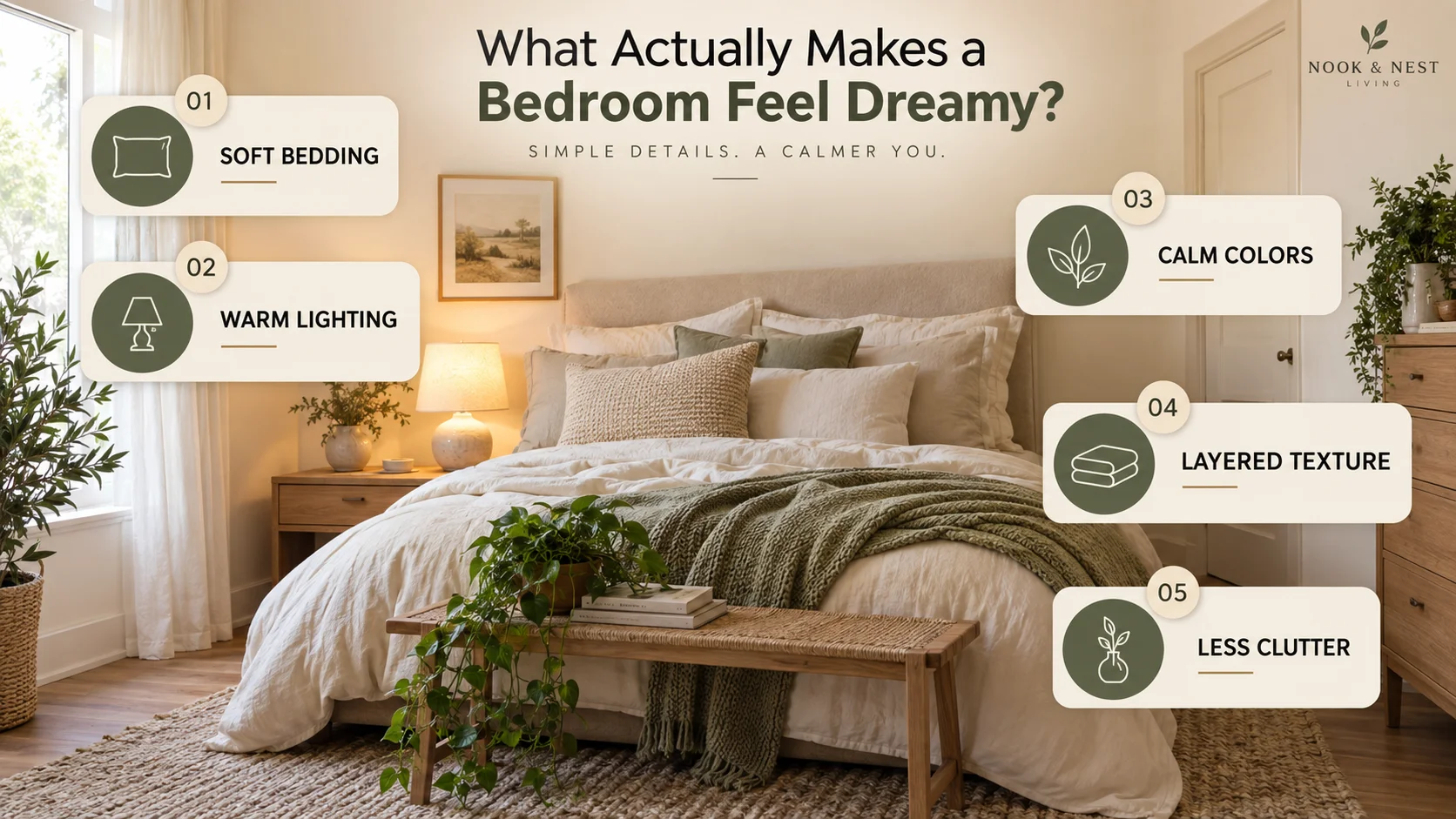
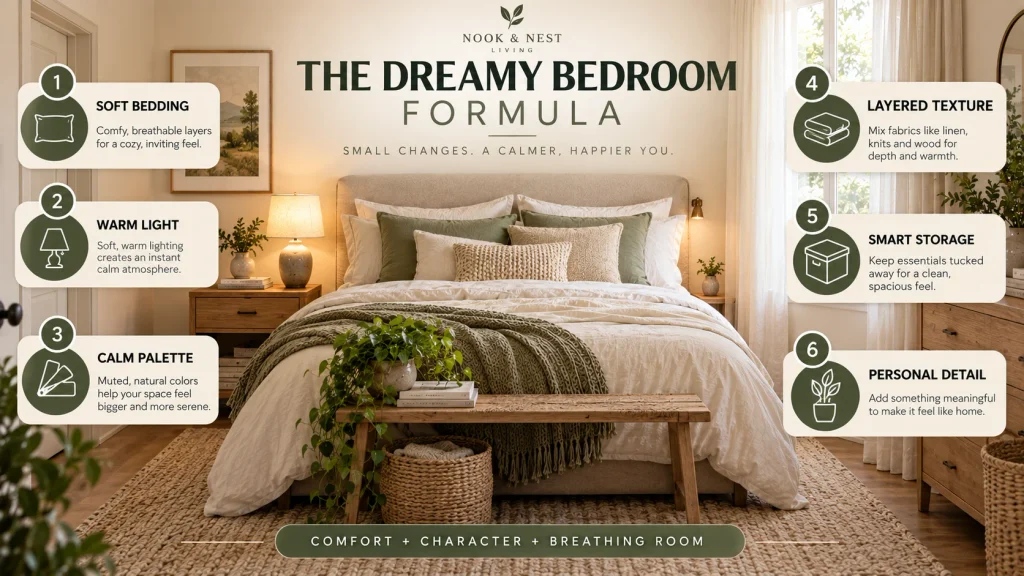
That usually comes from a combination of comfortable bedding, warm lighting, restrained color, layered texture, better curtains, thoughtful furniture placement, and less visual clutter.
And you don’t need a huge bedroom to get there.
In fact, Pinterest’s current home trend direction is moving toward more personal, comfortable spaces and smaller “micro-makeovers” rather than waiting for a giant renovation or a perfect dream home.
That makes this aesthetic especially useful for apartment dwellers and renters.
You can change the feeling of a bedroom without changing its architecture.
Here are 27 ways to do it.
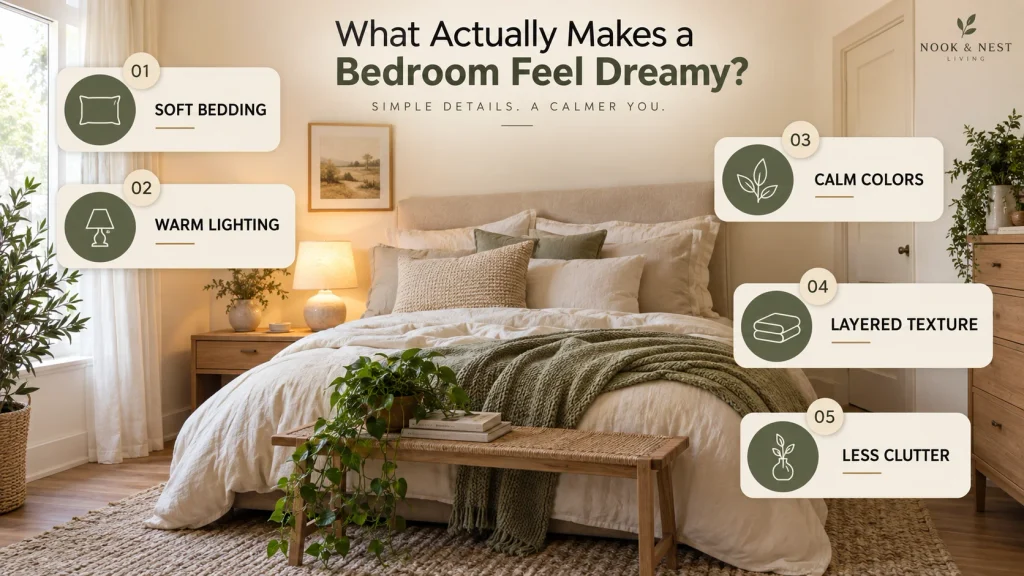
What Actually Makes a Bedroom Feel Dreamy?
Before you buy anything, understand what you’re trying to create.
A dreamy bedroom isn’t one specific aesthetic.
It can be:
- Soft and neutral
- Romantic and slightly vintage
- Moody and cocoon-like
- Light and airy
- Warm and earthy
- Whimsical
- Minimal but tactile
- Feminine without being overly decorative
The common thread is how the room feels, not whether every item belongs to the same design trend.
Five things tend to do most of the work:
1. Softness
The bed, curtains, rug, and textiles should visually soften the room.
2. Warmth
Warm bulbs and warm-toned materials prevent the room from feeling clinical.
3. Repetition
A few colors and materials repeated around the room make the design feel intentional.
4. Negative space
Not every surface needs decoration.
5. Personality
A dreamy bedroom should look like someone’s actual bedroom—not a generic hotel room.
That’s important because current Pinterest trend reporting points toward self-expression over perfectionism. Pinterest specifically describes 2026 home trends as a shift toward rooms that reflect the person living there rather than simply copying a polished aesthetic.
1. Start With Soft, Layered Bedding
If you want the fastest visual transformation, start with the bed.
It’s usually the largest object in the bedroom, so whatever happens there affects the entire room.
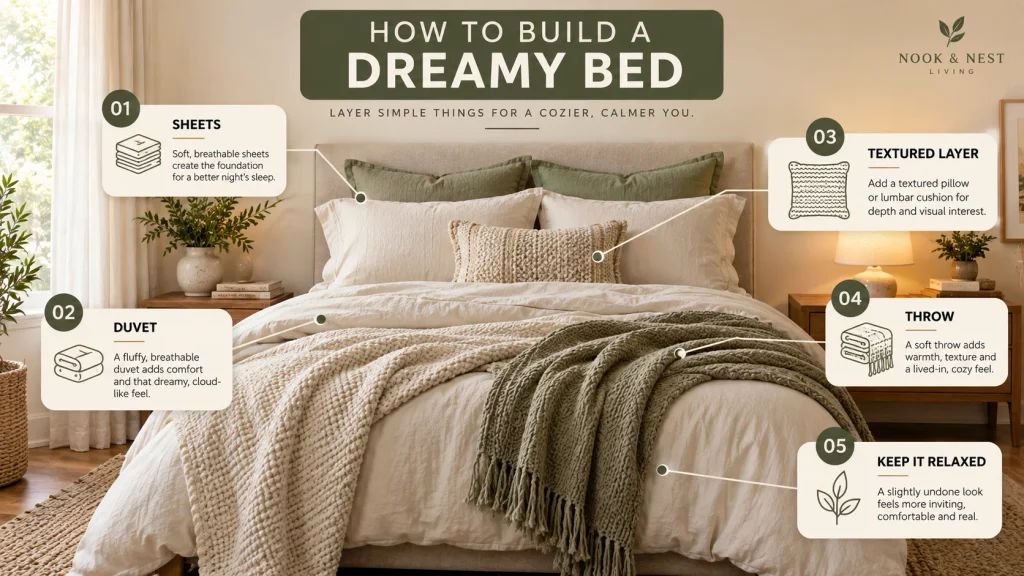
Instead of buying a complicated bedding set with matching everything, build layers.
Try:
- Simple sheets
- A duvet or comforter
- Lightweight quilt or coverlet
- One textured throw
- Two sleeping pillows
- Two larger shams
- One smaller decorative cushion
The trick is texture rather than quantity.
A cream linen duvet, waffle blanket, and chunky throw can look much richer than five different patterns fighting for attention.
And don’t make the bed too perfect.
A slightly relaxed throw at the foot of the bed can make the room feel lived-in instead of staged.
2. Use a Warm Bedside Lamp
Overhead lighting is one of the quickest ways to destroy a dreamy bedroom.
You want the room to feel different at night than it does during the day.
A bedside lamp gives you a much softer light source.
Look for:
- Fabric shades
- Frosted glass
- Ceramic bases
- Mushroom-style lamps
- Warm wood
- Aged brass
- Soft amber glass
Aim for warm light rather than an intense cool-white bulb.
You don’t need the bedroom to be dark.
You want layers of light.
A ceiling fixture can handle general illumination while bedside lamps create the evening atmosphere.
3. Choose a Calm Color Palette
Dreamy doesn’t mean white.
That’s an important distinction.
You can create the feeling with:
- Warm cream
- Soft beige
- Dusty blue
- Muted sage
- Warm blush
- Lavender
- Taupe
- Soft brown
- Muted green
The key is avoiding too many unrelated colors.
Choose one main color family and two supporting shades.
For example:
Cream + sage + walnut
or
Dusty blue + ivory + warm brown
or
Blush + beige + muted olive
This gives you room to add personality without making the room visually noisy.
4. Hang Curtains High and Wide
Curtains can completely change how a bedroom feels.
If they’re mounted directly above a window and stop at the windowsill, the room can look smaller and more fragmented.
When possible, hang the curtain rod higher and wider than the actual window.
Then allow the curtains to fall close to the floor.
This can make the window feel larger and visually increase the perceived height of the room.
For a dreamy bedroom, consider:
- Linen-look curtains
- Sheer white curtains
- Soft beige
- Warm ivory
- Dusty sage
- Muted floral patterns
If privacy allows, layering sheer curtains with heavier side panels can create a softer, more atmospheric look.
5. Make the Bed the Main Character
A dreamy bedroom doesn’t need ten focal points.
It needs one.
Usually, that’s the bed.
You can emphasize it with:
- An upholstered headboard
- A painted accent wall
- Large artwork
- Statement bedding
- A canopy
- Wall sconces
- Symmetrical bedside tables
If your bedroom is small, don’t automatically buy a massive headboard.
A tall but relatively shallow headboard can create the same vertical impact without stealing valuable floor space.
6. Add Texture Instead of More Decoration
This is one of the most important rules in dreamy bedroom design.
When a room feels flat, don’t automatically add more accessories.
Add different textures.
Think:
- Linen
- Cotton
- Wool
- Bouclé
- Waffle weave
- Velvet
- Cane
- Wood
- Woven fibers
- Ceramic
For example:
Smooth cotton sheets + crinkled linen duvet + chunky knit throw + woven basket
That combination already creates visual depth.
You don’t need twelve decorative objects on the nightstand.
7. Put a Rug Under or Beside the Bed
A rug makes a bedroom feel softer immediately.
If the room is large enough, a large rug positioned under the lower portion of the bed creates a strong visual foundation.
For smaller bedrooms, don’t force a huge rug into a space where it makes furniture movement difficult.
Instead consider:
- Two runners on either side
- A smaller rug at the foot
- A narrow textured rug beside the bed
The objective is to add softness where your feet actually land.
8. Create a Reading Corner if You Have the Space
A dreamy bedroom doesn’t have to be entirely about the bed.
If you have an unused corner near a window, turn it into a small retreat.
You don’t need an enormous chair.
Try:
- Compact upholstered chair
- Small lounge chair
- Floor cushion
- Small stool
- Slim side table
- Reading lamp
Pinterest’s 2026 Spring Trend Report shows growing interest in cozy retreats within small spaces, including searches for “comfy reading chair small spaces” rising sharply.
That fits perfectly with the dreamy-bedroom concept.
The goal is to create a tiny place where you can sit without automatically reaching for your phone.
If you like the idea of creating a dedicated reading retreat in an unused space, see our guide to closet reading nook ideas for adults.
9. Use a Round or Curved Element
Bedrooms contain a lot of rectangles.
Bed.
Dresser.
Nightstand.
Window.
Rug.
Artwork.
Adding one curved element can soften the entire composition.
Try:
- Round mirror
- Curved headboard
- Rounded bedside table
- Arched floor lamp
- Circular rug
- Curved chair
You don’t need all of them.
One is enough.
10. Add One Natural Element
Plants are an easy way to make a bedroom feel alive.
But don’t turn the room into a greenhouse because a Pinterest photo looked pretty.
One or two plants are enough.
If your bedroom gets good natural light, choose something suited to those conditions.
If it doesn’t, use a low-light-tolerant plant or a convincing faux option.
Other natural elements can include:
- Wood
- Rattan
- Cane
- Woven baskets
- Stone
- Dried branches
Natural materials prevent a soft bedroom palette from becoming visually bland.
11. Keep the Nightstand Simple
Your nightstand should support your routine, not become a storage dump.
A good setup might be:
Lamp + book + small tray + one personal object
That’s enough.
If you have chargers, medication, glasses, tissues, and other daily items, use a drawer or small tray to keep them contained.
The more visually calm your bedside area is, the calmer the entire room tends to look.
12. Try a Canopy Effect Without Buying a Canopy Bed
A traditional canopy bed can be beautiful, but it’s not always practical.
You can create a similar feeling with fabric.
For example:
- Sheer curtains around the head of the bed
- Ceiling-mounted fabric
- A simple four-poster frame
- Draped fabric above the headboard
Keep the fabric light.
Heavy curtains can make a small bedroom feel boxed in.
The goal is soft enclosure, not a bedroom tent.
13. Use Sheer Curtains for Morning Light
There is something about filtered daylight that makes a bedroom feel softer.
Sheer curtains diffuse direct sunlight without completely blocking it.
They can also soften:
- Harsh window frames
- Exterior views
- Strong morning light
- Blank walls
If your bedroom faces a busy street, combine sheers with blackout curtains so you can control the light when sleeping.
That gives you both atmosphere and practicality.
14. Make One Wall More Interesting
If you’re allowed to paint, this is an opportunity.
But you don’t need an elaborate accent wall.
A single color behind the bed can establish the entire mood.
Good dreamy colors include:
- Dusty blue
- Sage
- Warm taupe
- Muted blush
- Deep olive
- Soft lavender
- Warm cream
Renting?
Use removable wallpaper where appropriate, removable fabric panels, large artwork, or textiles instead.
Don’t risk your security deposit for an aesthetic trend.
15. Use Artwork That Feels Personal
Generic wall art can make a bedroom look like a staged apartment.
Choose something that actually means something to you.
It could be:
- A landscape
- Vintage botanical print
- Travel photograph
- Abstract artwork
- Family photograph
- Thrifted painting
- Textile wall hanging
The room becomes more dreamy when it feels personal.
That’s also consistent with Pinterest’s current shift toward curating rather than copying—using trends as inspiration rather than treating them like rules.
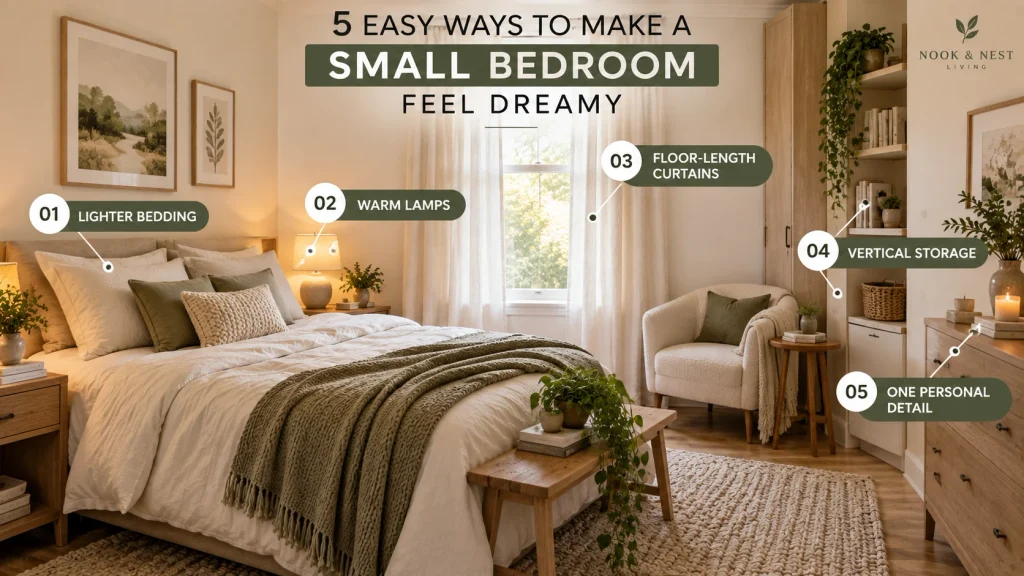
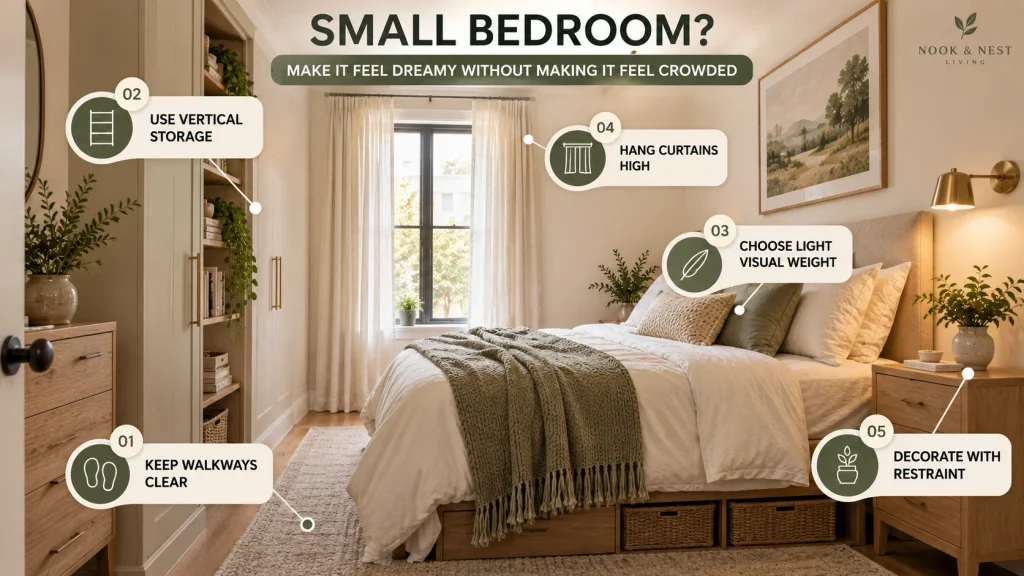
16. Use Vertical Space in a Small Bedroom
Small bedrooms don’t have much floor space.
So stop trying to solve every problem on the floor.
Look upward.
Use:
- Tall wardrobes
- Wall shelves
- Picture ledges
- Vertical bookcases
- Wall-mounted lamps
- Hooks
- Over-door storage
This keeps more floor visible.
And visible floor is valuable in a small bedroom because it creates breathing room.
Current small-bedroom design guidance repeatedly emphasizes vertical storage and multifunctional furniture as ways to preserve floor space.
If you’re trying to make a small bedroom easier to use without adding more furniture, see our guide to small bedroom organization ideas without buying new furniture
17. Choose Furniture With More Than One Job
This is especially important for apartments.
Instead of:
Bench + storage cabinet
choose:
Storage bench
Instead of:
Bed + separate drawers
consider:
Bed with under-bed storage
Instead of:
Nightstand + separate charging station
use:
Nightstand with a drawer and built-in cable management
The less furniture you need to accomplish the same functions, the easier it is to keep the bedroom visually calm.
18. Create a Soft Moody Bedroom
Dreamy doesn’t have to mean bright.
A darker room can feel incredibly cozy.
Try:
- Deep olive
- Moody blue
- Chocolate brown
- Charcoal
- Plum
- Warm burgundy
Then balance the darkness with lighter bedding or warm lighting.
This is where color becomes more interesting than simply painting everything white.
Pinterest’s broader 2026 trend data shows growing interest in more expressive, moodier colors rather than the old assumption that every calming room needs to be pale and neutral.
19. Try a Soft Romantic Palette
If your style is more feminine, don’t automatically go full pink.
Instead use muted versions.
Try:
Dusty rose + cream + warm brown
or
Blush + sage + ivory
or
Muted lavender + taupe + cream
The result feels romantic without looking like a children’s bedroom.
Keep the larger pieces neutral and introduce the color through:
- Bedding
- Curtains
- Artwork
- Cushions
- Flowers
20. Add a Small Bench at the Foot of the Bed
If you have the space, a bench can make a bedroom feel finished.
But don’t sacrifice your walking path just to have one.
For a small room, choose a narrow bench.
It can also provide:
- Extra seating
- Blanket storage
- A place to put clothes temporarily
- A visual transition between bed and floor
Storage benches are particularly useful because they combine function with styling.
21. Create a “Hotel Bed” Without Making It Uncomfortable
There’s a reason hotel beds look inviting.
They use layers.
But copying the hotel look literally isn’t always practical.
You don’t need six pillows.
Instead use:
2 sleeping pillows + 2 shams + 1 accent pillow
Then add:
1 textured throw
The bed looks layered but remains easy to use.
If you’re removing twelve pillows every night just to sleep, you’ve gone too far.
22. Hide Visual Clutter
This may be the least glamorous idea in the article—and one of the most effective.
A dreamy room cannot coexist comfortably with:
- Clothes piles
- Open packaging
- Random cords
- Shopping bags
- Unsorted laundry
- Overflowing shelves
- Products scattered across surfaces
Storage doesn’t have to be expensive.
Use:
- Under-bed boxes
- Baskets
- Drawer organizers
- Closed nightstands
- Wardrobe bins
- Hooks
The goal isn’t minimalism.
It’s controlled visibility.
For more practical ways to create storage without making a small home feel crowded, see our guide to smart small apartment storage ideas.
23. Give Your Bedroom a Signature Scent
A bedroom is experienced through more than sight.
A subtle scent can become part of the room’s identity.
Consider:
- Fresh linen
- Vanilla
- Cedar
- Lavender
- Soft floral
- Sandalwood
Use whatever scent you genuinely enjoy.
And don’t overwhelm the room.
The goal is subtle—not walking into the bedroom and immediately smelling an entire candle shop.
24. Create a Dreamy Bedroom on a Rental-Friendly Budget
You don’t need to repaint, replace flooring, or install built-ins.
Prioritize removable and movable elements.
Highest-impact rental changes
| Upgrade | Cost Level | Visual Impact | Rental Friendly |
|---|---|---|---|
| New bedding | $–$$ | Very high | Yes |
| Warm bedside lamp | $ | High | Yes |
| Curtains | $–$$ | High | Yes |
| Rug | $$ | High | Yes |
| Artwork | $–$$ | Medium–high | Usually |
| Throw + cushions | $ | Medium | Yes |
| Plant | $ | Medium | Yes |
| Freestanding mirror | $$ | High | Yes |
| Removable wallpaper | $$ | Very high | Depends |
| New furniture | $$$ | Very high | Yes, if freestanding |
If you’re on a tight budget, don’t start with furniture.
Start with bedding, lighting, and curtains.
Those three can change the visual character of a room dramatically.
For more practical pieces that can make a small apartment easier to live in without adding unnecessary clutter, see our guide to small apartment essentials that save space and reduce clutter.
25. Use One “Unexpected” Detail
A dreamy bedroom shouldn’t look algorithmically perfect.
Add one thing that makes the room yours.
Maybe:
- Vintage lamp
- Thrifted artwork
- Antique frame
- Colorful cushion
- Unusual ceramic
- Small collection
- Patterned blanket
- Sculptural mirror
Pinterest’s trend reporting increasingly frames trends as opportunities for identity curation, not rigid aesthetics.
So don’t erase your personality just because you’re trying to create a cohesive room.
26. Create a Small Bedroom That Feels Bigger
If your bedroom is genuinely small, use visual tricks rather than trying to squeeze in more furniture.
Keep the palette connected
Large differences in color can visually divide the room.
Use furniture with visible legs
Showing some floor underneath furniture can make the room feel lighter.
Hang curtains high
This draws the eye upward.
Use mirrors carefully
A large mirror can reflect light and visually extend the room.
Keep pathways clear
This matters more than decorative styling.
Use one large visual focal point
Too many small decorative objects can make a small room look busier.
27. Stop Before You Overdecorate
This is the final rule.
Once the bedroom feels good, stop.
You don’t need:
- Another pillow
- Another candle
- Another vase
- Another basket
- Another wall print
- Another decorative object
Dreamy bedrooms work because they have visual breathing room.
A room should have places where your eyes can rest.
That’s especially important for small bedrooms.
The temptation is to fill every empty corner because the room feels unfinished.
Sometimes it feels unfinished because you’re still figuring out what belongs there.
Don’t solve uncertainty by buying more stuff.
Live in the room for a week.
Then decide.
How to Build a Dreamy Bedroom Without Buying Everything at Once
If you’re starting from scratch, don’t try to do all 27 ideas at the same time.
That’s expensive and unnecessary.
Use this order instead.
Step 1: Fix the bed
Get the bedding right first.
Step 2: Fix the lighting
Add a warm bedside lamp.
Step 3: Fix the windows
Use curtains to soften the room.
Step 4: Add texture
Introduce a rug, throw, basket, or upholstered element.
Step 5: Edit clutter
Put away things that don’t belong.
Step 6: Add personality
Choose artwork, plants, or one meaningful decorative object.
Step 7: Stop
Don’t keep shopping because the room isn’t identical to your inspiration board.
It doesn’t need to be.
Common Mistakes to Avoid
1. Using Only White
White can be dreamy, but an all-white room without texture can look flat and sterile.
Use warm cream, beige, wood, and muted colors to add depth.
2. Too Many Decorative Pillows
A bed should be comfortable enough to sleep in.
If you’re moving a mountain of pillows every night, you’ve overstyled it.
3. Cool Blue-White Lighting
This can make warm bedding and furniture look completely different at night.
Use warmer lighting where practical.
4. Buying Decor Before Fixing Storage
A pretty bedroom with clothes piled on the chair isn’t pretty.
Solve the clutter first.
5. Copying a Bedroom That Is Twice Your Size
A giant canopy bed, oversized bench, huge dresser, and lounge chair may look fantastic online.
They may also make your apartment bedroom unusable.
Copy the principle, not the square footage.
6. Making Everything Match
Matching furniture sets can make a bedroom feel generic.
Mix wood tones carefully and combine textures.
7. Too Many Trends at Once
You don’t need:
boho + cottagecore + romantic + minimalist + vintage + modern
in one bedroom.
Choose a foundation and add a few influences.
8. Ignoring the Actual Function of the Room
Your bedroom needs to help you sleep, dress, relax, and store your belongings.
Aesthetic comes second to that.
Quick Checklist: Is Your Bedroom Actually Dreamy?
Before buying anything else, check these:
Bed
- Bedding has at least two or three textures
- Pillows are comfortable rather than excessive
- Throw adds softness without clutter
Lighting
- Bedside lighting is warm
- Overhead light isn’t doing all the work
- There is enough light for reading/dressing
Color
- Main palette uses 2–4 related colors
- Large surfaces aren’t visually chaotic
- Accent colors repeat naturally
Windows
- Curtains reach close to the floor
- Window treatment suits the room’s light
- Privacy and sleep needs are covered
Storage
- Clothing has a designated home
- Nightstand isn’t overloaded
- Floor remains mostly clear
Personality
- At least one piece feels personal
- Artwork isn’t completely generic
- The room feels like yours rather than a showroom
Small-Space Test
- Walking paths remain clear
- Furniture isn’t oversized
- Vertical space is being used
- Every major piece earns its footprint
If you can check most of these, don’t keep decorating.
You’ve probably already got enough.
FAQ: Dreamy Bedroom Ideas
How do I make my bedroom look dreamy?
Start with soft layered bedding, warm lighting, a calm color palette, floor-length curtains, natural textures, and less visible clutter. Then add one or two personal details instead of filling every surface with decor.
What colors make a bedroom look dreamy?
Warm cream, ivory, beige, dusty blue, muted sage, blush, lavender, taupe, and soft brown all work well. The important thing is keeping the palette restrained rather than using many unrelated colors.
How can I make a small bedroom feel dreamy?
Prioritize the bed, warm lighting, vertical storage, soft curtains, and clear walking paths. Use furniture with a lighter visual profile and avoid filling the room with pieces that aren’t necessary.
How do I make a bedroom cozy without making it cluttered?
Use texture instead of quantity. A textured throw, woven basket, warm lamp, soft rug, and coordinated bedding can add more atmosphere than dozens of small decorative objects.
How can renters create a dreamy bedroom?
Focus on movable elements such as bedding, curtains, rugs, lamps, artwork, plants, mirrors, and freestanding storage. Removable wallpaper or wall treatments can also work where the lease and product instructions allow them.
Does a dreamy bedroom have to be white or neutral?
No. Moody blue, olive, dusty pink, lavender, brown, and other richer colors can create a dreamy atmosphere. What matters more is how the colors work together and how much visual stimulation the room contains.
Final Thoughts
The best dreamy bedroom ideas aren’t really about creating a bedroom that looks like a fantasy.
They’re about creating a room that feels noticeably better at the end of the day.
Soft bedding makes the bed inviting.
Warm lighting changes the evening atmosphere.
Curtains soften the architecture.
Texture keeps neutral colors from feeling flat.
Storage removes visual noise.
And personal details make the room feel like yours.
You don’t need to renovate.
You don’t need a huge bedroom.
And you definitely don’t need to buy every piece of decor that appears in your Pinterest feed.
Start with the biggest visual problems.
Fix the bed. Fix the lighting. Fix the clutter. Then add personality.
That’s the formula.
And once the room feels calm, comfortable, and genuinely yours, stop decorating.
That’s usually when it starts looking the most dreamy.