
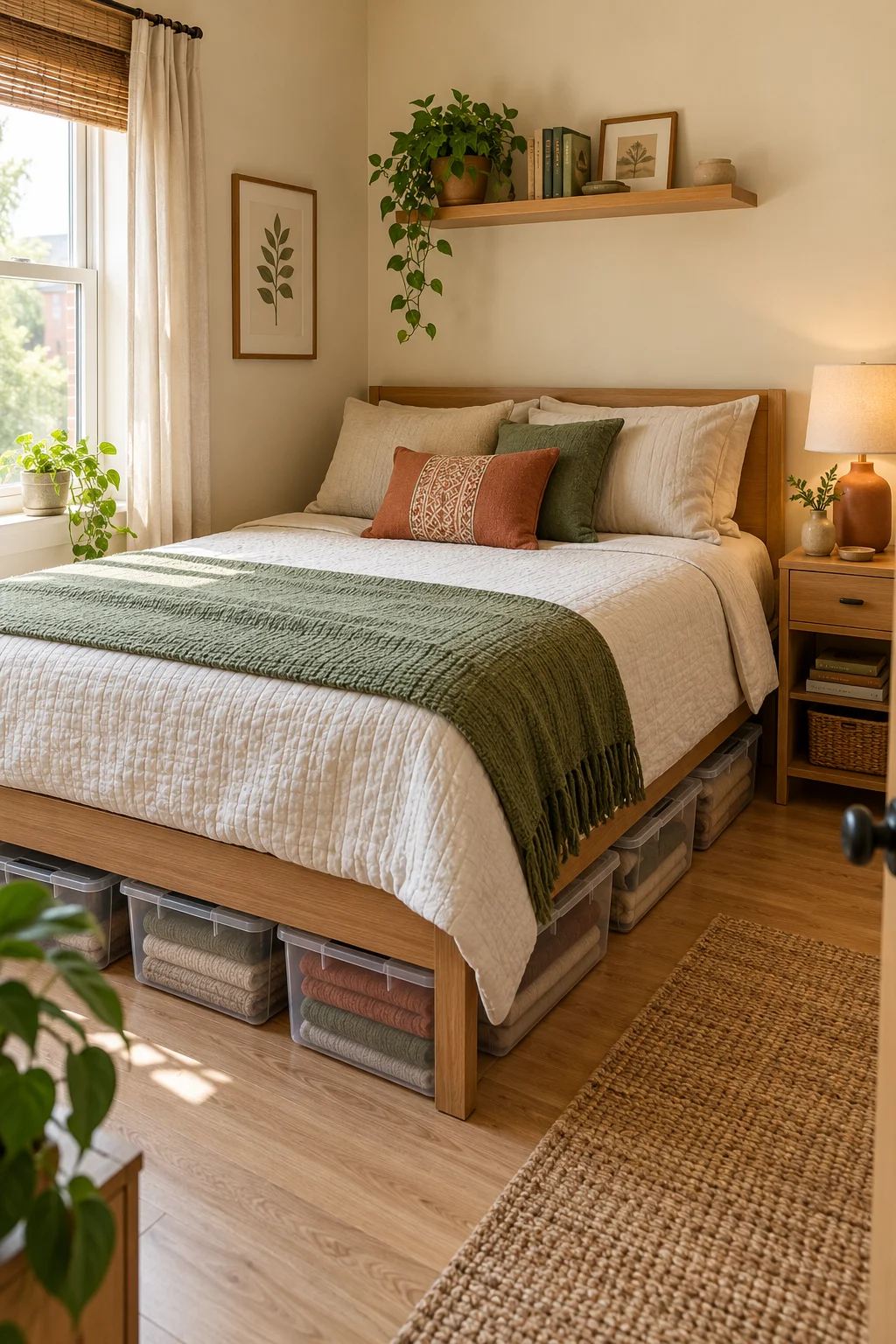
A small bedroom can feel cluttered even when you don’t own that much.
A chair becomes a clothes pile. The nightstand collects chargers and receipts. Shoes end up beside the bed. The closet gets packed, and suddenly the only clear walking space is a narrow strip around the furniture.
The obvious solution is often to buy another organizer, another shelf, or another piece of furniture.
But in a tiny apartment, more furniture can actually make the problem worse.
Before buying anything, look at what you already have.
Your bed, closet, doors, walls, drawers, corners, and even the space underneath your furniture may already provide more storage potential than you’re using.
These small bedroom organization ideas focus on making your existing space work harder while keeping the room comfortable and easy to move through.
The goal isn’t to fit more things into your bedroom. It’s to make the things you already own easier to store and use.
1. Start by Clearing the Floor
Before organizing anything else, look at the floor.
In a small bedroom, visible floor space has an outsized effect on how large the room feels.
Shoes, laundry, bags, boxes, chargers, and random belongings can quickly turn the floor into temporary storage.
Start by removing anything that doesn’t actually need to live there.
Create four groups:
- Keep here
- Move elsewhere
- Donate
- Discard
Don’t organize objects you don’t need.
Decluttering first makes every later storage decision easier.
And if your room already has enough furniture, resist the urge to immediately add another storage piece.
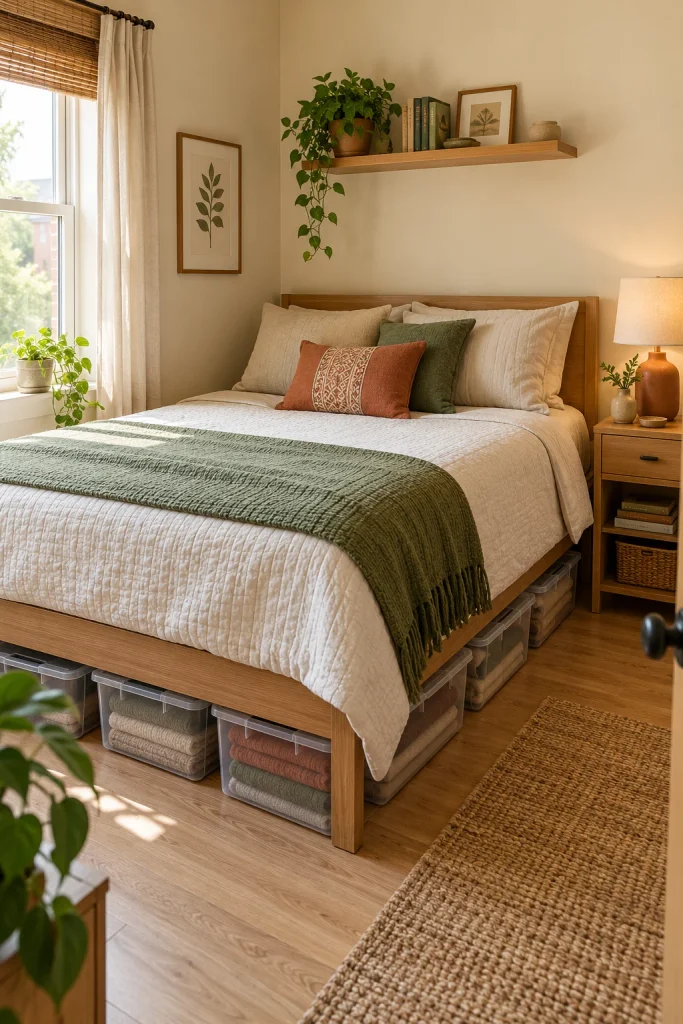
2. Use the Space Under Your Bed
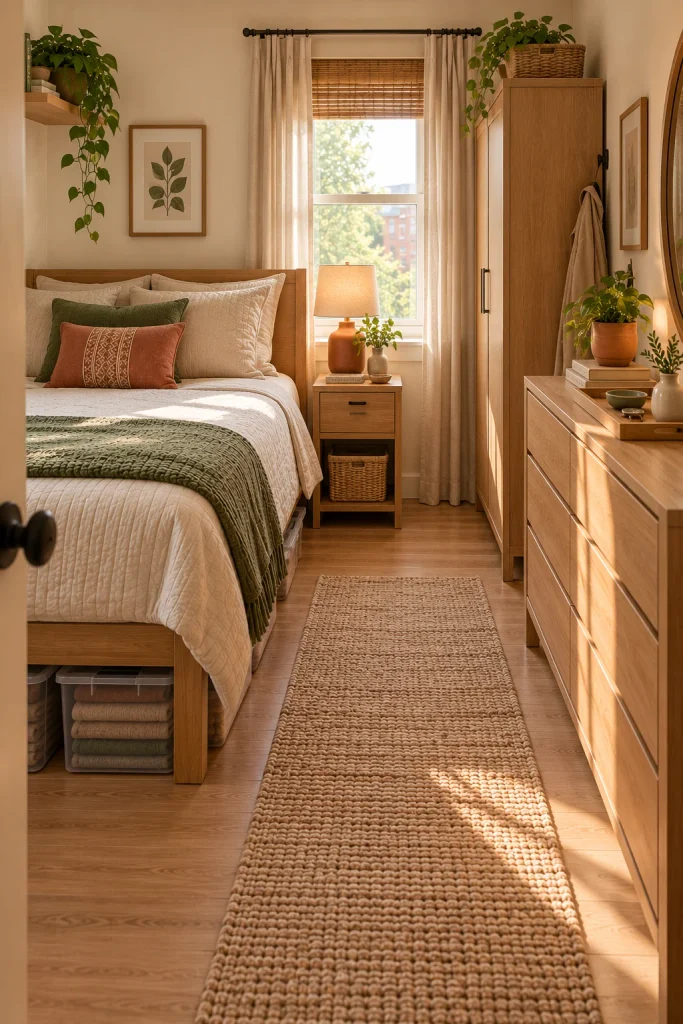
Your bed may occupy a large percentage of the bedroom floor, but the space underneath it is often almost completely wasted.
If there is usable clearance underneath, consider storing less frequently used items there.
Good candidates include:
- Seasonal clothing
- Spare bedding
- Extra towels
- Shoes
- Travel bags
- Occasionally used accessories
Use shallow containers that slide easily underneath.
The important part is keeping categories together rather than turning the entire area into a random storage cave.
A simple rule:
Frequently used → easy access.
Rarely used → under the bed.
Don’t store things underneath the bed that you need every morning.
3. Make Your Closet Work Harder
A small closet can become unusable long before it is technically full.
The problem is often how the space is arranged, not simply how much clothing you own.
Start by grouping similar items.
For example:
Tops → bottoms → dresses → outerwear
Then look for unused vertical space.
Could a shelf hold bags?
Could a higher section hold seasonal clothing?
Could one section be reserved for everyday pieces?
Don’t fill every inch just because it’s available.
A closet needs enough breathing room for you to actually remove and return clothes.
4. Use the Back of the Bedroom Door
The back of a door is an easy-to-miss storage surface.
Depending on the door and your rental situation, you can use appropriate over-door organizers or removable hooks for lightweight items.
Try using the door for:
- Bags
- Scarves
- Belts
- Hats
- Robes
- Small accessories
This is especially useful when wall and floor space are limited.
Just make sure the organizer doesn’t interfere with the door closing.
5. Turn the Wall Into Storage Without Adding Furniture
When floor space is precious, the walls become more important.
Look at the vertical area around:
- The bed
- Closet
- Door
- Desk
- Dresser
Depending on your rental restrictions, possibilities include:
- Removable hooks
- Small wall organizers
- Peg-style systems
- Floating shelves where permitted
- Narrow hanging organizers
The objective isn’t to cover every wall.
Use small vertical zones for items that otherwise take up floor or drawer space.
6. Give Your Nightstand a Job
A nightstand can become a miniature junk drawer in plain sight.
Instead of allowing everything to accumulate on top, decide what actually belongs there.
For example:
Top: lamp + one or two daily essentials
Drawer: charger, book, glasses, small personal items
Everything else: somewhere else
This tiny change can make a surprisingly large visual difference.
Your bedroom should feel restful.
A nightstand covered in receipts, cables, skincare products, and random objects works against that.
7. Stop Using the Chair as a Closet
This is one of the most common small-bedroom problems.
You sit down once.
Then a jacket goes there.
Then tomorrow’s outfit.
Then yesterday’s jeans.
Eventually the chair becomes a clothing mountain.
If something is clean enough to wear again but not clean enough to return to the closet, give it a defined temporary home.
Depending on your layout, that might be:
- One hook
- A small section of the closet
- A dedicated hanging rail
- A single basket
The goal isn’t to eliminate the habit.
It’s to contain it.
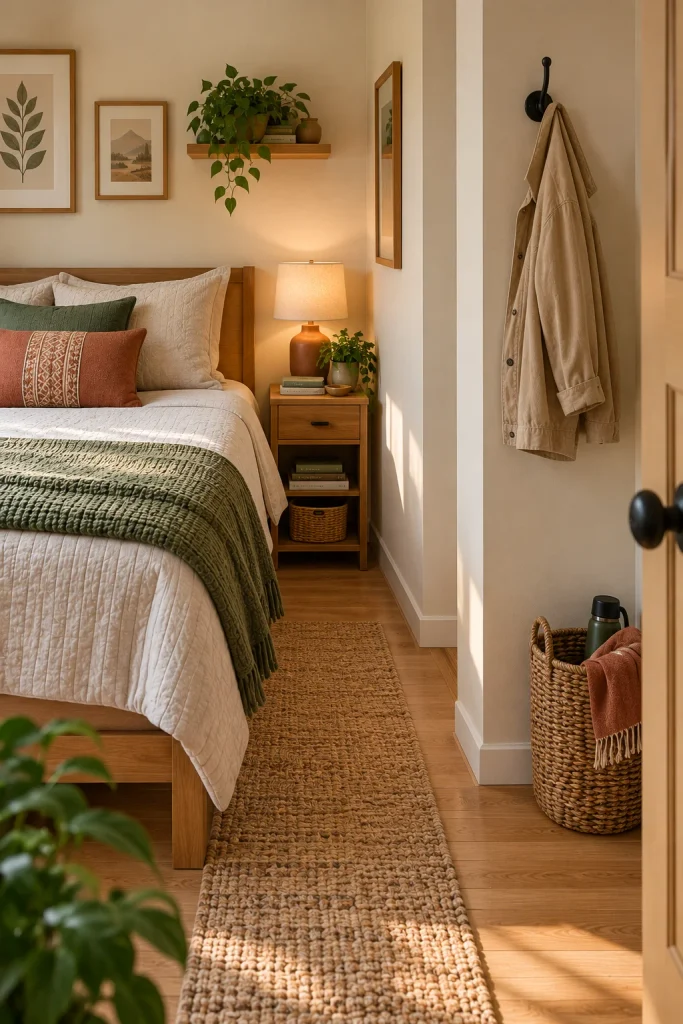
8. Use Corners Before Buying More Storage
Awkward corners often get ignored because they’re difficult to furnish.
That’s exactly why they’re useful.
A small corner can become a home for:
- A floor lamp
- A laundry basket
- A plant
- A narrow clothing rack
- A small storage basket
- A reading chair if the room genuinely has enough space
But don’t automatically fill an empty corner.
An empty corner can also be valuable because negative space makes a small room feel less crowded.
Only use it for storage if the storage solves a real problem.
9. Reorganize Your Drawers Instead of Adding More Storage
If your dresser drawers are overflowing, another cabinet isn’t necessarily the answer.
First remove everything.
Then group similar items.
For example:
Drawer 1: everyday underwear and socks
Drawer 2: sleepwear
Drawer 3: accessories
Drawer 4: less frequently used clothing
Fold or arrange items so you can see what you have instead of stacking everything into one deep pile.
For more ways to create storage without making a small apartment feel crowded, see these smart small apartment storage ideas.
10. Use the Top of Existing Furniture
Look at the furniture you already own.
Your dresser, wardrobe, desk, or cabinet may have vertical space above it that is completely unused.
But there’s an important distinction:
Unused space doesn’t automatically mean storage space.
If you stack too many things on top, you create visual clutter.
Instead, use one or two contained solutions:
- One basket
- One small box
- One tray
- One decorative storage container
Keep the surface mostly clear.
A small room benefits from visual breathing room.
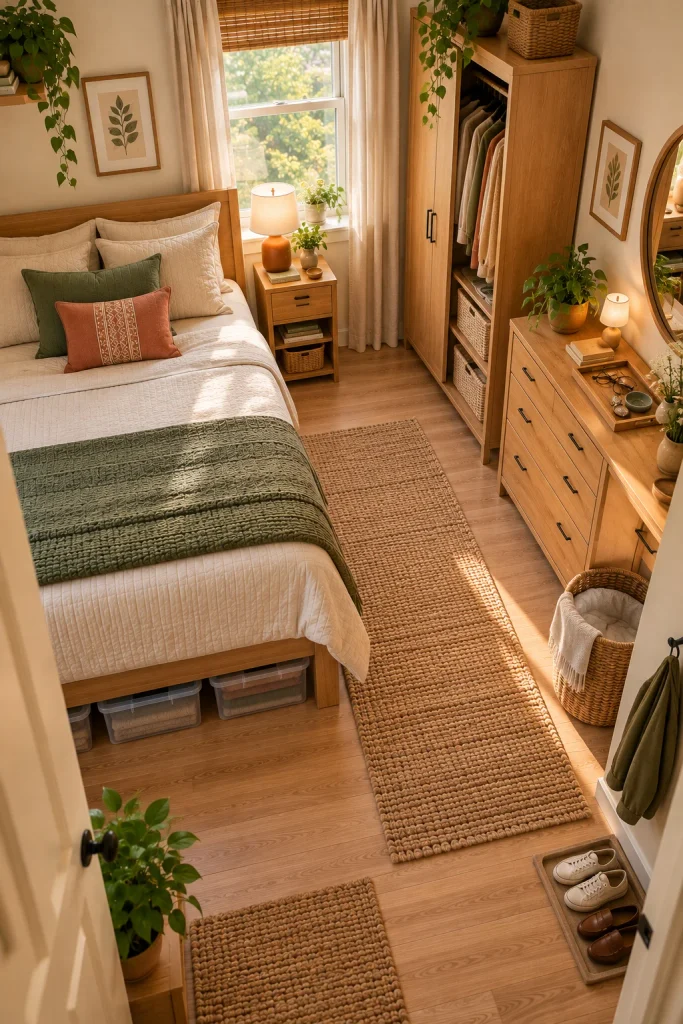
11. Create a Dedicated Shoe Zone
Shoes scattered around the bedroom can make the floor look much more crowded than it actually is.
You don’t necessarily need a shoe cabinet.
Depending on your existing layout, try:
- Keeping everyday shoes in one small basket
- Using existing closet floor space
- Storing less-used shoes under the bed
- Keeping only frequently worn pairs in the bedroom
The biggest improvement often comes from reducing the number of shoes competing for floor space, rather than finding a bigger shoe organizer.
12. Rotate Seasonal Clothing
You don’t need your entire wardrobe accessible every day.
If your bedroom is very small, consider rotating seasonal items.
For example:
Current season → closet
Off-season → under-bed storage or another suitable storage area
When the season changes, switch them.
This can make a small closet feel dramatically more manageable without adding furniture.
Pinterest’s current trend reporting also shows strong interest in wardrobe-reset content, making this particularly relevant to people already looking for seasonal organization inspiration.
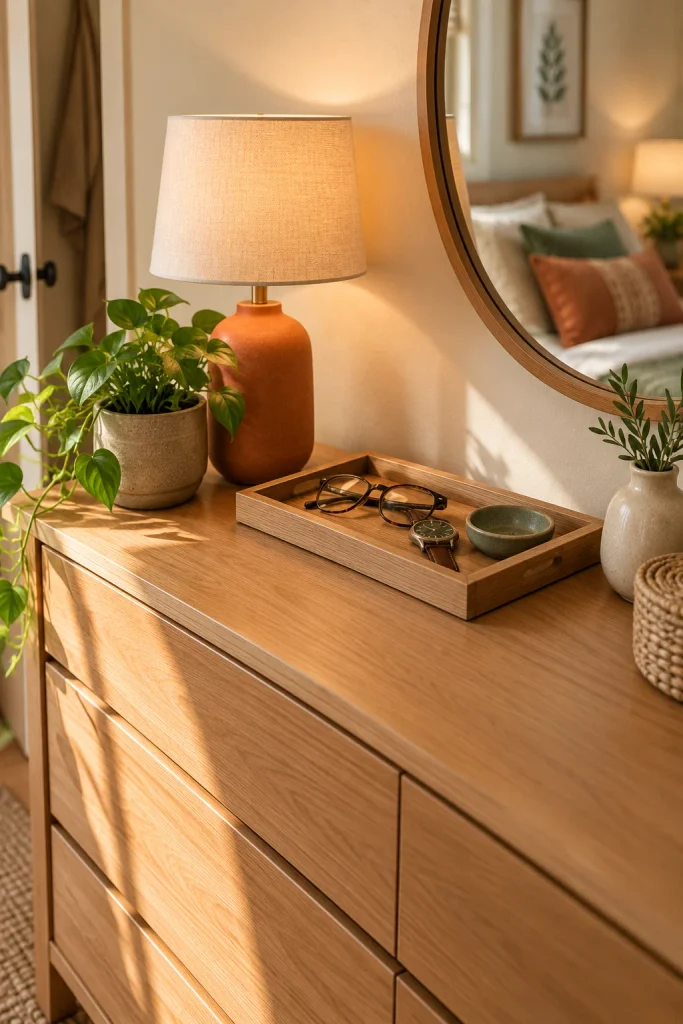
13. Create One Small “Daily Essentials” Zone
Small bedrooms often become cluttered because everyday objects don’t have a home.
Keys.
Watch.
Wallet.
Glasses.
Chargers.
Headphones.
Instead of allowing them to land wherever there’s an empty surface, create one small zone.
A tray on the dresser.
A small container inside a drawer.
A compact bedside organizer.
The exact solution doesn’t matter as much as the rule:
If you use it every day, give it an obvious home.
14. Make Your Bed the Visual Anchor
In a small bedroom, the bed is usually the largest object.
Instead of fighting that reality, make it the room’s visual anchor.
Keep the bedding relatively simple.
Use:
- One cohesive color palette
- A few pillows rather than many
- One folded throw
- Clear space around the bed where possible
When the largest object in the room looks calm and intentional, the whole bedroom can feel more organized.
15. Leave a Clear Walking Path
This is where organization becomes layout.
You don’t want storage solutions that technically hold your belongings but force you to squeeze around furniture.
Walk through your bedroom as you normally would.
Notice where you:
- Enter
- Get dressed
- Reach the closet
- Get into bed
- Open drawers
- Pick up laundry
Then protect those pathways.
A small bedroom doesn’t need every inch filled.
A clear path is part of the organization system.
The same principle applies to a small living room, where protecting the walking path can make the entire space feel more open.
16. Use Existing Furniture for More Than One Job
Before buying another piece of furniture, ask:
Can something I already own perform two functions?
Examples:
A dresser can provide storage + a surface.
A bed can provide sleeping space + under-bed storage.
A desk can provide workspace + drawer storage.
A nightstand can provide bedside space + hidden storage.
A wardrobe can provide clothing storage + accessory organization.
Multifunctionality is particularly valuable in apartments where floor space is limited.
17. Don’t Organize Around Clutter
This is an important distinction.
If your dresser is overflowing because you own too many clothes, buying drawer dividers won’t solve the underlying problem.
If your floor is covered in shoes, another basket might simply hide the excess.
If your closet is impossible to close, better hangers won’t magically create more room.
Sometimes the best organization system starts with:
Less stuff.
Then organize what remains. The same principle applies to other small-space problem areas, including tiny laundry zones where adding storage isn’t always the first solution.
The No-New-Furniture Bedroom Reset
If your bedroom feels completely out of control, don’t try to fix everything at once.
Use this simple sequence:
Step 1 — Clear the floor
Remove everything that doesn’t belong.
Step 2 — Clear the surfaces
Dresser, nightstand, desk, shelves.
Step 3 — Sort clothing
Keep, donate, relocate, seasonal.
Step 4 — Reclaim hidden space
Under the bed, closet corners, door, existing drawers.
Step 5 — Assign homes
Every frequently used item gets one obvious place.
Step 6 — Protect the walking path
Don’t let storage creep into circulation areas.
Step 7 — Add nothing unless necessary
Only after the reset should you decide whether you genuinely need another organizer.
The 5-Zone Small Bedroom System
You don’t need a complicated organizing method.
Think of your bedroom as five functional zones:
1. SLEEP
Bed and immediate bedside area.
2. DRESS
Closet, dresser, and clothing storage.
3. DAILY
Wallet, glasses, chargers, accessories, and everyday items.
4. DROP
Laundry, worn-once clothing, bags, and shoes.
5. MOVE
The walking path around the room.
If all five work together, the bedroom becomes much easier to maintain.
And MOVE is the zone people forget.
A bedroom can have plenty of storage and still feel cramped if the walking path is constantly blocked.
What Not to Do in a Small Bedroom
Don’t fill every empty wall.
Empty space can make a small bedroom feel larger.
Don’t buy storage before decluttering.
You may end up organizing things you don’t need.
Don’t use the chair as permanent clothing storage.
Give worn-once clothes a defined temporary home.
Don’t keep everyday items buried.
Frequently used things should be easy to access.
Don’t sacrifice the walking path.
Storage isn’t successful if using it makes the room frustrating.
How to Keep a Small Bedroom Organized
Once everything has a home, maintenance becomes much easier.
Try a quick five-minute reset:
Put clothes away.
Return shoes to their zone.
Clear the nightstand.
Put daily essentials back in their tray or drawer.
Remove anything that doesn’t belong in the bedroom.
You don’t need a major weekend organizing session every week.
The goal is to make the room easy enough to reset every day.
Frequently Asked Questions
How do you organize a small bedroom without buying furniture?
Start by decluttering, then use existing storage more efficiently. Reclaim under-bed space, closet space, doors, drawers, and vertical areas before adding new furniture.
How can I make my small bedroom feel less cluttered?
Keep the floor and walking paths clear, reduce visual clutter, group similar items, and avoid filling every available surface or wall.
Where should I store things in a very small bedroom?
Use the most accessible storage for everyday items and reserve hidden or less convenient areas—such as under the bed or high closet shelves—for seasonal or rarely used belongings.
How do I organize clothes in a small bedroom?
Start by removing clothes you no longer wear, then group the remaining items by type and frequency of use. Keep current-season clothing accessible and store less-used items elsewhere when possible.
What should I do if I have no closet?
Use the storage you already have more strategically, including drawers, under-bed space, hooks, narrow hanging solutions, and suitable vertical organizers. Keep the setup visually simple so the bedroom doesn’t feel overloaded.
Should I buy more storage for a small bedroom?
Not necessarily. Declutter and reorganize your existing furniture first. Only add storage after identifying a specific problem that your current setup genuinely cannot solve.
Final Takeaway
A small bedroom doesn’t automatically need more furniture.
It usually needs better decisions about the space you already have.
Clear the floor.
Reclaim hidden storage.
Use vertical space carefully.
Contain clothes and shoes.
Give daily essentials a home.
And protect the walking path.
The biggest mistake is trying to make a tiny bedroom hold more and more things.
The better goal is to make the room hold only what you actually use — and make those things easy to live with.
You don’t need a bigger bedroom to create more breathing room. You need less friction in the one you already have.
2 thoughts on “Small Bedroom Organization Ideas Without Buying New Furniture”