
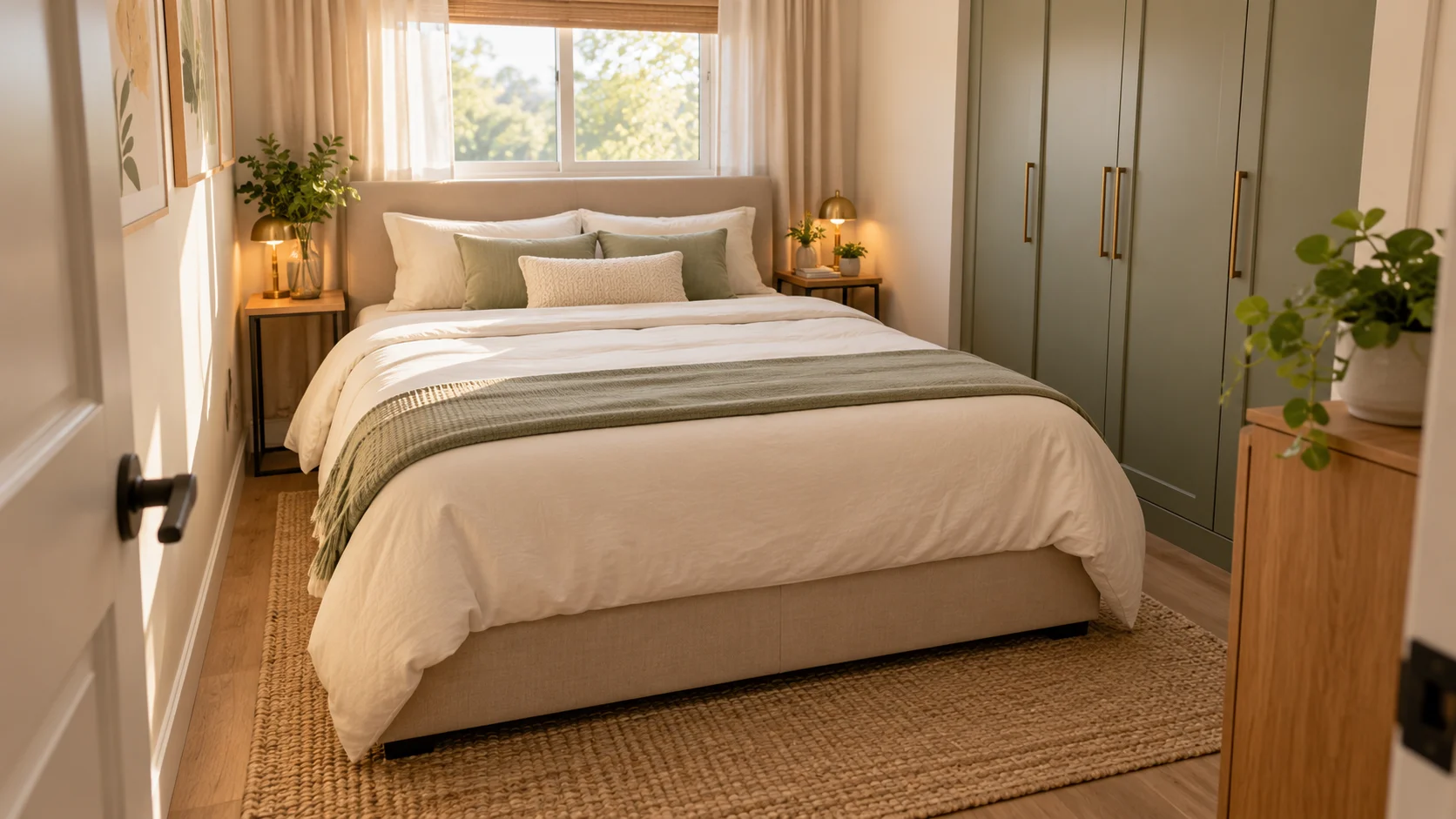
A queen bed can make a small bedroom feel crowded before you even add a dresser, bedside table, or laundry basket. You want a comfortable place to sleep, but you also need enough room to get dressed, open the closet, and walk around without squeezing sideways between furniture.
The solution isn’t always buying a smaller bed. Often, the biggest improvement comes from changing where the bed sits, choosing more suitable bedside furniture, or rethinking how the room’s storage is arranged.
These small bedroom layout ideas with a queen bed focus on real-life room configurations, not just attractive bedroom photos. We’ll look at seven practical layouts, explain when each works best, and cover the measurements and furniture choices that can make a compact bedroom easier to use.
Whether your room is nearly square, long and narrow, or has a closet that interrupts one wall, start with the layout that matches your room rather than trying to copy a design that doesn’t fit.
Quick Guide: Which Queen-Bed Layout Should You Try?
| Bedroom situation | Layout to consider | Main advantage |
|---|---|---|
| Room is nearly square | Center the bed on the main wall | Creates a balanced arrangement |
| Room is narrow | Place the bed along the longest suitable wall | Can preserve a clearer route |
| One side has very little clearance | Move the bed slightly off-center | Gives priority to the more useful side |
| Closet doors need room to open | Position the bed outside their swing or access zone | Keeps storage accessible |
| Room lacks storage | Choose a bed with drawers or under-bed clearance | Uses otherwise wasted space |
| Room has limited bedside space | Use floating shelves or wall-mounted lights | Frees floor area |
| Bedroom doubles as a work area | Keep a distinct desk zone where dimensions allow | Separates sleep and work functions |
1. Center the Queen Bed on the Main Wall
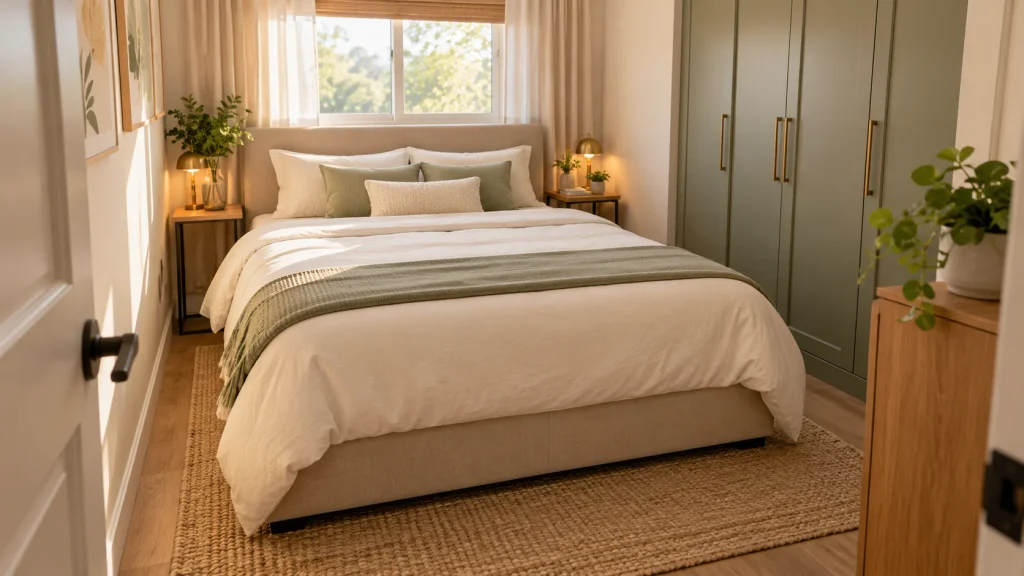
Centering a queen bed is often the most straightforward arrangement when the bedroom is reasonably square and the main wall is wide enough.
The bed becomes the visual anchor, and matching or similarly sized bedside surfaces can make the room feel intentional rather than crowded. This layout can also work well when you want the bedroom to look balanced in photographs.
However, symmetry should not come at the expense of function. If centering the bed leaves almost no room on one side, blocks a closet, or makes the door difficult to use, a slightly offset arrangement may be more practical.
How to make this layout work:
- Measure the wall before deciding on the bed’s exact position.
- Use compact bedside tables instead of full-size nightstands.
- Consider wall-mounted reading lights to free up table surfaces.
- Avoid adding a wide bench at the foot of the bed unless there’s enough clearance.
- Check that drawers and closet doors can still open.
Amazon product option: Shop Narrow Bedside Tables on Amazon →
2. Place the Bed Along the Longest Suitable Wall
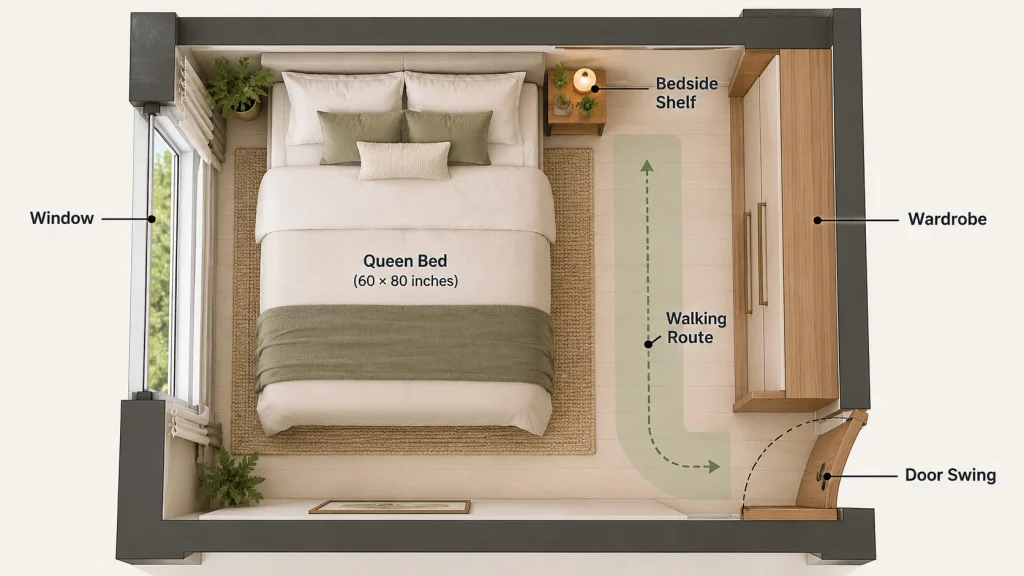
In a long, narrow bedroom, centering the bed on a short wall may leave the room feeling like a corridor. Depending on the location of the window and closet, placing the bed along a longer wall can sometimes make better use of the available floor space.
The trade-off is that you may lose the familiar symmetrical look of a traditional bedroom. One bedside surface might fit while the other needs to be replaced with a wall shelf, or removed altogether.
Before committing to this arrangement, draw a simple floor plan. Mark the bed, closet, windows, and door swing. This can reveal problems that aren’t obvious when you’re standing in an empty room.
Try this layout when:
- The bedroom is noticeably longer than it is wide.
- The main wall has a window or closet that complicates centered placement.
- You need a clear route from the entrance to the bed.
- One full-size nightstand would otherwise block the walking space.
Don’t place the bed along a wall simply because it appears to fit. You still need access to the bed, usable closet space, and a practical route through the room.
3. Offset the Bed When One Side Needs More Space
Sometimes the best layout is deliberately asymmetrical.
If one side of the bedroom contains a closet, entrance, radiator, or other obstacle, moving the bed away from the center can create more useful space where you need it. You might keep a small table on one side and use a floating shelf on the other.
This arrangement is especially useful when a perfectly centered bed creates awkward, equally narrow gaps on both sides.
The goal isn’t to push the bed into a corner automatically. It’s to prioritize the route you use most often and make sure the remaining space is functional.
Before moving the bed, check:
- Can you get in and out of bed comfortably?
- Can the closet doors open fully?
- Is there enough space to make the bed?
- Can the bedroom door open without hitting furniture?
- Does the new position leave an awkward, unusable gap elsewhere?
If the room is shared by two people, consider whether both sides need equal access. A layout that works for one sleeper may be frustrating for two.
Amazon product option: Shop Floating Bedside Shelves →
4. Use a Storage Bed When the Room Has Little Closet Space
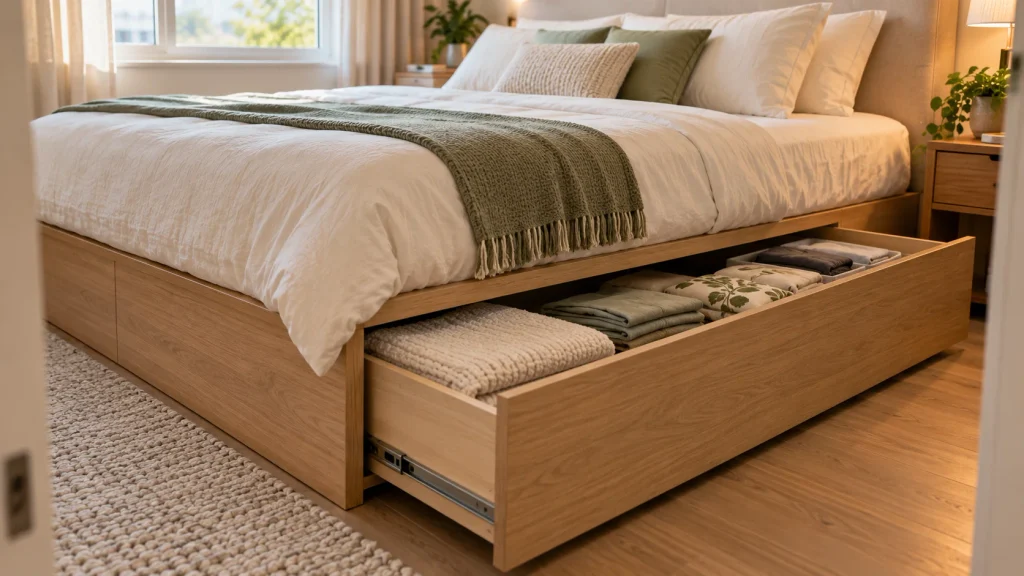
When a bedroom has limited closet space, a storage bed can reduce the need for a separate chest of drawers or extra storage bins.
There are several options: beds with built-in drawers, lift-up storage bases, and conventional frames that leave enough clearance for containers underneath. The right choice depends on how frequently you need to access the stored items.
Built-in drawers are convenient when you regularly use the contents, but they need room to pull out. A lift-up base can provide access to a larger area, though it may be less convenient for everyday items. Under-bed containers are often simpler if you already own a suitable bed frame.
What to check before buying:
- The total bed-frame dimensions, not just the mattress size.
- Whether drawers can open fully in your room.
- The internal storage dimensions and weight limits.
- Whether the bed’s height will work with your existing mattress.
- Whether the storage is easy to access without moving other furniture.
Practical tip: Store spare bedding, seasonal clothes, or occasional-use items underneath the bed. Keep daily essentials somewhere easier to reach.
Amazon product option: Explore Queen Storage Beds on Amazon →
5. Replace Full-Size Nightstands With Floating Shelves
A traditional nightstand can take up more floor space than its storage is worth, particularly when a queen bed already occupies most of the room.
A floating bedside shelf provides a surface for a phone, book, or glass of water without adding a full piece of furniture. It can be paired with a wall-mounted reading light to keep the bedside area simple.
This is a particularly useful option when one side of the bed has limited clearance. You can use a small shelf on the tighter side and keep a conventional nightstand on the side with more room.
Floating shelves are not automatically the right answer for renters. Installation requirements vary, and adhesive shelves have weight and surface limitations. Check the wall type, mounting hardware, and manufacturer’s instructions before installing anything.
Simple setup:
- One small shelf for essentials.
- A wall-mounted light where permitted.
- A compact basket elsewhere for items that don’t fit.
- No unnecessary decor that takes up the limited surface.
Amazon product option: Shop Floating Nightstands →
6. Keep the Wardrobe and Door Zones Clear
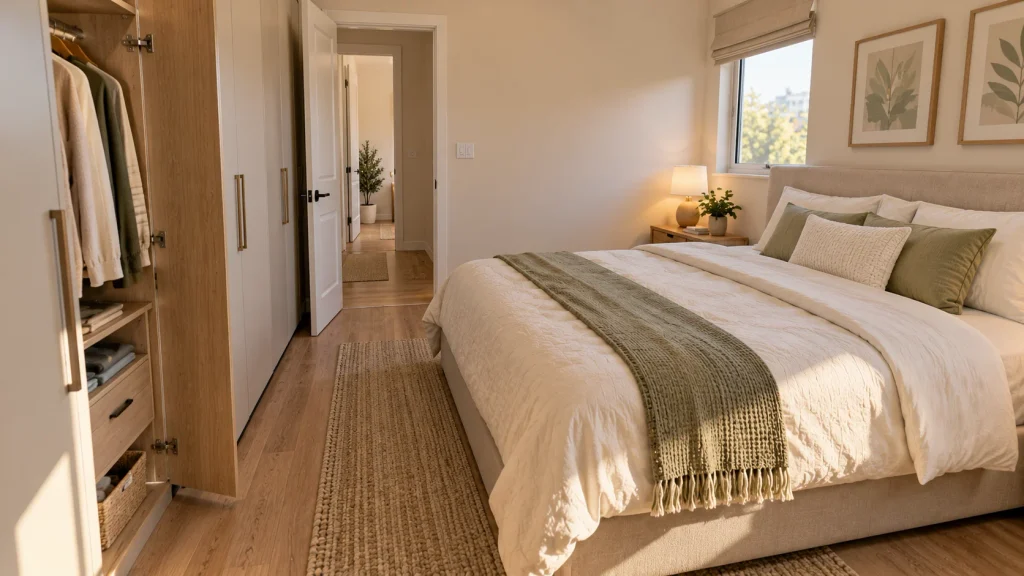
A bedroom can look fine until you try to open the wardrobe or bedroom door. The bed may technically fit, but the room won’t function well if furniture blocks the places you use every day.
When planning your queen-bed layout, think about the room as a set of moving parts. Doors swing, drawers slide, and people need to stand in front of closets to get dressed.
If the closet is opposite the bed, check whether the wardrobe doors can open without hitting the bed frame. If the closet has sliding doors, you may have more flexibility, but you’ll still need space to stand and reach inside.
Common fixes include:
- Choosing sliding-door storage when appropriate.
- Moving a dresser away from the closet’s access zone.
- Using a narrower bedside table.
- Removing an unnecessary bench at the foot of the bed.
- Repositioning the bed to create a more useful route.
Don’t rely on a staged furniture photo to judge clearances. Measure your actual room and the furniture you intend to use.
7. Create a Small Work or Dressing Zone Without Crowding the Bed
A small bedroom sometimes needs to serve more than one purpose. You might need a compact desk, a dressing area, or a place to fold laundry in addition to the bed.
The key is to avoid adding every function as a separate piece of furniture. A narrow desk can sometimes double as a vanity. A wall shelf may replace a bulky side table. A wardrobe with suitable internal storage may reduce the need for a separate dresser.
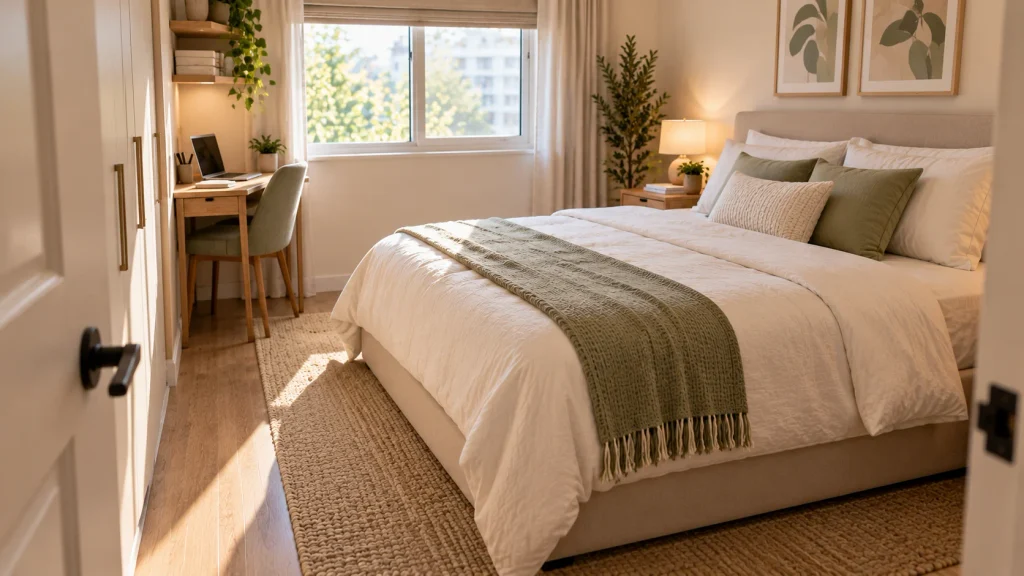
Before adding a desk or dressing table, decide which activity matters most. If you work in the bedroom every day, a proper desk may be worth the space. If you only need somewhere to get ready, a smaller wall-mounted surface could be enough.
Try not to create a layout that forces you to move the chair every time you open a drawer or walk to the closet. The room needs to work during ordinary routines, not just look attractive when everything is tucked away.
Amazon product option: Shop Compact Bedroom Desks →
How Much Space Do You Need Around a Queen Bed?
A standard US queen mattress measures approximately 60 inches wide by 80 inches long. The bed frame may be larger, so plan around the frame’s actual external dimensions.
There is no single clearance number that makes every bedroom layout work. The amount of space you need depends on who uses the room, whether you share the bed, how the closet opens, and what furniture sits nearby.
Use these steps to plan:
- Measure the room’s length and width.
- Mark the door swing, closet doors, windows, and any radiators or other obstacles.
- Draw the bed using its actual frame dimensions.
- Add the furniture you genuinely need.
- Check the route from the door to the bed and closet.
- Test whether drawers and doors can open without collisions.
A quick paper sketch can save you from buying a bed frame or nightstand that doesn’t fit. For additional ways to organize a compact bedroom without adding more furniture, see our guide to small bedroom organization ideas.
Common Queen-Bed Layout Mistakes to Avoid
Buying furniture before measuring: A nightstand or dresser can look small online but take up too much room once delivered. Measure its full dimensions before purchasing.
Keeping two nightstands out of habit: If one side of the bed is tight, a single nightstand may work better than two cramped tables.
Ignoring closet access: The bed shouldn’t make it difficult to open doors, reach hanging clothes, or use drawers.
Adding a bench without enough space: A bench at the foot of the bed is optional. If it blocks the route through the room, skip it.
Choosing storage that is hard to reach: Under-bed storage is useful for occasional items, but everyday essentials should remain accessible.
Copying a layout from a larger room: A beautiful bedroom photograph may show furniture that simply won’t fit your dimensions. Adapt the idea to your room rather than copying every piece.
Frequently Asked Questions
Can a queen bed fit in a small bedroom?
Yes, a queen bed can fit in many small bedrooms, but the result depends on the room dimensions, door and closet locations, and bed-frame size. Measure before buying furniture and make sure the remaining space works for daily movement.
Where should a queen bed go in a small bedroom?
Center it on the main wall if the room allows enough usable space on both sides. In narrow or irregular rooms, placing it along a longer wall or slightly off-center may work better. The best layout preserves access to the door and closet.
How do you arrange a small bedroom with a queen bed and wardrobe?
Start by marking the wardrobe’s doors and access area on a floor plan. Place the bed where it doesn’t obstruct them, then use narrow bedside furniture or wall-mounted shelves if space is limited.
Should a queen bed be against the wall in a small room?
It can be practical when the room is very narrow, especially for a single sleeper. However, it can make bed-making and access more difficult, particularly for two people. Compare the benefits with the everyday inconvenience before choosing this arrangement.
What furniture should you remove from a small bedroom?
Start with items that block movement or duplicate a function. A large bench, two oversized nightstands, or an unnecessary dresser may be less useful than one compact storage solution.
How can I make a small bedroom feel bigger with a queen bed?
Keep walking routes clear, reduce unnecessary furniture, use visually light bedside pieces, and avoid overcrowding the walls and surfaces. Good lighting and a simple bedding palette can also help the room feel calmer.
Final Thoughts
The best small bedroom layout with a queen bed is the one that supports your everyday routine. A centered bed may look balanced, while an offset or wall-aligned layout can be more practical in a narrow room. Storage beds, floating shelves, and compact desks can help, but only when they fit the available space.
Start with measurements rather than shopping. Mark the bed, wardrobe, door swings, and walking routes before deciding which furniture to keep or add. Then choose the layout that gives you the most useful space, not simply the one that looks best in a photograph.
You don’t need a perfectly symmetrical bedroom or a collection of expensive organizers. You need a comfortable bed, accessible storage, and enough room to move around without constantly shifting furniture.