
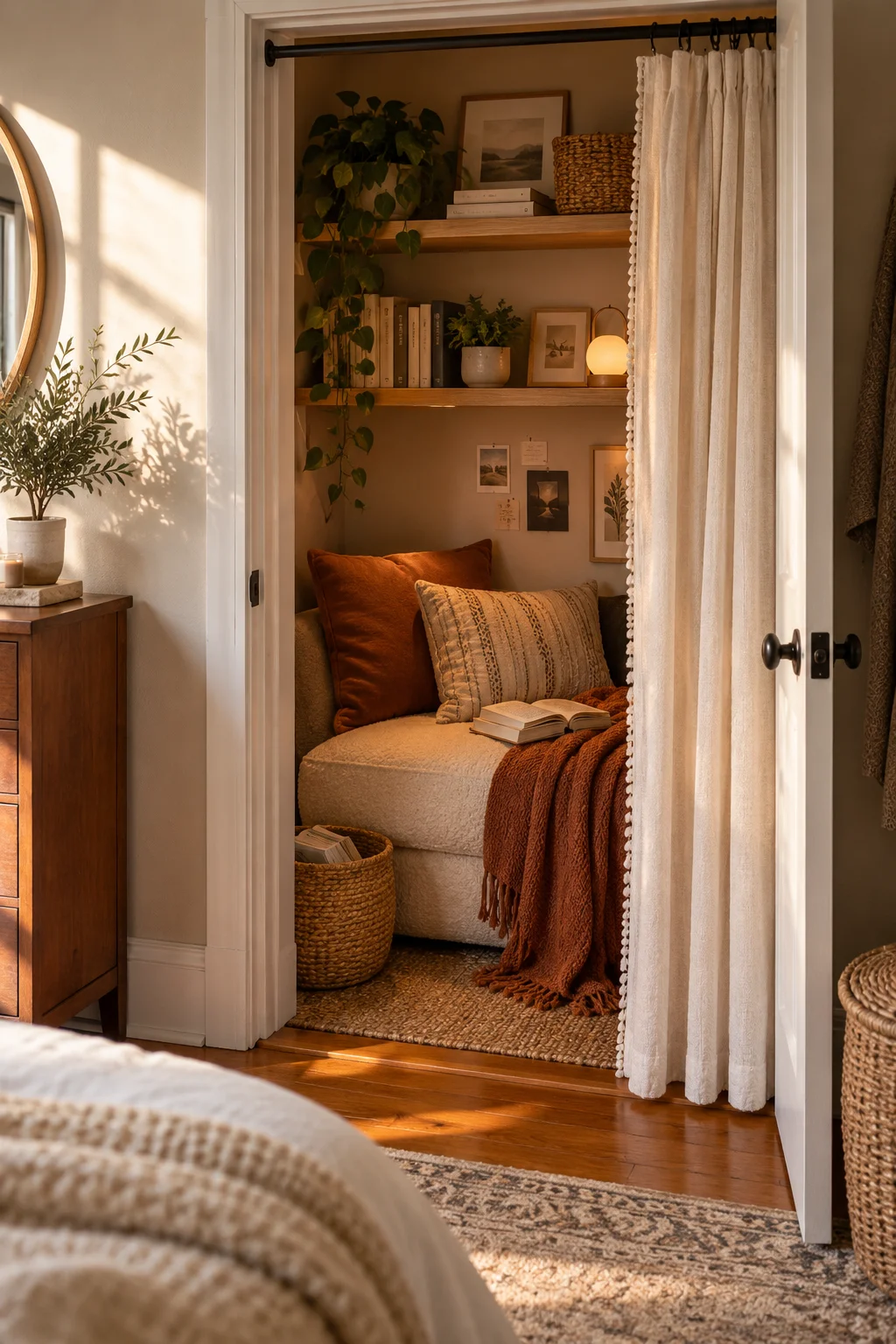
A closet reading nook for adults might not sound like the obvious place to create a comfortable reading space.
But if you’re short on square footage, an unused closet can give you something a living-room corner often can’t: a dedicated little space that feels separate from everything else.
And you don’t need to build a custom bench, install permanent shelving, or spend a weekend renovating it.
With the right seating, lighting, a few soft textures, and a smart way to handle the closet door, you can turn an overlooked closet into a reading nook that actually feels intentional.
For more practical ideas for making a smaller home feel comfortable and functional, explore our small space living guide.
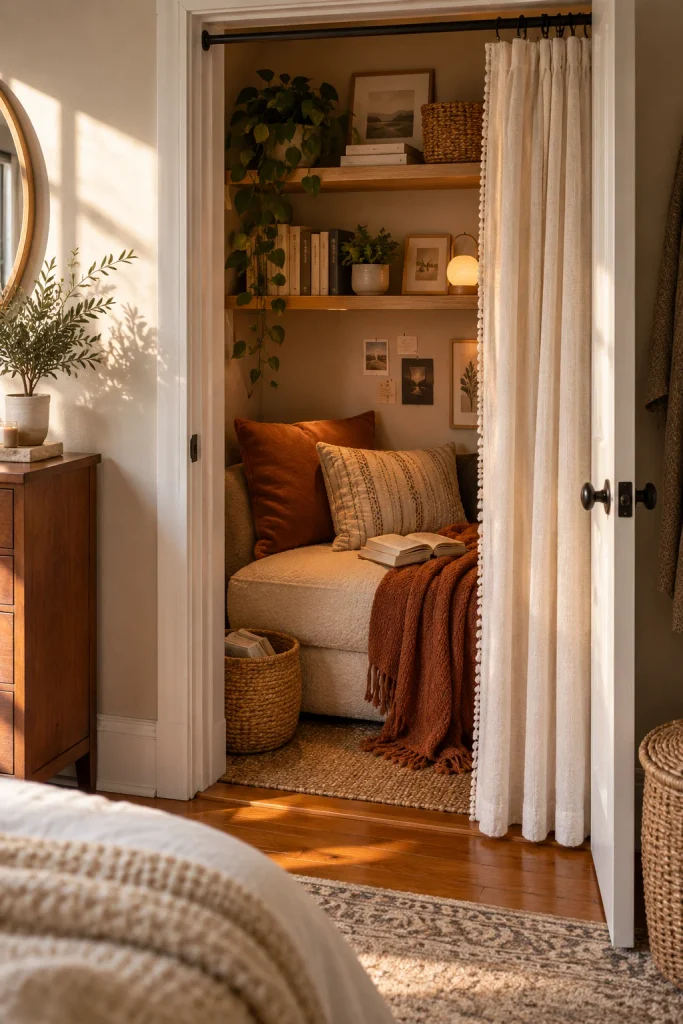
The key is not to make the closet look bigger than it really is.
The goal is to make the space work better than it did before.
Here’s how to do it.
Why a Closet Can Make a Great Reading Nook
A closet already gives you something a reading nook needs: a defined boundary.
Instead of putting a chair in the middle of a bedroom or living room, you’re using a space that’s already separated from the main traffic area.
That can make the nook feel more intentional without requiring you to create a new room.
It’s also a smart small-space move because you’re reclaiming space that may already be underused.
An empty reach-in closet, guest-room closet, or awkward storage closet doesn’t necessarily need to remain storage forever.
The key is to make sure you’re not giving up storage that you genuinely need just to create a pretty corner.
Before you start, decide what the closet can realistically become.
If you still need some of its storage capacity, create a reading nook that keeps a narrow shelf, basket, or small section for useful items.
1. Empty the Closet Before You Design It
Don’t start by buying cushions or a chair.
Start by taking everything out.
Remove the clothes, boxes, shoes, random bags, and anything else that has slowly migrated into the space.
Then look at the actual dimensions.
Ask yourself:
- How wide is the closet?
- How deep is it?
- Does the door swing inward?
- Is there an existing shelf?
- Can you comfortably sit without blocking the entrance?
- Is there enough ventilation?
- Where will your light come from?
This step matters because a closet that looks spacious in a Pinterest photo may be much smaller in real life.
And don’t automatically remove the existing hanging rod.
Depending on the closet, it may become useful for:
- hanging a curtain
- attaching a lightweight clip-on light
- keeping a small section of storage
- creating visual separation
Design around what the closet already gives you before adding anything new.
2. Choose Seating That Matches the Closet
The seating is the biggest decision you’ll make.
And you don’t need a built-in bench.
For a narrow closet, a floor cushion with a firm back pillow can be enough.
For a wider closet, a small armless chair may work better.
Here are the easiest options:
| Seating Option | Best For | Main Advantage |
|---|---|---|
| Floor cushion + back pillow | Very narrow closets | Takes almost no space |
| Folded mattress topper | Budget setup | Soft and flexible |
| Floor pouf | Casual nook | Easy to move |
| Small armless chair | Wider closets | More upright reading position |
| Built-in bench | Permanent renovation | Maximum integration |
The important rule is: don’t choose furniture by appearance alone.
Measure first.
A chair with wide arms may look beautiful online but make a narrow closet feel cramped.
An armless chair or low-profile cushion usually gives you more usable space.
If you’re renting, freestanding seating is also much easier to change or remove later.
3. Get the Lighting Right
A beautiful reading nook is useless if you don’t actually want to read there.
Closets often have one major problem: poor lighting.
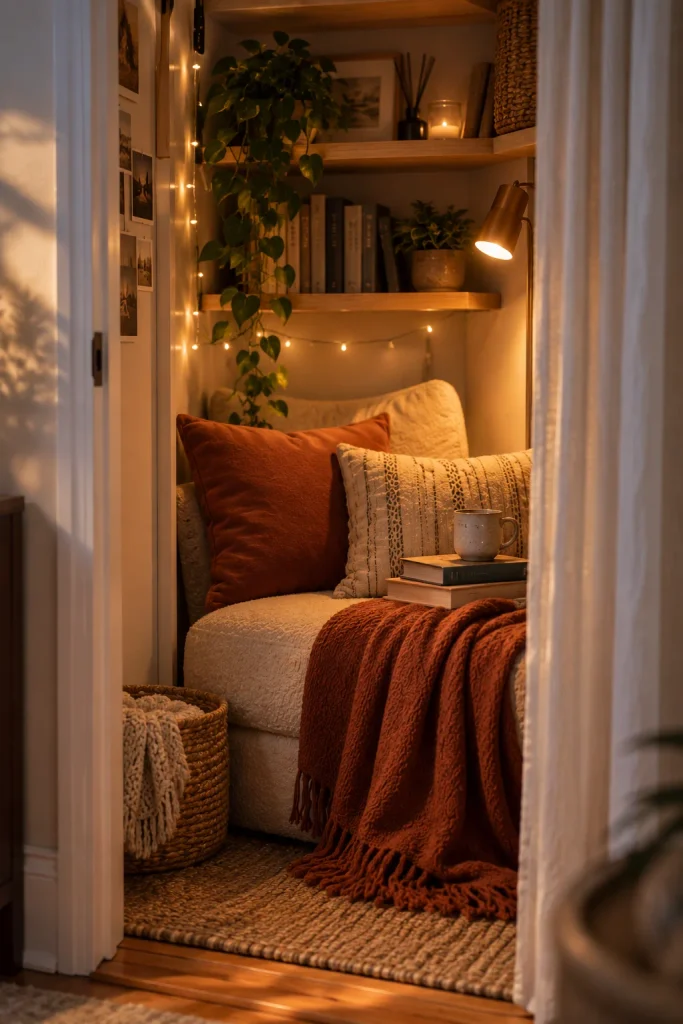
Instead of relying only on an overhead bulb, create a softer light source closer to where you’ll actually sit.
Good renter-friendly options include:
- rechargeable reading lights
- clip-on book lights
- battery-powered lanterns
- rechargeable string lights
- small plug-in lights if an outlet is already nearby
The goal isn’t to make the closet extremely bright.
You want enough focused light to comfortably read while keeping the space warm and inviting.
A simple combination works especially well:
soft ambient light + focused reading light.
That gives you atmosphere without sacrificing function.
4. Use the Closet Door to Your Advantage
You have several options here.
Keep the Door
This works if you want the reading nook to disappear when you’re finished.
Remove the Door
This makes the nook feel more open and visually connected to the room.
Replace the Door With a Curtain
For renters, this is often the most flexible option.
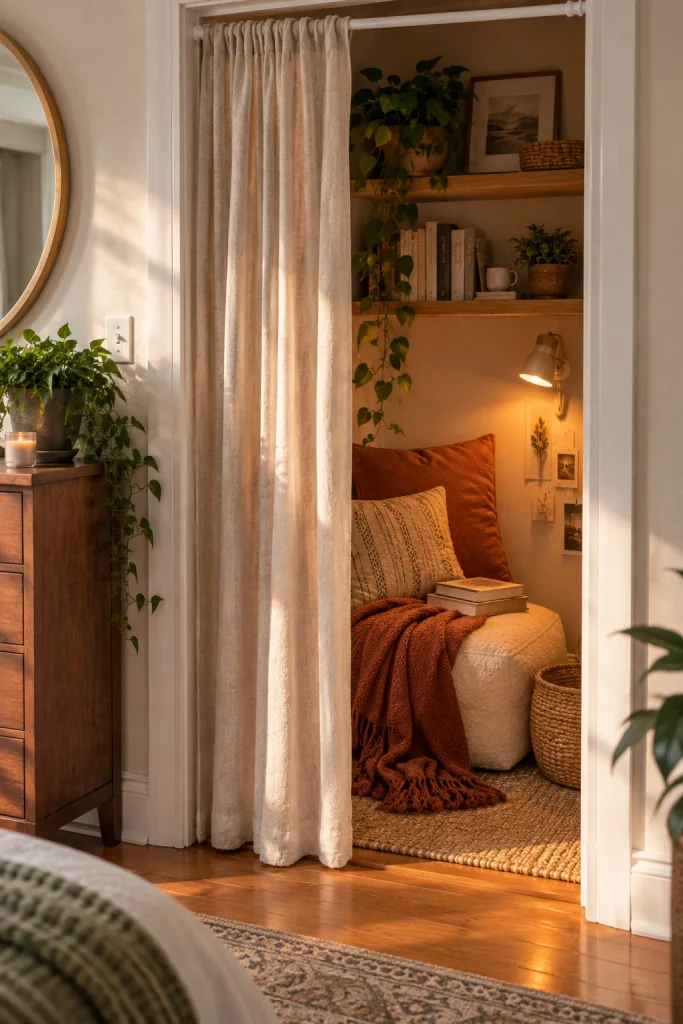
A curtain can provide some visual privacy without making the nook feel permanently closed off.
A suitable tension rod can also be useful when the closet structure allows it because it avoids drilling into the wall.
Choose a curtain that is lightweight enough for the rod and wide enough to cover the opening properly.
For a softer look, linen-look or cotton curtains work particularly well with cozy reading spaces.
5. Give Your Books a Proper Home
Don’t let your reading nook become a pile of books on the floor.
That immediately eats into the limited usable space.
Instead, use the smallest storage solution that fits your closet.
Try:
- a narrow vertical shelf
- one small wall shelf where appropriate
- a slim basket
- a small book ledge
- a few books displayed on an existing shelf
If you have almost no room, keep only your current reading rotation there.
You don’t need to turn the nook into a complete home library.
The goal is easy access, not maximum book storage.
If you’re also trying to make other small areas of your home work harder, see our guide to smart small apartment storage ideas for more space-saving storage strategies.
6. Add Softness Without Overdecorating
A reading nook should feel comfortable, but you don’t need to fill every inch with decor.
Start with just a few elements:
A Soft Throw
Keep one blanket within reach rather than storing it somewhere else.
One or Two Cushions
Use cushions to make floor seating or a simple chair more comfortable.
A Small Rug or Mat
This can make a hard closet floor feel much warmer.
A Small Plant
One plant can soften the space without turning it into a jungle.
A Small Tray
A tray gives you somewhere to place reading glasses, a mug, or another small everyday item.
The trick is function first, decoration second.
If you can’t comfortably sit down because you’re surrounded by baskets, plants, candles, and decorative objects, the nook has gone too far.
7. Keep One Small Surface for Reading Essentials
You don’t need a full side table.
In a tiny closet, even a small surface can be enough.
Use it for the things you actually reach for:
- book
- reading glasses
- tea or water
- phone
- small lamp
- bookmark
A narrow shelf or small stool can do the job.
If there’s no room for a surface at all, a small basket beside the seating can become a simple alternative.
This keeps the floor from becoming a dumping ground.
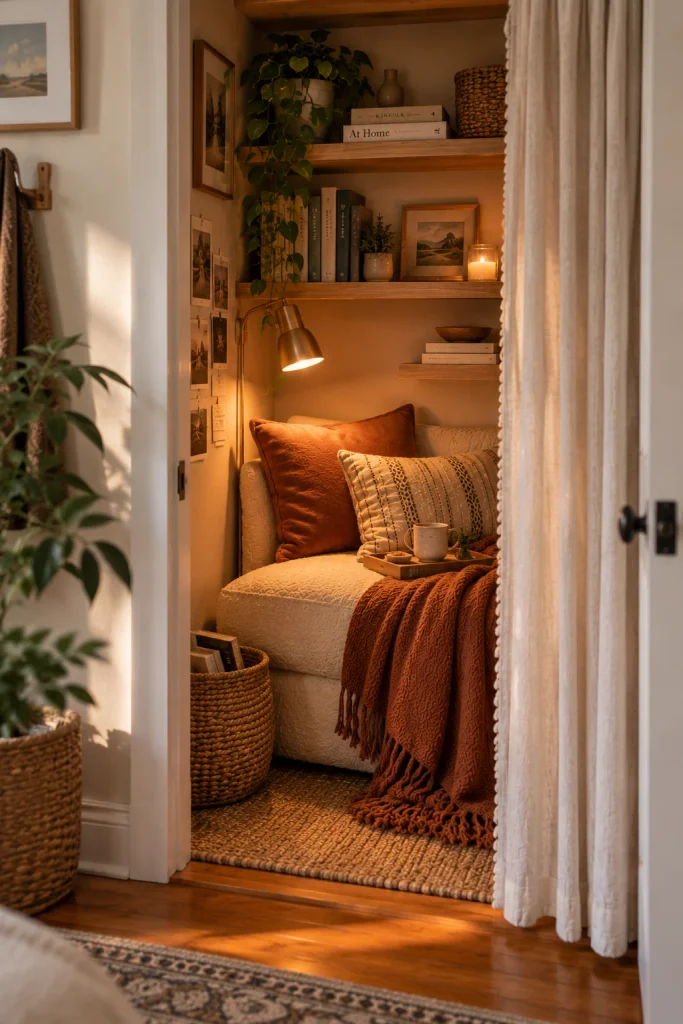
8. Make the Nook Feel Like an Adult Space
If you’re organizing the rest of a small bedroom too, these small bedroom organization ideas can help you make better use of the space you already have.
This is where the “for adults” part of the idea becomes especially useful.
A closet reading nook doesn’t have to look childish or heavily themed.
Instead of filling it with novelty decor, focus on:
- warm neutrals
- natural textures
- linen
- wood
- woven baskets
- soft lighting
- a few favorite books
- one or two personal objects
You can make it minimalist, traditional, vintage, modern, cozy, or eclectic.
The important thing is that the space feels like your retreat, not a children’s hideaway.
9. Don’t Forget Ventilation
This is one of the least glamorous parts of designing a closet nook — but it matters.
Closets can become warm or stuffy, particularly when the door remains closed.
If you’re using the closet as a reading space:
- keep the door open when practical
- consider a curtain instead of a solid door
- don’t block existing vents
- avoid overcrowding the space
- make sure the seating doesn’t obstruct airflow
A beautiful nook that feels uncomfortable after ten minutes isn’t a successful nook.
10. Use the Existing Closet Features Instead of Fighting Them
One of the easiest ways to keep the project inexpensive is to work with what’s already there.
Have a shelf?
Use it for books.
Have a hanging rod?
Use it for a curtain or lightweight accessories.
Have a deep back wall?
Use it as the visual focal point.
Have an awkward corner?
Use a basket or small floor cushion rather than forcing in furniture.
This is especially useful in rentals because you can often make a surprisingly big visual change without making structural changes.
11. Know When Your Closet Is Too Small
Not every closet should become a reading nook.
That’s okay.
If you can’t sit comfortably without your knees hitting the wall or doorway, forcing the idea will make the space frustrating rather than cozy.
Pay attention to:
- seating depth
- entrance clearance
- door swing
- headroom
- ventilation
- ability to get in and out easily
A very shallow closet may work better as storage.
A deeper closet or walk-in closet gives you considerably more flexibility.
Don’t copy the dimensions of a Pinterest photo. Design around the space you actually have.
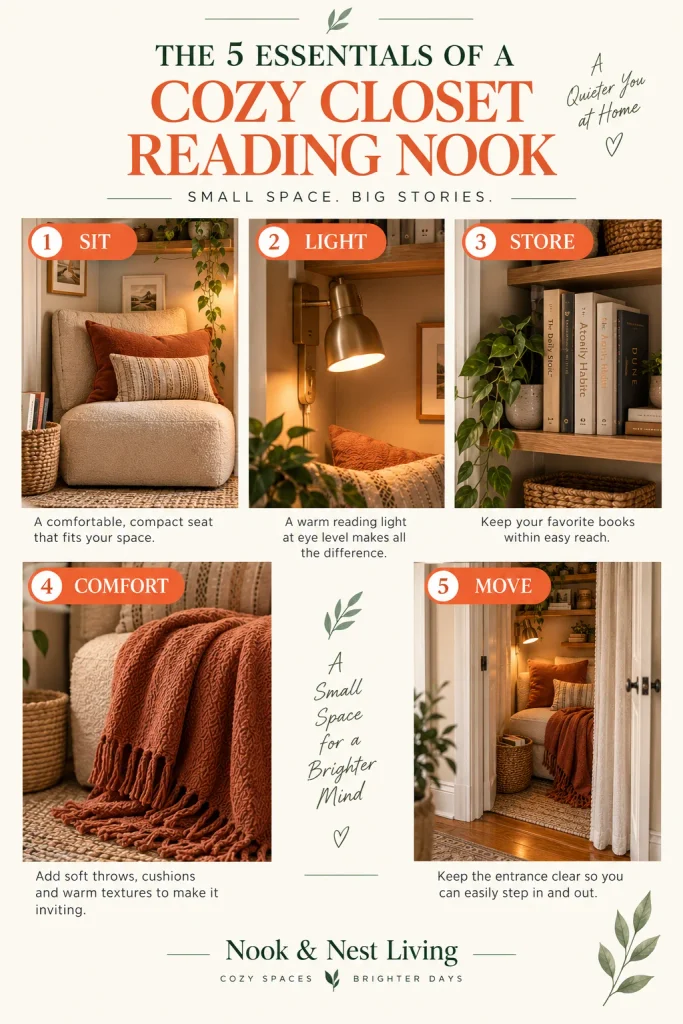
12. Create a Simple 5-Part Reading Nook System
Instead of thinking about decoration first, think about five basic functions:
1. SIT
You need somewhere comfortable enough to stay for a while.
2. LIGHT
You need focused light that makes reading practical.
3. STORE
Keep your current books and small accessories nearby.
4. COMFORT
Add one or two soft elements that make the space inviting.
5. MOVE
Keep enough clear space to enter, sit down, and leave comfortably.
This simple system prevents a tiny closet from becoming overloaded with unnecessary furniture and decor.
13. Make It Easy to Use Every Day
The biggest mistake isn’t choosing the wrong pillow.
It’s creating a nook that looks beautiful but is annoying to use.
If you have to:
- move three baskets before sitting down
- search for the reading light
- retrieve your book from another room
- clear the chair before every use
- unplug something every time
you’ll probably stop using it.
Instead, keep your most-used reading items permanently nearby.
A small basket, tray, shelf, or book stack can make the entire space easier to maintain.
The best reading nook is the one you actually use.
14. Don’t Sacrifice Necessary Storage
Before you permanently convert a closet, think about what you are giving up.
If it’s the only place you can store coats, clothes, cleaning supplies, or other essentials, completely removing that function may simply move the clutter somewhere else.
Instead, consider a dual-purpose setup.
You might keep:
- a narrow upper shelf
- one slim basket
- a small storage bin
- a section of hanging space
- books and blankets underneath the seating
The reading nook doesn’t have to eliminate storage.
It just needs to use the available space more intentionally.
15. Avoid These Common Closet Reading Nook Mistakes
Making It Too Shallow to Sit Comfortably
If the closet doesn’t give you enough room to sit naturally, don’t force the idea.
Skipping the Lighting
A cozy-looking nook still needs practical reading light.
Overfilling It With Decor
A tiny nook needs breathing room.
Choosing Seating That’s Too Large
Large arms and deep furniture can quickly consume the usable space.
Blocking the Entrance
You should be able to get into and out of the nook easily.
Ignoring Ventilation
Don’t create a sealed, uncomfortable space just because it looks good in photographs.
Giving Up Useful Storage Without a Plan
If you remove storage, decide where those belongings will go first.
The No-Renovation Closet Reading Nook Checklist
Before calling the project finished, check:
- Closet completely cleared
- Seating fits comfortably
- Entrance remains easy to use
- Reading light works without major wiring
- Books are within reach
- Curtain or door solution chosen
- One comfortable throw or cushion added
- Small surface or basket available for essentials
- Ventilation considered
- Unnecessary decor removed
If all ten are checked, you probably don’t need much else.
6
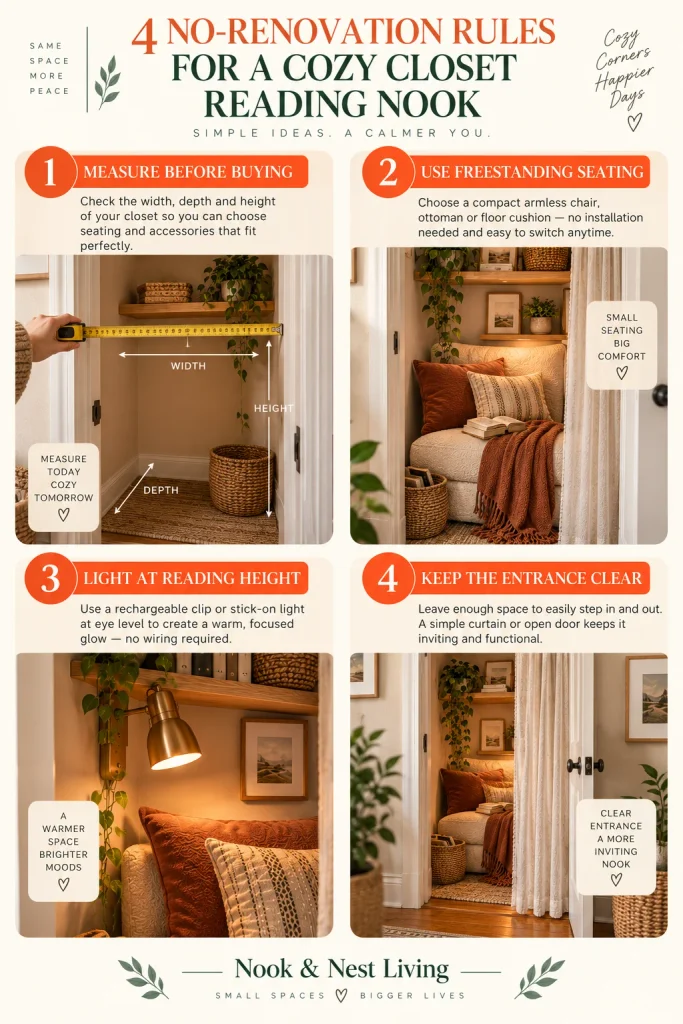
A Simple Closet Reading Nook Setup
If you want the simplest possible version, start here:
Seating
Floor cushion or compact armless chair.
Lighting
Rechargeable reading light plus warm ambient light.
Privacy
Curtain on a suitable tension rod if desired.
Books
Small vertical shelf or current-reading stack.
Comfort
One throw and one or two cushions.
Styling
One plant or personal object.
Essentials
Small tray or basket.
That’s enough.
You don’t need built-ins, custom cabinetry, or a complete closet renovation to make the space feel intentional.
Final Thought
You don’t need a spare room to have a place that feels like your own.
Sometimes the best reading nook is hiding inside the space you’ve been using for things you barely touch.
Clear it out. Measure it. Give yourself somewhere comfortable to sit. Add good light. Keep your favorite books nearby.
Then stop.
A small, usable reading nook will always beat a perfectly decorated one that you never actually use.
FAQ
Can a small closet really become a reading nook?
Yes, provided you have enough room to sit comfortably and enter and exit without constantly bumping into furniture. Very shallow closets may be better suited to storage, while deeper closets give you more seating options.
What is the easiest closet reading nook for a renter?
A floor cushion or freestanding armless chair, rechargeable light, and curtain on a suitable tension rod are among the simplest options because they don’t require permanent construction.
Do I need a built-in bench?
No. A floor cushion, folded mattress topper, pouf, or compact chair can create a comfortable reading spot without building anything.
How do I light a closet reading nook without an outlet?
Try a rechargeable reading light, clip-on book light, battery-powered lantern, or rechargeable string lights. Choose lighting based on where you’ll actually sit and read.
Can I use a closet for both storage and reading?
Absolutely. Keep a narrow section for books, a small basket for blankets, or a slim shelf for reading accessories. The goal is to reclaim the space without creating a new storage problem.
How can I make a closet reading nook feel more adult?
Keep the design simple and intentional. Warm lighting, natural textures, neutral or sophisticated colors, comfortable seating, books, and a few personal objects usually create a more grown-up look than heavily themed decor.