What Is a Dark Cottagecore Kitchen?
A dark cottagecore kitchen takes the traditional cottage kitchen aesthetic and gives it a richer, moodier color palette.
Instead of relying mainly on white cabinets, pale wood and pastel accents, this style uses colors such as forest green, deep olive, charcoal, muted navy, espresso brown and even soft black.
The important part is that dark does not mean cold.
Cottagecore comes from the natural materials, vintage details, imperfect textures, useful objects and relaxed atmosphere layered into the room.
That combination creates a kitchen that feels collected over time rather than decorated all at once.
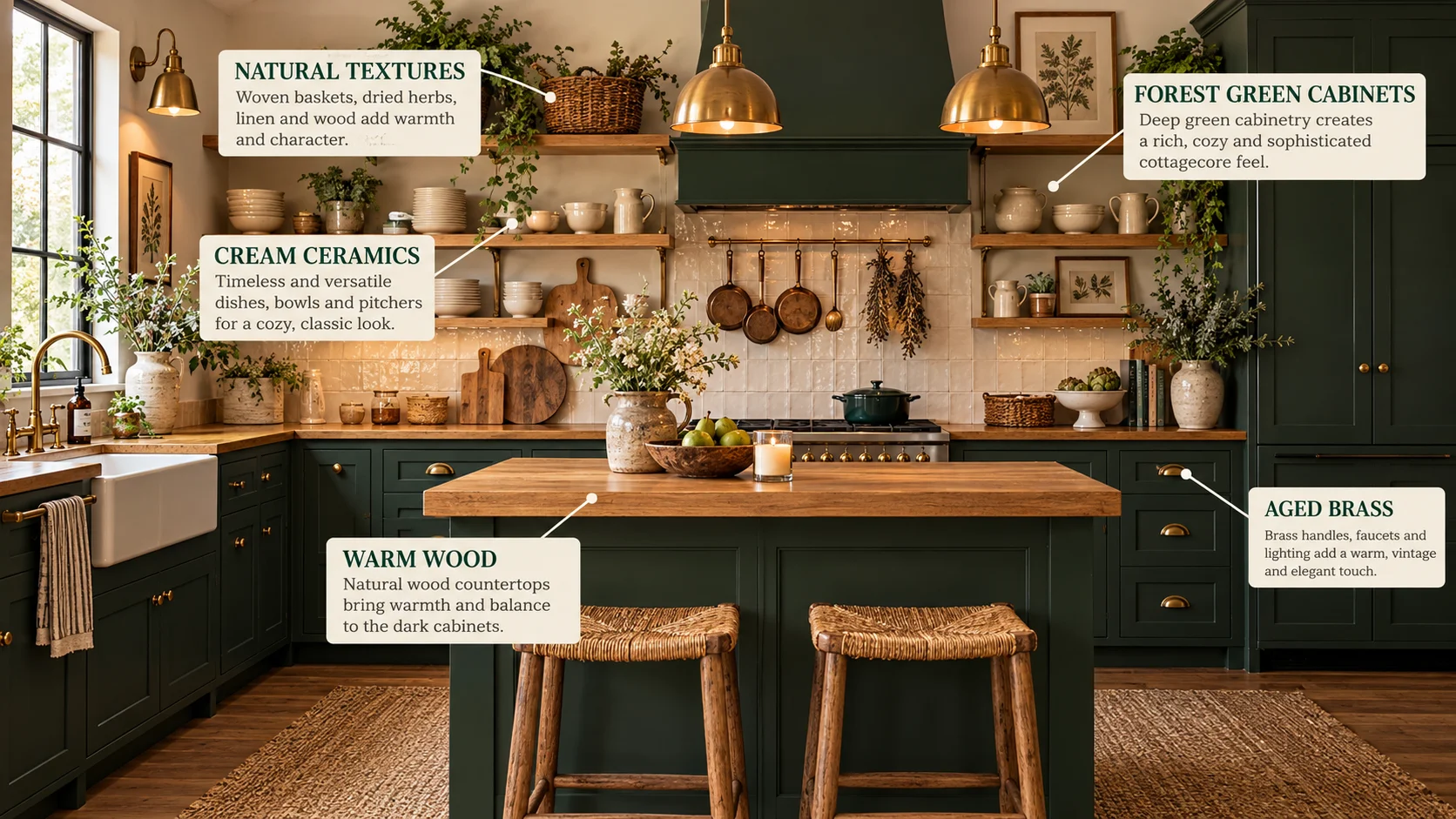
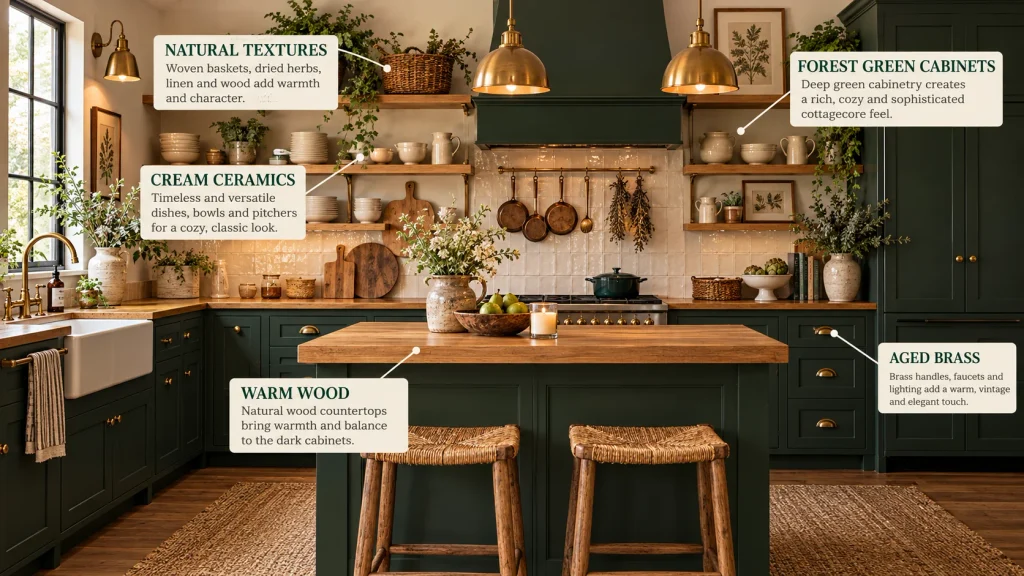
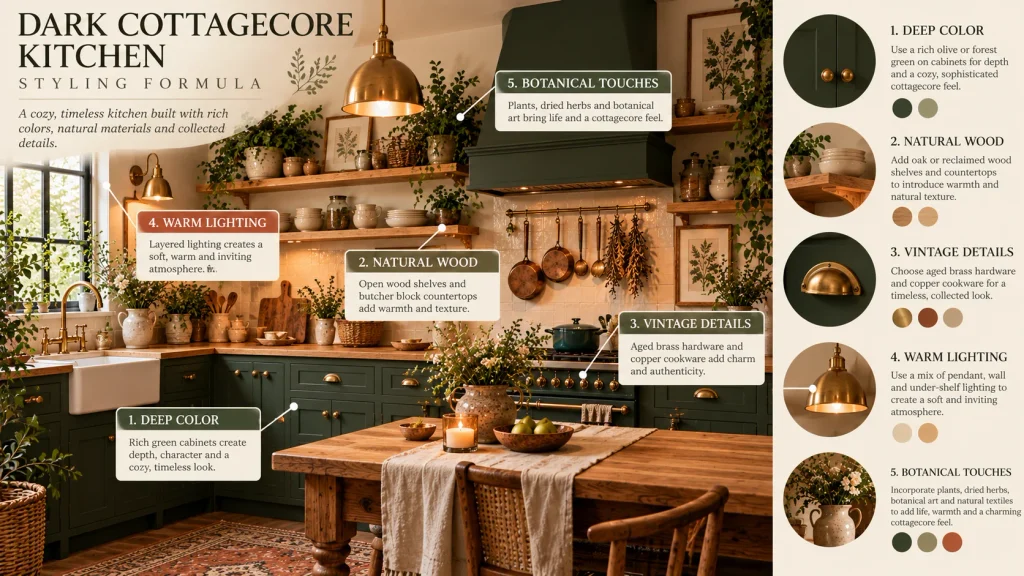
1. Paint the Cabinets Deep Forest Green
Forest green is one of the easiest ways to create a dark cottagecore kitchen without making the room feel harsh.
Choose a muted, slightly earthy green rather than an extremely bright or blue-toned shade.
Pair the cabinets with:
- Warm white walls
- Natural wood countertops
- Aged brass hardware
- Cream ceramic dishes
- Woven baskets
The contrast keeps the kitchen dark enough to feel atmospheric while still allowing the natural materials to stand out.
2. Add Warm Wood to Balance Dark Colors
Dark cabinets become much more inviting when they are surrounded by natural wood.
You can introduce wood through:
- Butcher block countertops
- Floating shelves
- Cutting boards
- Wooden stools
- A small kitchen island
- Vintage wooden furniture
- Exposed ceiling beams
The goal is not to make everything wooden. A few substantial wood elements are enough to prevent a dark kitchen from feeling visually flat.
3. Try a Moody Olive Green Kitchen
Forest green is not your only option.
Muted olive green works especially well for a cottagecore kitchen because it feels connected to gardens, herbs and the outdoors.
Olive cabinets look particularly good with:
- Cream walls
- Terracotta accessories
- Aged brass
- Natural oak
- Vintage botanical artwork
For a small kitchen, consider using olive green on the lower cabinets while keeping the upper portion lighter.
4. Use Open Wooden Shelving
Open shelves are almost a signature element of cottage-style kitchens.
Instead of filling them with random decorations, use them for things you actually use.
Display:
- Ceramic mugs
- Wooden bowls
- Small plates
- Glass jars
- Cookbooks
- Dried herbs
- Small plants
- Vintage kitchenware
This creates the collected, lived-in quality that makes cottagecore work.
Keep some empty space between objects. Overloading every shelf will make a small kitchen feel cluttered rather than cozy.
5. Choose Aged Brass Hardware
Hardware can completely change the character of a kitchen.
For a dark cottagecore look, aged brass works particularly well because it adds warmth without looking overly polished.
Try brass on:
- Cabinet pulls
- Cup handles
- Drawer knobs
- Faucet fixtures
- Shelf brackets
If you already have a functional kitchen, changing the cabinet hardware can be one of the simplest ways to move the room toward this aesthetic without replacing the cabinets.
6. Add a Farmhouse Sink
A farmhouse-style apron-front sink naturally fits the cottage kitchen aesthetic.
White fireclay can create useful contrast against dark cabinetry, while a darker or stone-look sink can create a more dramatic result.
If you are not renovating, do not feel like you need to replace your sink just for the aesthetic.
Instead, recreate some of the visual character around the existing sink with:
- Linen towels
- Wooden brushes
- Ceramic soap dispensers
- A small herb pot
- Vintage-inspired accessories
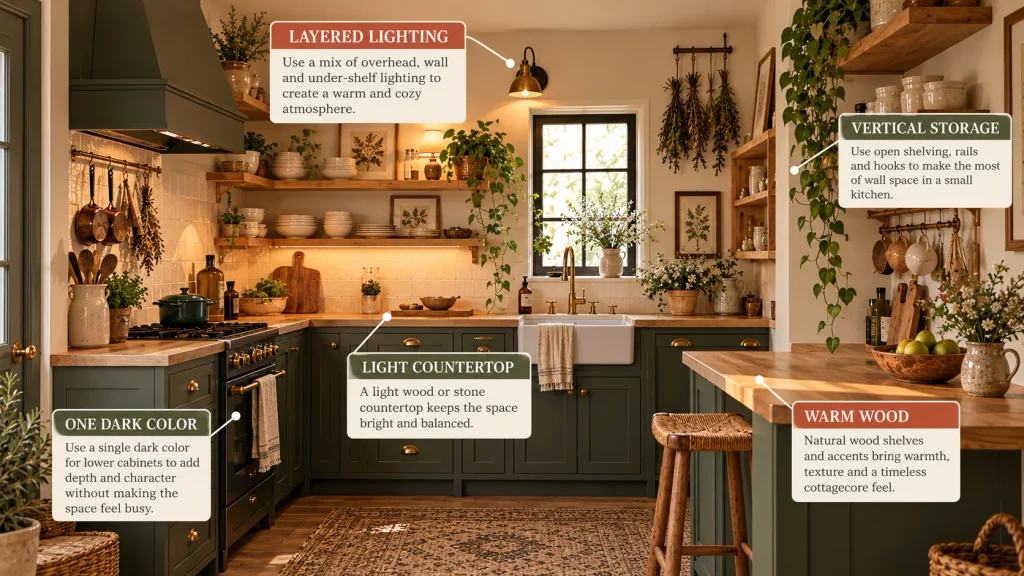
7. Install Warm, Layered Lighting
Lighting is one of the most important parts of dark cottagecore kitchen decor.
Dark colors absorb more visual light, so relying on a single ceiling fixture can leave the room feeling gloomy.
Instead, combine several light sources:
- Pendant lights
- Under-cabinet lighting
- Wall sconces
- Small table lamps where practical
- Warm bulbs
- Candle-style accent lighting
The kitchen still needs bright task lighting for food preparation. The cozy glow should be an additional layer, not the only source of illumination.
8. Try a Handmade-Looking Tile Backsplash
Perfectly uniform surfaces can make a cottagecore kitchen feel too contemporary.
Handmade-looking tiles introduce subtle variation and texture.
Consider:
- Cream zellige-style tile
- Handmade-look subway tile
- Muted green tile
- Deep blue tile
- Warm beige tile
- Dark grout with lighter tile
You do not necessarily need a complicated pattern.
Sometimes a simple tile with slight variations in texture creates enough character.
9. Hang Copper Pots and Pans
Copper cookware instantly adds warmth to a dark kitchen.
You can hang a few pieces from a simple rail above the counter or near the range.
The important word is few.
A wall completely covered with cookware can become visually overwhelming. Two or three useful pieces can provide the vintage character without turning the kitchen into a display set.
10. Decorate With Dried Herbs
Dried herbs are a natural fit for dark cottagecore kitchen ideas because they connect the room to gardening and traditional food preparation.
Try hanging small bundles of:
- Rosemary
- Lavender
- Thyme
- Sage
You can also place dried herbs in small ceramic containers or glass jars.
Besides looking attractive, they reinforce the natural, practical feeling of the style.
11. Use Vintage Ceramic Dishware
Cottagecore kitchens should look like they are meant to be used.
Instead of relying entirely on decorative objects, display beautiful everyday items.
Cream, brown, muted green and blue ceramics work especially well with dark cabinetry.
Look for:
- Slightly irregular shapes
- Floral patterns
- Speckled finishes
- Handmade-looking edges
- Vintage-inspired designs
A few mismatched pieces can actually make the kitchen feel more authentic.
12. Add a Small Vintage Hutch
If you have enough floor space, a vintage hutch can become the focal point of a cottagecore kitchen.
Use it to store:
- Plates
- Mugs
- Glassware
- Cookbooks
- Serving bowls
- Linens
A painted wooden hutch in deep green, charcoal or warm brown can work beautifully against a lighter wall.
For a small kitchen, use a narrow cabinet or wall-mounted shelving instead.
13. Bring in Cottagecore Textiles
Textiles soften dark kitchens.
Try adding:
- Linen café curtains
- Checked tea towels
- Floral kitchen towels
- Woven runners
- Small patterned seat cushions
- Natural-fiber rugs (Natural-fiber rugs are also useful when you’re trying to add warmth to a small space without adding visual clutter.)
Keep the patterns restrained.
One floral curtain or a patterned runner can add personality. Covering every surface in patterns will compete with the darker cabinetry and make the room feel busy.
14. Add Botanical Artwork
Dark cottagecore kitchens have a natural relationship with botanical prints.
Look for artwork featuring:
- Herbs
- Wildflowers
- Fruits
- Garden plants
- Vintage botanical illustrations
Use simple wood or aged frames rather than glossy modern frames.
A small gallery wall can work beautifully above a breakfast nook, open shelving or an unused section of wall.
15. Create a Cozy Breakfast Corner
If you have an awkward corner in your kitchen, turn it into a small breakfast spot.
A simple setup could include:
- A small wooden table
- Two vintage-style chairs
- A linen cushion
- A pendant light
- A small vase of greenery
This adds functionality while making the kitchen feel more like a room to live in rather than simply a place to prepare food.
16. Use Deep Blue Instead of Green
Not every dark cottagecore kitchen needs green.
Deep navy and muted blue can create a beautiful alternative.
Pair dark blue cabinets with:
- Warm oak
- Cream countertops
- Brass hardware
- Handmade tile
- Natural linen
The result feels moody without becoming overly dramatic.
This is especially useful if you already have blue elements elsewhere in your home.
17. Mix Dark Cabinets With Light Countertops
If you are worried that an all-dark kitchen will feel too heavy, use contrast.
Deep cabinets paired with a light countertop can keep the room visually balanced.
Good combinations include:
Forest green + cream
Charcoal + warm white
Deep blue + pale stone
Espresso brown + ivory
The countertop acts as a visual break between the dark cabinetry and the rest of the kitchen.
18. Give a Small Kitchen the Dark Cottagecore Look
You do not need a large kitchen for this style.
For a compact space, smart small-apartment storage ideas can help you use vertical space without making the kitchen feel crowded.
In fact, a small kitchen can feel especially cozy with the right balance.
For a compact space:
- Choose one dominant dark color.
- Keep at least one major surface light.
- Use natural wood to add warmth.
- Keep open shelving edited.
- Use vertical storage instead of covering every counter.
- Install good task lighting.
- Add only a few decorative pieces.
The biggest mistake is assuming that every surface needs to be dark.
In a small kitchen, contrast is what keeps the room from feeling boxed in.
19. Try Dark Walls With Natural Wood Cabinets
You can reverse the usual approach.
Instead of painting the cabinets dark, keep the cabinetry natural and make the walls the dramatic element.
Deep charcoal, olive or smoky blue walls can create a beautiful backdrop for:
- Oak cabinets
- Wooden shelves
- Copper cookware
- Cream ceramics
- Brass lighting
This approach is especially useful if you already like your existing wooden cabinets and do not want to replace them.
20. Add One Statement Vintage Piece
You do not need twenty vintage accessories to make the kitchen feel old-world.
One substantial piece can do more.
Consider:
- An antique wooden stool
- A vintage wall clock
- An old wooden cutting board
- A reclaimed shelf
- A traditional-style pendant
- A vintage-inspired range
- An old-fashioned kitchen scale
Choose something that looks useful rather than something that exists only for decoration.
That distinction keeps the kitchen from feeling like a themed set.
21. Keep the Kitchen Lived-In, Not Cluttered
This is probably the most important dark cottagecore kitchen idea of all.
Cottagecore is not the same thing as filling every available surface with objects.
The strongest spaces usually have a mixture of:
Useful objects + natural materials + vintage character + empty space.
Leave some counter space clear.
Let your best ceramics be visible.
Keep everyday ingredients accessible.
Use baskets to hide less attractive items.
Allow a few imperfections.
The goal is a kitchen that looks like someone actually cooks, drinks tea, grows herbs and spends time there.
How to Make a Dark Cottagecore Kitchen Feel Bright Enough
The biggest concern with dark kitchen ideas is usually lighting.
The solution is not necessarily abandoning dark colors.
Instead, create contrast.
Use lighter countertops, reflective hardware, pale ceramics, glass-front cabinets and warm task lighting to bounce light around the room.
If your kitchen receives very little natural light, avoid painting every wall, cabinet and ceiling the darkest possible shade.
A dark focal point surrounded by lighter surfaces can create the same mood without sacrificing visibility.
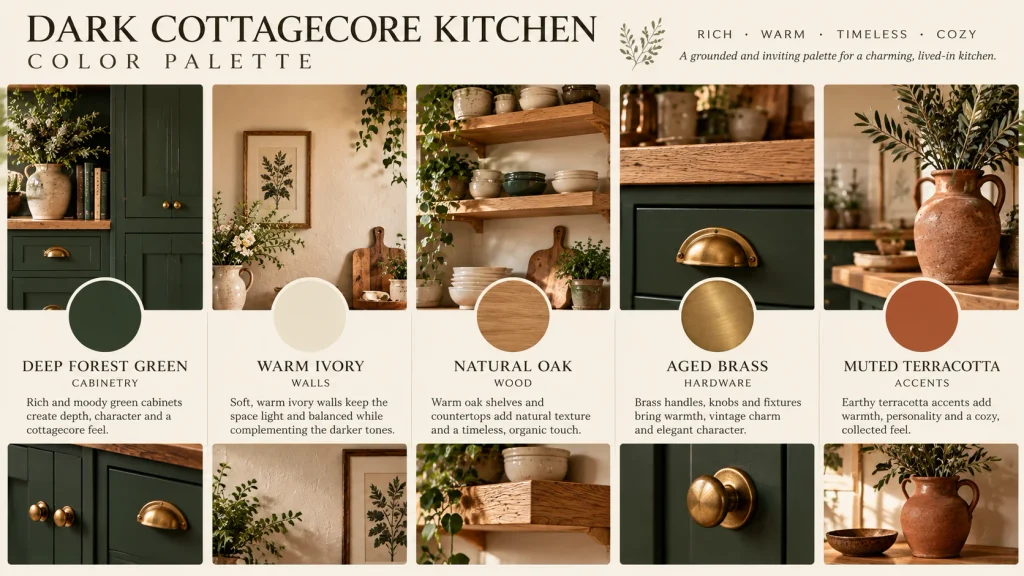
Dark Cottagecore Kitchen Color Palette
If you want a simple starting palette, try:
| Element | Color Direction |
|---|---|
| Cabinets | Forest green or deep olive |
| Walls | Warm ivory or muted beige |
| Countertops | Natural wood or light stone |
| Hardware | Aged brass |
| Textiles | Linen, cream and muted checks |
| Accent Color | Terracotta or deep blue |
| Decor | Natural wood, ceramic and greenery |
This combination gives you the dark cottagecore feeling without forcing every element to be dark.
Dark Cottagecore Kitchen Ideas on a Budget
You do not need a full kitchen renovation to experiment with the style.
Start with inexpensive changes:
- Replace cabinet handles
- Add a wooden cutting board
- Display ceramic mugs
- Hang dried herbs
- Add a linen tea towel
- Introduce a small woven runner
- Install warm under-cabinet lighting
- Add one vintage-style frame
- Use open shelves for everyday dishes
- Bring in a small herb plant
Start with two or three changes rather than trying to transform everything at once.
That also makes it easier to figure out which elements actually work in your kitchen.
Common Mistakes to Avoid
Making Everything Black
An entirely black kitchen can lose the softness that makes cottagecore appealing.
Use dark colors as anchors and balance them with warm, lighter materials.
Using Too Many Decorative Objects
Cottagecore should feel collected, not chaotic.
Give your favorite pieces room to breathe.
Forgetting Task Lighting
A beautiful kitchen still needs to function as a kitchen.
Make sure food-preparation areas are properly illuminated.
Mixing Too Many Colors
Deep green, dark blue, brown, terracotta, brass and multiple patterns can quickly become too much.
Choose one dominant dark color and one or two supporting accents.
Making Everything Look Brand New
Perfectly coordinated accessories can make the space feel artificial.
Mix newer practical pieces with vintage-inspired or genuinely older items to create more character.
Final Thoughts
The best dark cottagecore kitchen ideas are not about making a kitchen as dark as possible.
They are about creating contrast.
Deep green or blue cabinets become warmer beside natural wood. Vintage ceramics feel more interesting against dark shelving. Brass hardware catches the light. Dried herbs add a connection to nature. Soft textiles keep hard surfaces from feeling cold.
Most importantly, the kitchen should still work for everyday life.
You can create the look through a full renovation, but you can also start with a cabinet color, a wooden shelf, warm lighting or a few vintage pieces.
The result should feel cozy, practical and personal, with enough character to make an ordinary kitchen feel like somewhere you actually want to spend time.
Frequently Asked Questions About Dark Cottagecore Kitchens
What colors work best for a dark cottagecore kitchen?
Deep forest green, olive, charcoal, muted navy, espresso brown and soft black all work well. Pair darker colors with cream, warm beige, natural wood or light stone to maintain balance.
Can a small kitchen have a dark cottagecore style?
Yes. The key is not covering every surface in dark colors. Use one dark anchor, lighter countertops or walls, natural wood and strong task lighting to keep the space visually open.
What makes a kitchen cottagecore?
Natural materials, vintage-inspired details, practical objects, soft textiles, botanical elements, handmade-looking ceramics and a relaxed, lived-in atmosphere are common cottagecore characteristics.
How do you make a dark kitchen feel cozy?
Warm layered lighting, natural wood, textiles, ceramics, greenery and aged metals can make dark colors feel warm instead of harsh.
Is dark cottagecore the same as a gothic kitchen?
Not exactly. Dark cottagecore borrows some darker colors from gothic interiors, but it keeps the softer, natural and practical character of a traditional cottage kitchen.