
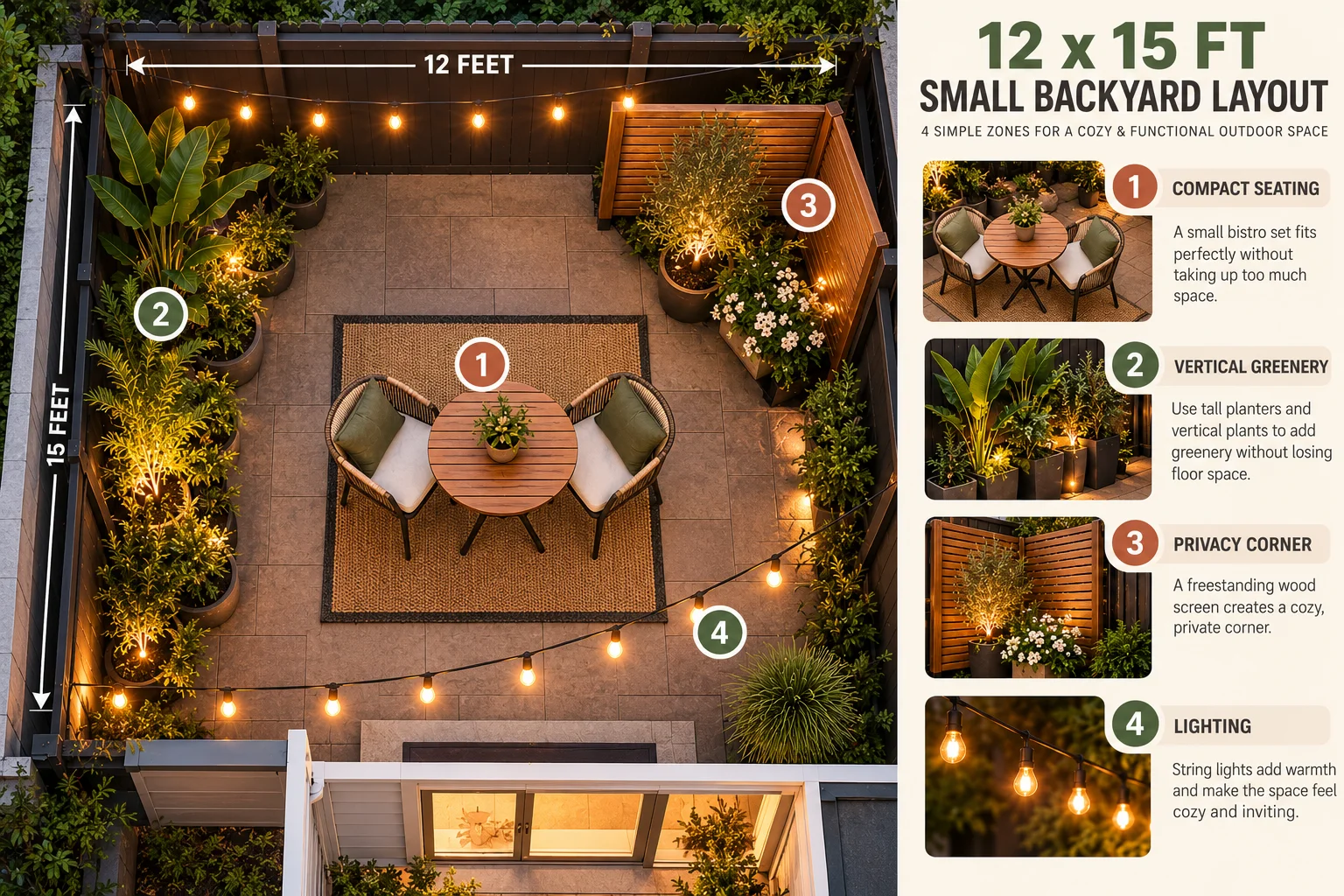
A small backyard doesn’t need another oversized sectional, a giant pergola, and twelve decorative planters fighting for attention.
What it needs is a good layout.
The best small backyard ideas make a compact outdoor space feel intentional without trying to disguise its size. A tiny yard can become a breakfast spot, reading corner, mini garden, entertaining area, or quiet retreat when you stop treating it like leftover space and start treating it like an outdoor room.
That’s the approach behind these ideas.
Instead of giving you a pile of random backyard inspiration, we’re going to work through the problems that actually make small yards difficult: limited floor space, awkward layouts, lack of privacy, too much sun, boring concrete, not enough greenery, and the temptation to buy furniture that simply doesn’t fit.
And you don’t need to tackle everything at once.
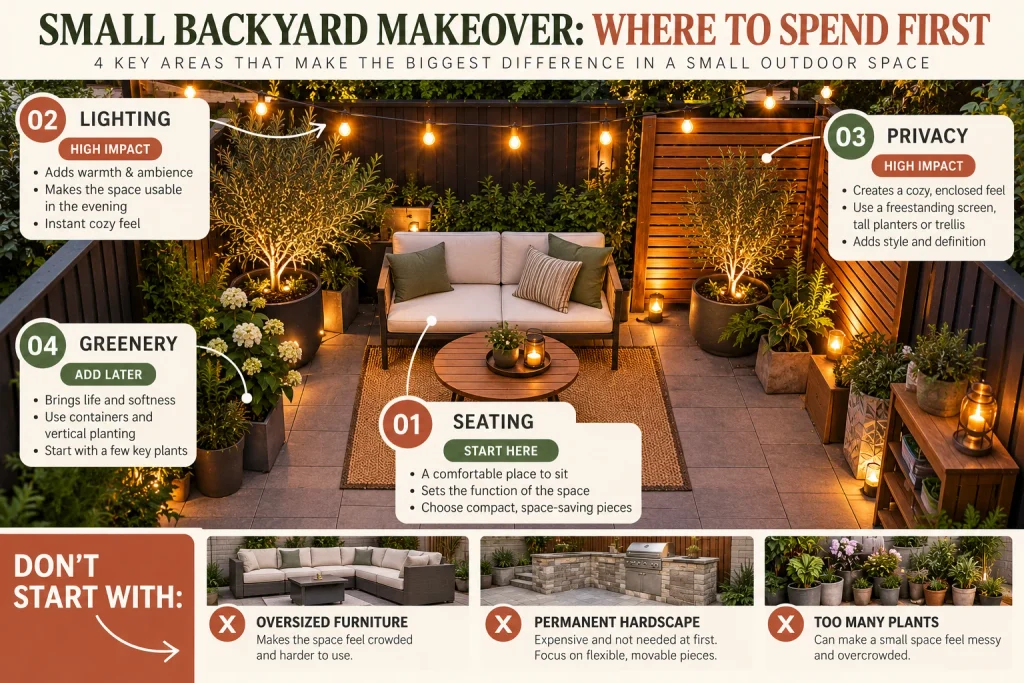
One defined seating area, some vertical greenery, better lighting, and a little privacy can completely change how a small backyard feels.
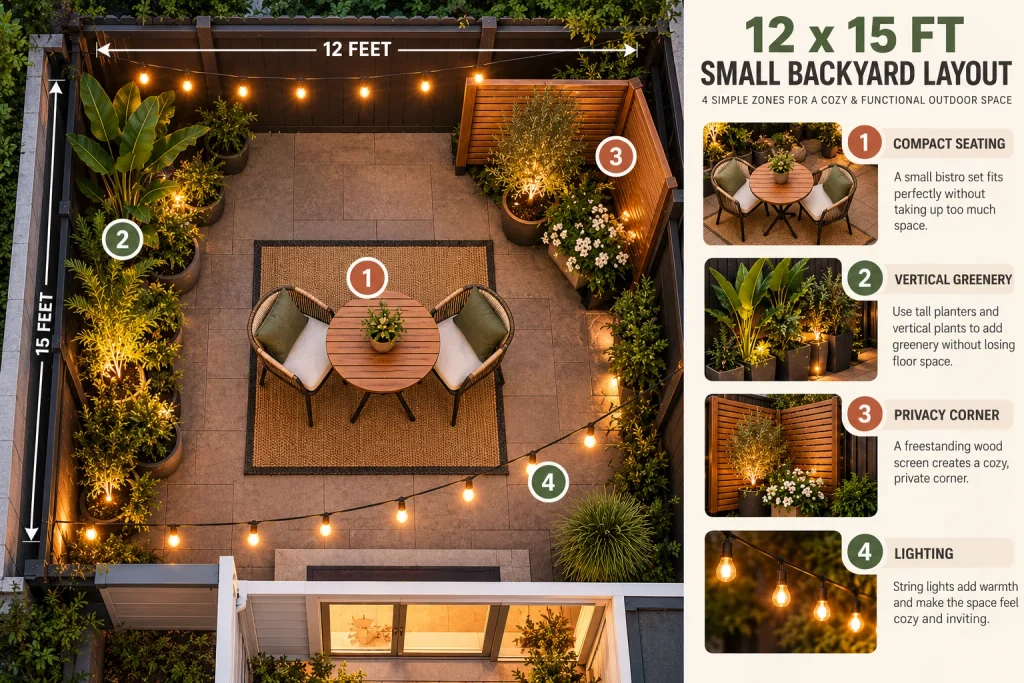
1. Start by Treating the Backyard Like an Outdoor Room
This is the single biggest mindset shift.
A small backyard often looks unfinished because everything is floating independently:
a chair here, a planter there, a grill somewhere else, a random patch of grass in the middle.
There is no visual destination.
Instead, think about the backyard the same way you would think about a small living room.
A living room usually has:
- a floor
- seating
- lighting
- a focal point
- some greenery
- a defined circulation path
Your backyard can have exactly the same things.
The “floor” might be:
- an existing patio
- pea gravel
- pavers
- decking tiles
- an outdoor rug over an appropriate surface
The seating might be:
- two lounge chairs
- a compact loveseat
- a bistro set
- a bench
- floor cushions
The ceiling can be suggested by:
- string lights
- a shade umbrella
- a pergola
- a shade sail
And the walls can come from:
- fences
- trellises
- privacy screens
- tall plants
- container gardens
This approach is increasingly common in small-yard design advice because defining zones gives the space a purpose instead of leaving it as one undifferentiated patch of outdoor space.
2. Define One Main Purpose First
Don’t start shopping.
First ask:
What do I actually want to do out here?
If your answer is “everything,” that’s exactly where small yards go wrong.
Choose the primary function.
If you want morning coffee
Create a tiny café-style zone with:
- round bistro table
- two folding chairs
- small planter
- outdoor rug
If you want to relax
Use:
- one loveseat or two lounge chairs
- side table
- shade
- soft lighting
If you want to entertain
Prioritize:
- flexible seating
- small movable tables
- clear walking space
- lighting
If you want to garden
Prioritize:
- vertical planters
- raised containers
- trellises
- narrow planting beds
If you want privacy
Prioritize:
- screening
- tall containers
- layered plants
- shade
You can eventually combine functions.
But start with one.
A recent small-yard discussion on Reddit makes the problem obvious: homeowners with very limited areas often struggle because they have multiple ideas—seating, gardens, fire pits, storage—but not enough room to comfortably fit them all.
3. Use a Small Outdoor Rug to Define the Seating Area
An outdoor rug is one of the easiest ways to make a small backyard look finished.
It gives the furniture a visual boundary.
Without one, two chairs can look like furniture randomly placed outside.
With one, they become a seating zone.
Try:
4 × 6 ft: tiny conversation corner
5 × 7 ft: two chairs + small table
6 × 9 ft: compact loveseat + coffee table
Don’t automatically buy the largest rug you can fit.
You still need circulation around the seating.
For a very small yard, a slightly undersized rug can actually preserve more breathing room.
Choose simple patterns rather than extremely busy ones.
Faded stripes, subtle geometric patterns, woven neutrals, and muted botanical designs tend to integrate easily with plants and outdoor furniture.
4. Build Up Instead of Out
When floor space is limited, the obvious answer is:
look upward.
Vertical gardening is repeatedly recommended for compact yards because it adds greenery without consuming the same amount of ground space as conventional planting. Apartment Therapy, for example, highlights living walls and wall-mounted pots as practical small-yard solutions.
You can use:
- freestanding ladder shelves
- narrow plant stands
- trellises
- tall planters
- hanging pots
- vertical herb gardens
- climbing plants
- wall-mounted systems where permitted
A narrow backyard with plants at multiple heights usually feels much richer than one with every plant sitting at ground level.
Create three plant heights
Think:
LOW: herbs and small pots
MID: flowering containers and shrubs
HIGH: trellis, climbing plant, tall grasses or slim trees
This creates depth without demanding more floor area.
5. Turn an Ugly Fence Into a Feature
If your backyard has an ugly fence, don’t automatically try to hide every inch of it.
Use it as the backdrop.
A fence can become the visual wall of your outdoor room.
Add:
- climbing greenery
- a trellis
- hanging planters
- outdoor artwork
- a narrow shelf
- string lights
- a privacy screen
The goal isn’t necessarily to cover the fence completely.
Sometimes repeating one material—like natural wood planters against a dark fence—is enough to make it look intentional.
For renters, freestanding plant stands and movable trellises are particularly useful because they don’t require permanent modifications. Recent renter-focused backyard guides emphasize movable planters, portable furniture and freestanding greenery for exactly this reason.
6. Create Privacy Without Building a Massive Fence
Privacy is one of the biggest reasons people avoid using small backyards.
You might technically have outdoor space, but if the neighbors can see directly into it, you may never feel comfortable sitting there.
The solution doesn’t always need to be a full privacy fence.
Try creating a privacy corner.
Use:
- folding privacy screens
- lattice panels
- tall planters
- ornamental grasses
- bamboo screening
- climbing plants
- a shade umbrella
- freestanding outdoor curtains
A recent Reddit discussion about backyard privacy specifically involved a homeowner who couldn’t install a conventional fence and wanted year-round screening. Other discussions show renters considering portable screens, umbrellas and freestanding structures instead.
The important thing is that you don’t necessarily need 100% visual blockage.
Even partial screening can make a seating area feel more private.
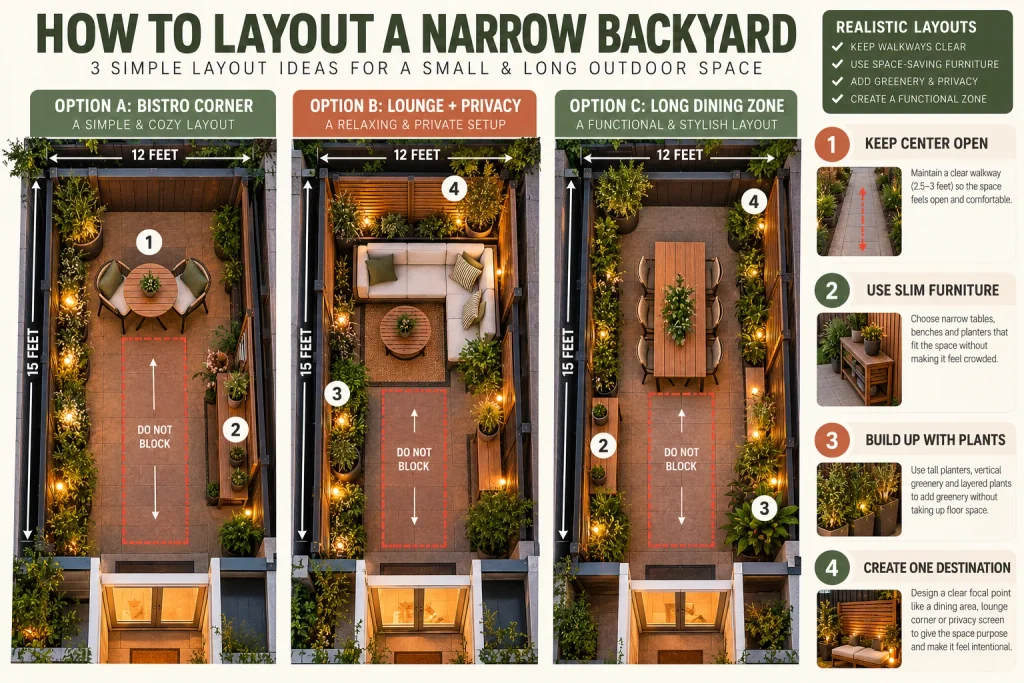
7. Make a Narrow Backyard Feel Wider With the Right Layout
A narrow yard creates a particular problem.
If you put a large rectangular table directly in the center, you’ve created a physical barrier.
Instead, work with the length.
Try:
bench → narrow table → vertical plants
or:
bistro table → open walkway → planting strip
or:
lounge chair → small side table → privacy screen
Keep the center of the yard visually open.
If the backyard is extremely narrow, use furniture with:
- slim legs
- open backs
- rounded edges
- lighter visual weight
Avoid oversized boxy sectionals unless the dimensions genuinely allow them.
A recent Reddit example of a roughly 5 × 15-foot townhome outdoor area shows why this matters: extremely narrow spaces need a layout that works with the proportions instead of pretending they’re standard patios.
8. Use a Small Round Table Instead of a Large Rectangular One
For tiny yards, furniture shape matters.
A round table can make circulation easier because there are no sharp corners projecting into the walking path.
It’s especially useful for:
- two-person dining
- morning coffee
- small patios
- townhouse yards
- narrow outdoor areas
Pair it with two lightweight chairs.
And here’s an important rule:
Don’t buy a six-person dining set because you occasionally host six people.
If you use the backyard every day as a couple, optimize for daily life.
For larger gatherings, bring out folding chairs when needed.
That’s better space planning than allowing six chairs to occupy the yard permanently.
9. Choose Furniture That Can Do More Than One Job
Small spaces punish single-purpose furniture.
Look for:
- storage benches
- nesting tables
- folding chairs
- stackable stools
- ottomans
- benches that double as plant stands
- side tables with storage
- rolling carts
A small backyard becomes much more useful when furniture can change configuration.
A bench can be:
daily seating → party seating → plant display → temporary storage
A folding table can be:
breakfast table → work surface → entertaining table → stored away
That flexibility is especially valuable for renters and people with very small yards.
Small spaces punish single-purpose furniture. The same principle applies indoors too—our guide to smart small apartment storage ideas covers ways to make limited space work harder.
10. Use Gravel to Create an Affordable Outdoor Zone
You don’t necessarily need a professionally installed patio.
Pea gravel or another appropriate compacted aggregate can create a defined seating area, depending on local drainage, soil conditions and installation requirements.
Budget backyard guides frequently recommend gravel because it can define a patio-like area without the cost and complexity of a full hardscape installation.
For a small yard, you could create:
gravel circle + two chairs + fire-safe tabletop feature
or:
rectangular gravel pad + bistro table
or:
gravel strip + lounge chairs + potted plants
The important part is to make the gravel area look intentional.
Use a defined edge.
That might be:
- metal edging
- stone
- pavers
- timber edging where appropriate
Don’t simply dump gravel into the grass and call it a patio.
11. Give Concrete a Second Chance
A boring concrete patio doesn’t necessarily need to be demolished.
That can be expensive and unnecessary.
Instead, change everything around it.
Add:
- outdoor rug
- compact furniture
- large planters
- string lights
- privacy screen
- colorful cushions
You can also investigate suitable exterior concrete coatings or stenciling if the surface condition and local climate allow it.
The point is to avoid the expensive assumption:
“The patio is ugly, so the patio has to go.”
A recent homeowner asking for budget backyard advice specifically wanted ways to make a plain concrete patio more inviting without replacing the entire surface.
That’s exactly the kind of problem a good small-space makeover should solve.
12. Add Lighting Before You Add More Decor
Lighting changes how a backyard feels after sunset.
And it doesn’t need to be complicated.
Try:
- warm string lights
- lanterns
- solar path lights
- portable rechargeable lamps
- flameless outdoor candles
For a small yard, avoid turning every surface into a glowing object.
Choose one lighting layer overhead and one lower layer.
For example:
string lights overhead + lantern beside seating
That’s enough.
The warm glow creates a ceiling-like effect, which helps the backyard feel more like a room.
Budget-focused outdoor guides consistently recommend lighting as a relatively high-impact way to change the atmosphere of small patios and yards.
13. Create a Cozy Corner Instead of Decorating the Entire Yard
Here’s a mistake I see constantly in small-space design:
People think every empty corner needs something.
It doesn’t.
Sometimes the best backyard has:
one beautiful corner + empty space around it.
For example:
A single lounge chair.
A small round side table.
One tall planter.
A privacy screen.
String lights.
Done.
That can look far more sophisticated than:
chair + bench + table + fountain + six pots + garden statue + fire pit + rug + lanterns + outdoor cart.
Small spaces need editing.
14. Add Shade Without Building a Permanent Structure
Shade is essential if you actually want to use the yard during hot afternoons.
But a permanent pergola isn’t always realistic.
Try:
- cantilever umbrella
- large market umbrella
- shade sail
- portable canopy
- freestanding umbrella
- outdoor curtain structure
A shade umbrella has another advantage:
You can angle it toward the sun and reposition it.
For renters, portable shade is particularly useful because it doesn’t permanently change the property.
And in a small yard, a movable umbrella can perform double duty as a privacy tool.
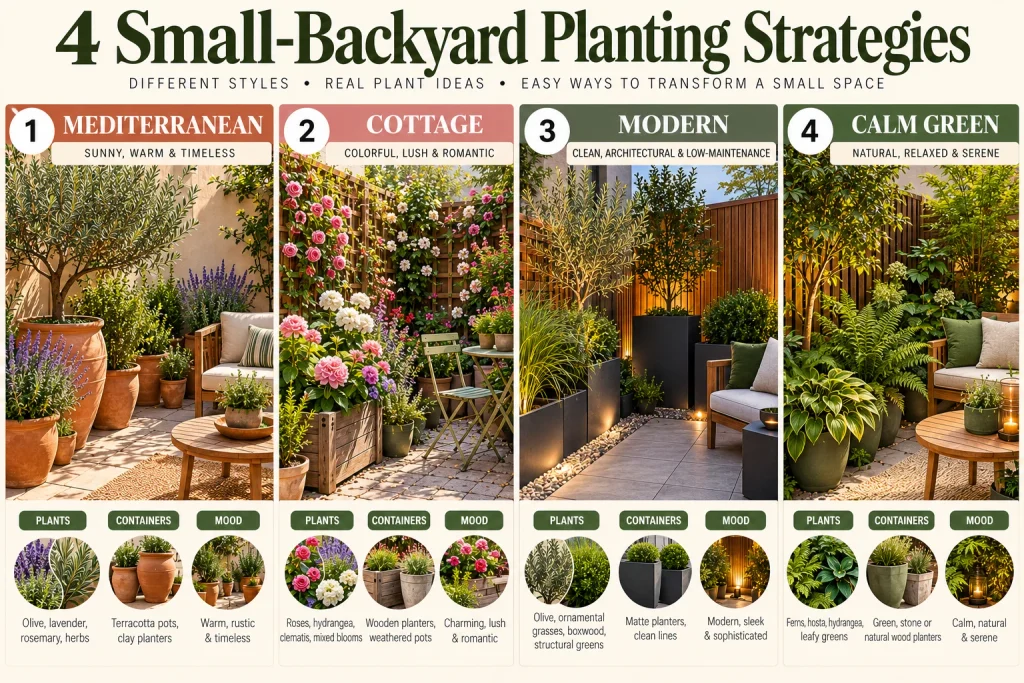
15. Use One Strong Planting Style Instead of a Plant Collection
A small backyard can become visually chaotic very quickly.
You don’t need twelve different plant varieties.
Choose a theme.
Mediterranean-inspired
Think:
- terracotta pots
- herbs
- olive-like foliage
- lavender
- warm stone
Cottage-inspired
Think:
- soft flowers
- climbing vines
- weathered wood
- vintage pots
Modern
Think:
- architectural plants
- simple planters
- grasses
- restrained colors
Green and calming
Think:
- ferns
- leafy plants
- mossy greens
- natural wood
Repeating the same planter color can make a collection of inexpensive containers look much more intentional.
16. Use Container Plants When You Don’t Want a Major Garden
Containers are the safest starting point when you’re unsure about the backyard.
You can move them.
You can rearrange them.
You can change seasonal plants.
And you don’t have to commit the entire yard to one planting plan.
For a small backyard, use containers strategically.
One tall container
Creates height.
Two matching medium containers
Frames a doorway or seating area.
A cluster of three
Creates a small garden moment.
A narrow row
Defines an edge without blocking circulation.
Don’t scatter pots everywhere.
Group them.
Grouping creates visual weight.
17. Make a Backyard Privacy Screen Part of the Design
A privacy screen shouldn’t look like something you threw up because your neighbor could see you.
Make it part of the composition.
A wood slat screen can become:
privacy + backdrop + architectural feature
A lattice screen can become:
privacy + climbing garden
A fabric screen can become:
privacy + softness
A tall planter row can become:
privacy + greenery
HGTV’s extensive backyard privacy guidance similarly includes planting, screens and other methods rather than treating a solid fence as the only solution.
The best option depends on whether you need:
- full privacy
- partial privacy
- seasonal privacy
- visual softness
- renter flexibility
18. Create a Mini Outdoor Dining Room
If you love eating outside, don’t waste the yard on a giant dining set.
Create a tiny dining room.
Use:
- 30–36-inch round table
- two to four chairs
- outdoor rug
- lantern
- one planter
That’s enough.
For occasional guests, use folding chairs.
You can even use a narrow console or outdoor cart to hold serving pieces.
The goal is not to recreate a restaurant patio.
It’s to create a place where two people actually want to eat dinner on Tuesday night.
19. Add a Fire Feature Carefully
A fire pit is one of the most attractive ideas for backyard inspiration.
But it is also one of the easiest ways to overcrowd a tiny yard.
Before buying one, ask:
How much seating space does the fire feature require around it?
The answer isn’t simply the diameter of the bowl.
You need safe clearance, seating, movement and local-rule compliance.
If the yard is too small for a conventional fire pit, consider a smaller approved outdoor fire feature or skip it entirely.
A cozy lighting setup can create much of the same evening atmosphere without consuming the same amount of space.
20. Make a Small Backyard Kid-Friendly Without Losing the Adult Space
If children use the backyard, don’t automatically fill it with large play equipment.
Use flexible pieces.
For example:
- foldable water table
- compact outdoor storage box
- chalkboard panel
- small sensory garden
- portable play tent
- outdoor cushions
- foldable picnic table
The trick is to make the children’s area temporary or multifunctional.
When adults want to use the backyard, the equipment can be folded, moved or stored.
That preserves the outdoor room rather than turning the entire yard into a permanent play zone.
21. Use Vintage Pieces to Make a Backyard Feel Less Generic
This is where you can get personality without spending much.
Look for:
- vintage metal chairs
- old garden stools
- weathered wooden benches
- secondhand planters
- antique-style lanterns
- thrifted outdoor tables
Secondhand outdoor furniture is specifically recommended in budget backyard guidance because older pieces can be refreshed rather than replaced.
But don’t buy something just because it’s cheap.
Measure first.
A $20 chair that blocks your only walkway is not a bargain.
22. Use a Single Color Palette
Small spaces look more cohesive when the colors repeat.
Try:
Warm neutral
Cream + tan + natural wood + olive
Cottage
White + sage + dusty blue + weathered wood
Modern
Charcoal + cream + green + natural oak
Mediterranean
Terracotta + cream + olive + warm wood
The plants will provide plenty of color.
Your furniture doesn’t need to compete with them.
23. Make the Backyard Feel Bigger by Preserving Sightlines
This is less glamorous than buying décor, but it matters more.
Don’t block the entire view with:
- giant furniture
- tall opaque storage
- oversized planters
- unnecessary partitions
Keep at least one clear sightline.
If you’re standing inside the house looking toward the yard, you should be able to see through part of it.
That visual depth makes the outdoor area feel connected to the home.
And connected spaces generally feel more useful.
24. Create a Backyard Reading Corner
You don’t need a full outdoor lounge.
One chair can be enough.
Choose:
- comfortable lounge chair
- small side table
- shade
- privacy screen
- one plant
- portable lamp or lantern
This works especially well in a tiny backyard because it gives the space a clear emotional purpose.
You’re not designing a “backyard.”
You’re designing:
the place where I drink coffee.
the place where I read at 6 PM.
the place where I sit after work.
That’s a much better starting point.
You don’t need a full outdoor lounge. One chair can be enough. The same small-space principle works indoors when creating a closet reading nook for adults.
25. The Best Small Backyard Ideas Are the Ones You Actually Use
This is the part Pinterest inspiration can sometimes get wrong.
A beautiful backyard photograph isn’t automatically a useful backyard.
A gorgeous fire pit that you never light is wasted space.
A six-person table that only gets used twice a year is wasted space.
A huge garden that you don’t have time to maintain becomes a chore.
The best design is based on your real habits.
Recent small-yard discussions repeatedly come back to this issue: homeowners want spaces they can actually use, not just spaces that photograph well.
So ask yourself:
What would make me come outside more often?
That answer should drive the design.
Small Backyard Layouts to Copy
| Backyard type | Best layout | Main feature | What to avoid |
|---|---|---|---|
| Tiny square yard | Bistro corner | Round table | Oversized dining set |
| Narrow yard | Linear seating | Bench + plants | Furniture across walkway |
| Concrete patio | Lounge zone | Rug + lighting | Replacing concrete unnecessarily |
| Rental yard | Portable retreat | Movable furniture | Permanent construction |
| Privacy problem | Screened corner | Screen + plants | Blocking entire yard |
| Gardening-focused | Vertical garden | Trellis + containers | Too many floor pots |
| Entertaining yard | Flexible seating | Folding chairs | Fixed bulky furniture |
| Shady yard | Cozy lounge | Lanterns + textiles | Sun-loving plants |
Small Backyard Ideas on a Budget
You don’t have to spend thousands.
Start with the highest-impact changes.
Under $50
- outdoor cushions
- solar lights
- small planters
- lanterns
- secondhand accessories
$50–$150
- outdoor rug
- bistro table
- privacy screen
- larger planter
- string lights
$150–$300
- compact loveseat
- gravel seating zone
- shade umbrella
- quality outdoor chairs
- larger vertical garden
$300+
Start thinking about structural improvements only when you know the yard’s layout works.
That’s important.
Don’t spend $2,000 fixing a layout you haven’t tested.
Furniture and movable accessories let you prototype the backyard first.
Common Mistakes to Avoid
Mistake 1: Buying furniture before measuring
Measure first.
Then buy.
Not the other way around.
Mistake 2: Trying to fit everything
Small backyard does not mean:
patio + dining room + lounge + garden + fire pit + pool + playground.
Pick priorities.
Mistake 3: Ignoring privacy
If you don’t feel comfortable sitting outside, you won’t use the space.
Mistake 4: Using every inch
Empty space is not wasted space.
It provides breathing room.
Mistake 5: Putting all plants on the ground
Go vertical.
Mistake 6: Choosing furniture that is technically small but visually bulky
A deep dark sectional can dominate a tiny yard even if its dimensions technically fit.
Mistake 7: Forgetting storage
Outdoor cushions, gardening tools and children’s toys need somewhere to go.
A storage bench can solve several problems simultaneously.
Mistake 8: Overdecorating
Three strong elements beat fifteen mediocre ones.
Mistake 9: Making permanent changes before testing the layout
Especially if you’re renting.
Use movable pieces first.
Mistake 10: Designing for photographs instead of real life
A beautiful backyard that nobody uses has failed.
FAQ: Small Backyard Questions People Actually Ask
How do I make a small backyard look nice?
Start by creating one defined purpose, such as a seating, dining or garden zone. Add an outdoor rug or defined surface, appropriately scaled furniture, vertical greenery and layered lighting. Avoid filling every open area.
How can I make a small backyard feel bigger?
Keep the center and major sightlines open, use slim furniture, build greenery vertically and avoid too many competing materials or colors. A cohesive palette can also make the space feel more visually connected.
What’s the cheapest way to make a small backyard look better?
Start with movable improvements such as an outdoor rug, secondhand furniture, cushions, container plants and warm lighting. Budget guides commonly recommend these kinds of changes before expensive hardscape projects.
How do I add privacy to a small backyard?
Use a targeted privacy corner rather than automatically building a full-height barrier. Freestanding screens, lattice, tall planters, grasses, climbing plants and umbrellas can all provide varying levels of screening.
What can renters do to improve a backyard?
Focus on movable and reversible elements: portable furniture, containers, outdoor rugs, freestanding screens, plant stands, umbrellas and portable lighting. Document the original condition of the yard and check your lease before making permanent changes.
How do I make an awkward small backyard usable?
Measure the space and identify its natural circulation path first. Then create one strong destination zone rather than scattering furniture around the perimeter.
How can I add greenery without taking up much space?
Use vertical gardening, trellises, ladder shelves, hanging planters and tall narrow containers. Vertical planting is one of the most practical ways to add greenery where horizontal space is limited.
What furniture is best for a tiny backyard?
Choose furniture with a small footprint and low visual weight. Round bistro tables, folding chairs, benches, nesting tables and compact lounge chairs are usually easier to work with than deep sectionals or large rectangular dining sets.
Can a small backyard have both seating and a garden?
Absolutely, but combine functions. Use containers around the seating area, grow plants vertically, and let the seating zone double as the main focal point rather than creating separate large areas for each purpose.
How do I make a small backyard cozy at night?
Start with warm layered lighting: string lights overhead, lanterns near seating, and subtle solar or rechargeable lights around pathways. Add soft outdoor textiles and keep the lighting concentrated around the area you actually use.
Should I put a fire pit in a small backyard?
Only if the space provides adequate clearance, ventilation, safe seating and compliance with local fire rules. A fire feature can become the focal point, but in a very small yard it can consume more usable space than expected.
Quick Checklist: Small Backyard Makeover
Before buying anything, check these:
Layout
- Measure the entire backyard
- Mark the main walking route
- Choose one primary purpose
- Define one main zone
- Keep at least one sightline open
Furniture
- Measure before purchasing
- Prefer lightweight or multifunctional pieces
- Consider folding or stackable seating
- Avoid oversized sectionals
- Leave comfortable circulation space
Greenery
- Use vertical space
- Group containers instead of scattering them
- Choose plants for the actual light conditions
- Repeat planter colors
- Consider one strong focal plant
Privacy
- Decide whether you need partial or full screening
- Try a targeted privacy corner
- Consider screens, lattice or tall plants
- Use shade structures strategically
Atmosphere
- Add warm lighting
- Use an outdoor rug where appropriate
- Add a few comfortable textiles
- Keep the color palette cohesive
- Leave some empty space
Budget
- Test the layout before permanent work
- Shop secondhand for furniture
- Start with high-impact accessories
- Avoid expensive hardscape until the layout works
- Prioritize things you’ll actually use
Final Takeaways
The smartest small backyard ideas don’t try to make a tiny yard look like a giant suburban backyard.
That’s the wrong goal.
A small yard can actually feel more intimate, more intentional and more useful when the design works with its limitations.
Start with one purpose.
Create one defined zone.
Use furniture that fits the actual dimensions.
Build greenery upward.
Solve privacy strategically instead of blocking everything.
Add lighting.
Then stop.
You don’t need to fill every corner.
A compact bistro table beneath warm string lights, two comfortable chairs, a few tall planters and one privacy screen can create a backyard that you’ll use far more than an expensive outdoor room packed with furniture.
And if you’re working with a rental or a very tight budget, that’s even more important. Movable pieces let you test the space before committing to anything permanent, while containers, rugs, lighting and secondhand furniture can produce a surprisingly big visual change for relatively little money.
The best backyard isn’t the one with the most features.
It’s the one that gives you a reason to go outside.