
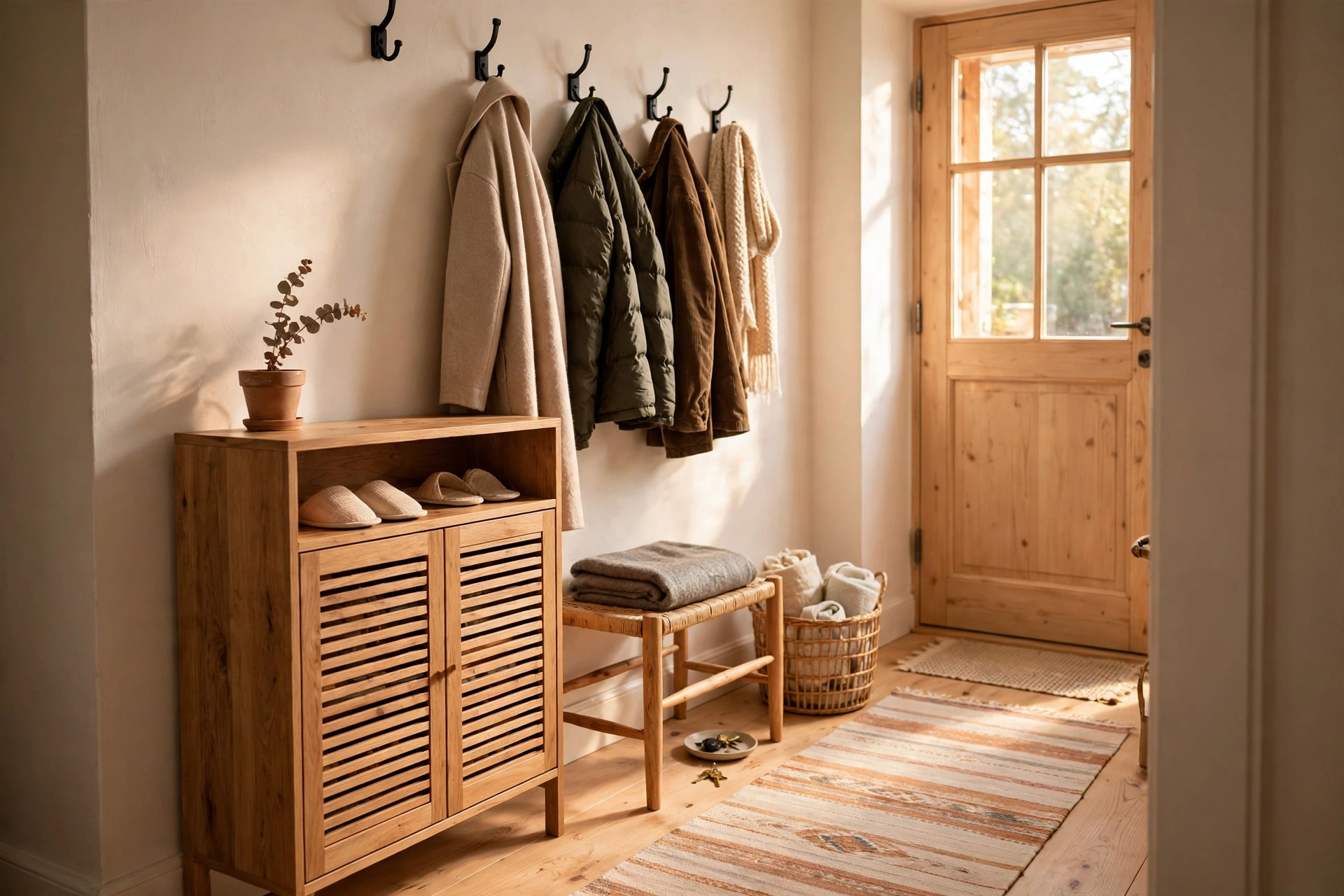
Small Entryway Organization Ideas for Apartments With No Mudroom
Disclosure: This post contains affiliate links. If you buy through them, we may earn a small commission at no extra cost to you. Read our affiliate disclosure.
These small entryway organization ideas work for apartments with no mudroom, no foyer, and sometimes no wall to spare. If your front door opens straight into the living room, you already know the pattern. Shoes pile up by the door, keys vanish into a bowl that is not a system, coats land on the nearest chair, and mail migrates to the kitchen counter. The entry is not messy because you are messy. It is messy because it has no system, and a small space punishes that faster than a big one.
The fix is not a mudroom replica. You do not need built-ins, a bench wall, or a renovation. You need a small system that fits the space you actually have: one drop zone, one shoe rule, one coat plan, and measurements taken before anything is bought. That order matters. Furniture bought first and measured later is how narrow entries end up blocked by the very pieces meant to organize them.

Small Entryway Organization Ideas That Fit Your Space
Start with the tape measure, not the shopping cart. A depth-first checklist from nestsorted puts it plainly: in a narrow hall, keep pieces around 10 to 14 inches deep, under 10 inches for very tight halls, and preserve roughly 36 inches of walkway. That one rule eliminates half the furniture you might otherwise buy, and it is the reason this guide organizes picks by depth before anything else.
Walk the route before you buy anything. Open the front door fully and walk the path people actually take, carrying a bag, in wet shoes, with groceries. Check that the door, closet doors, and any drawers open fully past the piece. A slim cabinet that technically fits the wall is not a good buy if it makes passing through the doorway awkward. NestTidy’s walkway and door swing rule says the same thing: keep the entrance functional before trying to maximize storage.
Measure four things and write them down: the wall run you have, the depth from the wall to the edge of the walkway, the door swing arc, and the height of your tallest boots if they will live here. Then use the depth bands below to shop.
- Under 10 inches deep: tilt-out shoe cabinets, wall rails, over-door hooks, key holders. This is the ultra-narrow band, and it is where most apartment entries live.
- 10 to 14 inches deep: narrow consoles, shoe benches, and slim hall trees. Fine for standard small entries, but only if the walkway stays clear.
- Over 14 inches deep: skip it unless your hallway is genuinely wide. Deep furniture in a narrow entry costs more walkway than it returns in storage.
Then run the 24-inch test. A footprint 24 inches wide by 12 inches deep can hold a key hook, two coat hooks, and a small shoe cabinet. That is not comfortable, but it is functional, and it is the minimum viable entry. If you have less wall than that, the back of your front door is your entry, and the over-door picks below are built for exactly that case.
Build a Drop Zone on One Wall
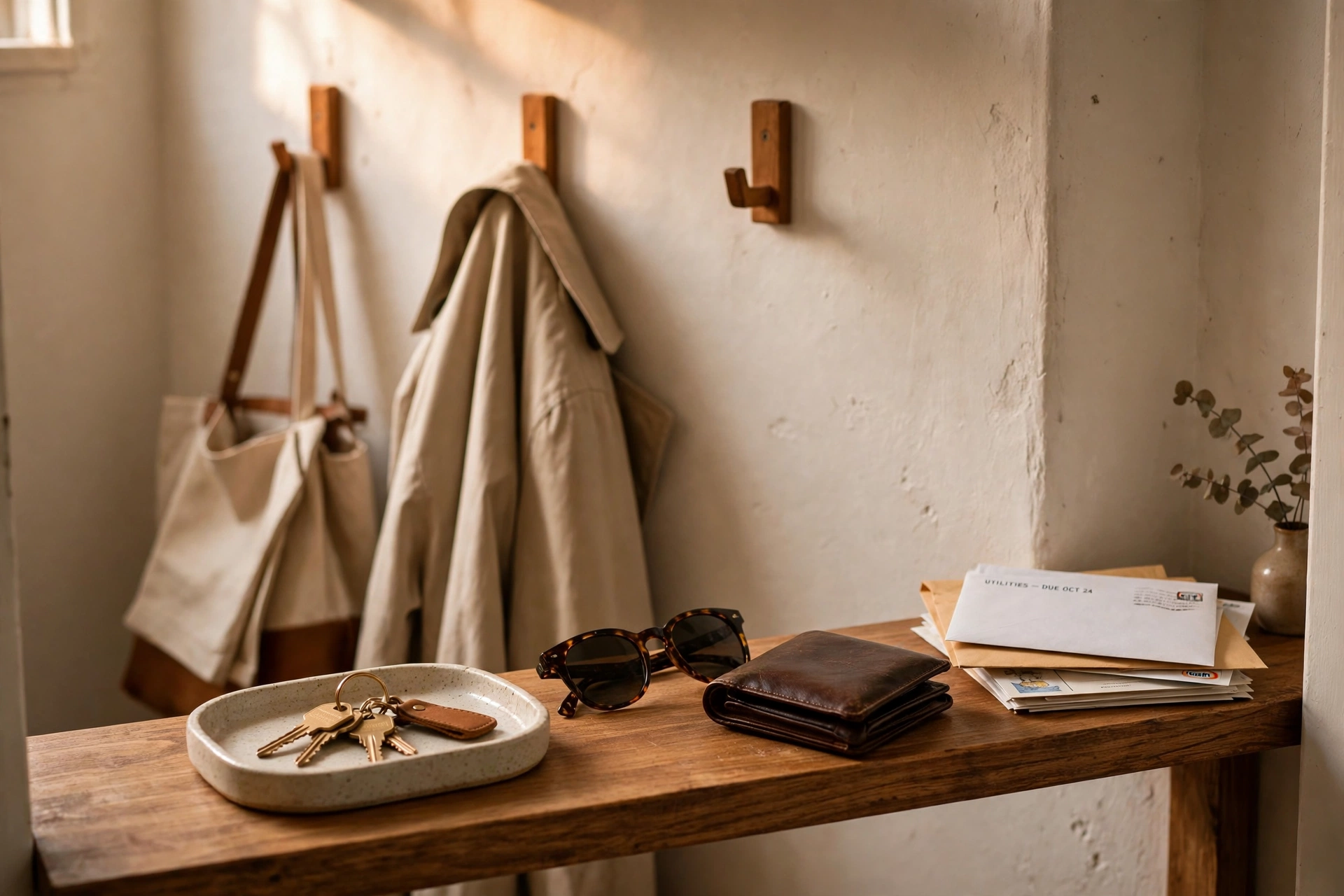
A drop zone is one surface, one hook, and one container in the same spot by the door. That is all it needs to be. Keys, wallet, sunglasses, and the bag you carry daily land here, and outgoing mail gets one small spot so it stops colonizing the kitchen counter. The top of a slim shoe cabinet, a narrow console, or a small wall shelf all work as the surface. What matters is that everything has one obvious landing place, and that the landing place is between the door and the rest of the apartment, so using it is easier than dropping things on a chair.
Give mail a same-day rule. Junk mail leaves the day it arrives, and everything else gets opened or filed within a day. A small basket for tomorrow’s things, returns, library books, the parcel you need to post, stops the morning scramble and stops those items from living on the entry floor. If your door opens straight into the living room, choose a setup that visually blends with the room. A simple shelf and a few hooks feel lighter than bulky entryway furniture, and they keep the entry from looking like a storage room that happens to have a door in it.
If the whole apartment needs the same treatment, start with our declutter guide first. An entry system built on top of too much stuff will fill up again within a week, no matter how good the furniture is.
Shoes: The Today-Only Rule
Most small entryway organization ideas fail on shoes, because they try to store every pair at the door. A small entry cannot hold a shoe collection. It can hold today’s shoes, and that distinction is the whole system. Keep one everyday pair per person at the door, plus a weather pair only when the season demands it, and store everything else elsewhere. Seasonal rotation is not extra work. It is the work that keeps the entry from filling up again.
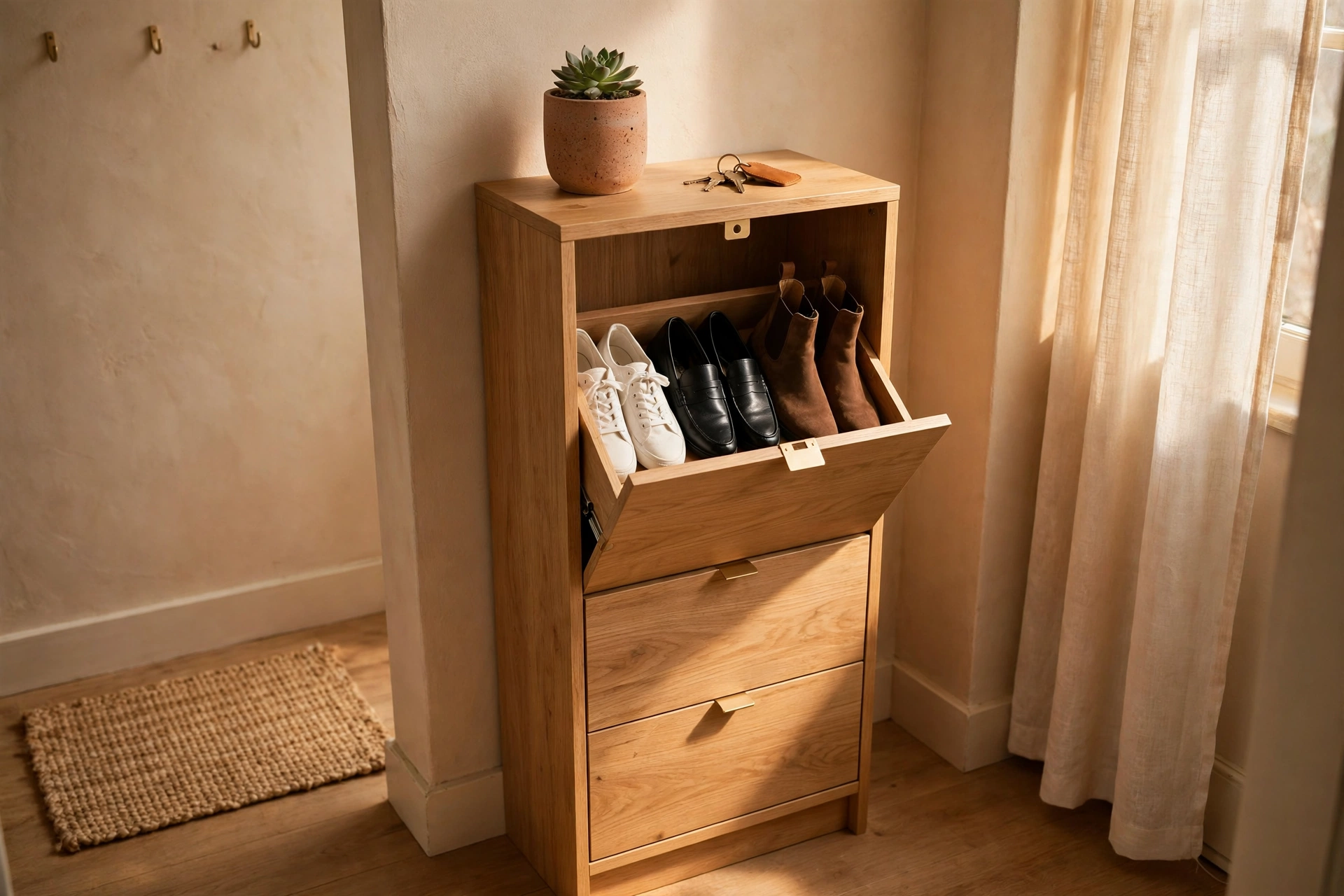
Closed storage beats open storage in a small entry. Four pairs on the floor read as clutter, while four pairs behind a closed cabinet front read as nothing at all. A tilt-out shoe cabinet hides 18 to 24 pairs in under 10 inches of depth, and its top doubles as the drop zone surface. An open bench is cheaper and gives you a seat, but it shows every shoe, so it needs tidying to look good. Pick the closed cabinet if the sight of shoes bothers you, and pick the bench if you need the seat for lacing up and do not mind seeing the shoes.
Wet shoes need their own plan. A rubber boot tray with a raised lip catches rain, snow melt, and mud before it reaches the floor, and it rinses clean under a tap. Put the tray where wet shoes actually land, not where it looks tidiest, or nobody will use it. And check boot height before buying a tilt-out cabinet. Very bulky boots may not fit the tilt-out drawers, and that is a frustrating discovery to make after assembly. Measure your tallest boots against the drawer height first.
Off-season shoes do not live at the door. They live in the closet, and our small closet organization guide shows how to fit them there without losing them.
Coats and Bags Without a Closet
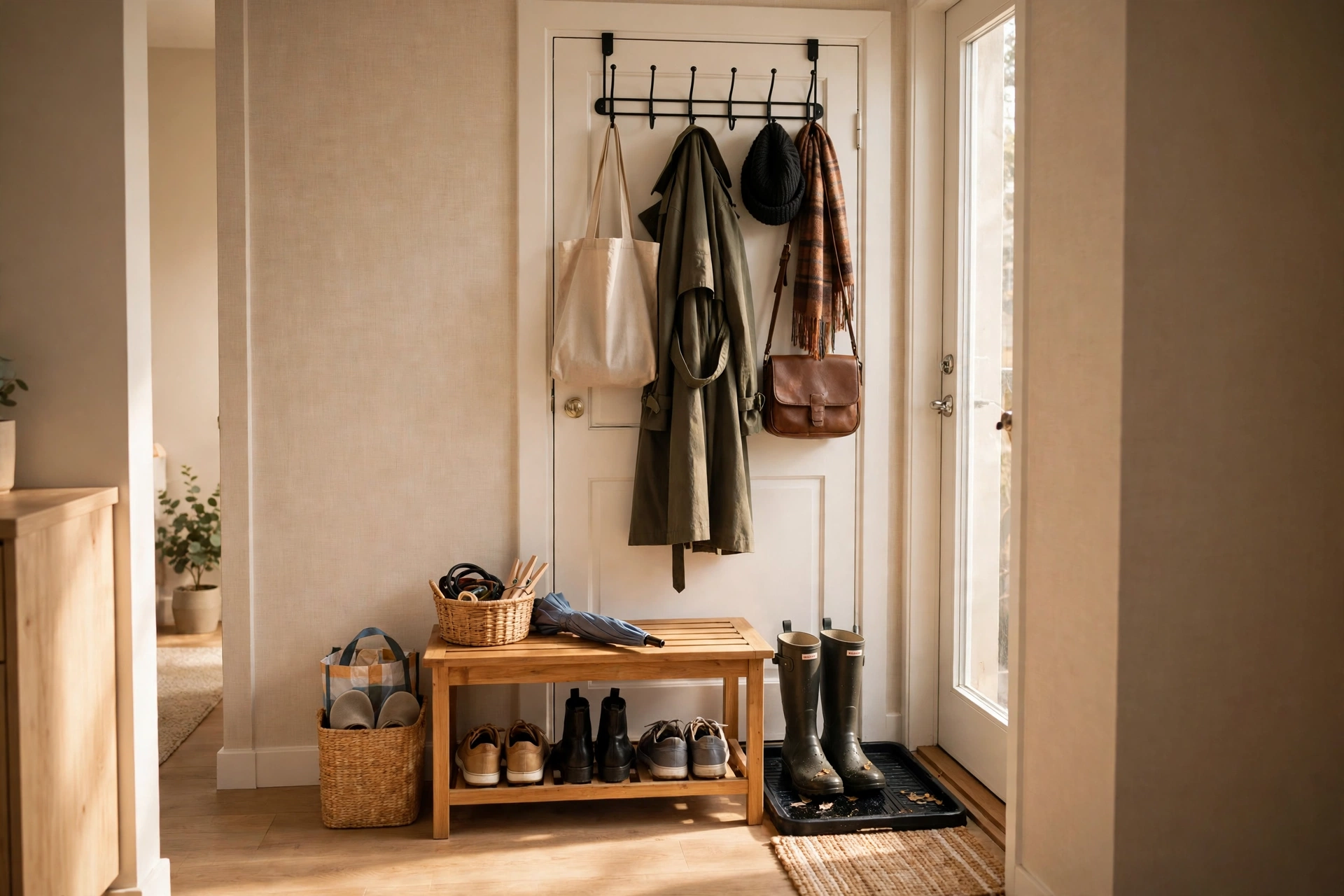
Without a coat closet, coats need one of three homes: a hall tree, a wall rail, or the back of the door. A hall tree solves coats, shoes, and seating in one footprint, and it is the best single purchase if you have about 28 inches of wall and no closet at all. A wall rail with fold-away hooks is the lightest option. It holds five coats on 20 inches of wall and disappears when the hooks fold back. The back of the door is free storage you already own, and an over-door hook rack turns it into coats, bags, and leash storage without touching a wall.
Renters should work down a ladder, not jump to drilling. Freestanding pieces come first, because they move with you at the end of the lease. Over-door organizers come second, because they leave zero marks, but check two things: the door thickness, most fit standard 1 3/8 inch to 1 3/4 inch doors, and the latch, because hooks that are too thick can stop the door from closing. Test the latch before you load the hooks up. Adhesive hooks come last, and only for light items. A large Command hook holds up to 5 pounds each, which is fine for keys, a dog leash, and a light bag, but not for a wet winter coat. Clean the surface with rubbing alcohol first, wait seven days after painting before sticking anything, never use them on wallpaper, and test one on a hidden corner first, because some paint finishes react differently to adhesive.
Anchor anything tall. Hall trees and shoe cabinets come with anti-tip kits for a reason, and that reason gets more important with kids or pets in the house. A tall cabinet that tips when a drawer is pulled open is a safety problem, not a storage solution. Use the kit, even if the piece feels stable when empty.
For the rest of the home’s storage, our best storage products for small apartments covers the pieces that work beyond the entry.
The 12 Picks for Small Entryways
Every pick below fits the depth rules above, and every link is a price-check link, so you see the current price on Amazon before deciding. Prices change, and several of these listings show no featured offers at times, so no prices are printed here. Check the listing for the price on the day you buy.
| Pick | Best for | Depth | Link |
|---|---|---|---|
| VASAGLE 4-in-1 Hall Tree | No closet at all | 13.3 in | Check price on Amazon |
| BORNOON 3-Flip Shoe Cabinet | Hiding shoes | 9.45 in | Check price on Amazon |
| SONGMICS Shoe Bench | Seating on a budget | 12.2 in | Check price on Amazon |
| HOOBRO Narrow Console | Tight hallways | 9.4 in | Check price on Amazon |
| Umbra Flip 5-Hook Rail | Small walls | 1.25 in | Check price on Amazon |
| Dseap Over-Door Hook | Zero wall space | Door mounted | Check price on Amazon |
| Lwenki Key and Mail Organizer | Keys and mail | 3.6 in | Check price on Amazon |
| SUPENUIN Boot Tray | Wet shoes | Floor tray | Check price on Amazon |
| Casafield Baskets, Set of 4 | Gloves and extras | 10.5 in cubes | Check price on Amazon |
| Command Large Utility Hooks | Renters, light items | Wall mounted | Check price on Amazon |
| EARTHALL Washable Runner 2×6 | Defining the zone | Floor rug | Check price on Amazon |
| SONGMICS Umbrella Stand | Wet umbrellas | 6.1 in square | Check price on Amazon |
1. VASAGLE 4-in-1 Hall Tree
Best for apartments with no entry closet at all. One piece gives you a bench, a shoe rack, a hanging rod, and 9 removable hooks in 2 rows, in a 28.3 inch wide footprint that suits most entry walls. The bench supports up to 198 pounds, the steel frame keeps it steady, and an anti-tip kit is included. At 13.3 inches deep, it sits at the top of the small-entry depth band, so measure your walkway before buying. Watch out: the surfaces are particleboard, not solid wood, and the open design shows everything you hang, so it needs regular tidying. Check price on Amazon.
2. BORNOON 3-Flip Shoe Cabinet
Best for hiding shoes in a narrow hall. At just 9.45 inches deep, this cabinet slides against a hallway wall without blocking foot traffic, while standing 47.2 inches tall to make up for the lack of width. Three flip drawers hold 18 to 24 pairs depending on shoe size, each drawer has a two-tier organizer with adjustable panels, and the top surface doubles as a mini console for keys. An anti-tip device is included. Watch out: very bulky boots may not fit the tilt-out drawers, and it must be anchored to the wall for safety. Check price on Amazon.
3. SONGMICS Shoe Bench
Best for small entries that need seating plus a few pairs of shoes. The 2 inch thick foam cushion with a breathable linen cover gives you a comfortable seat for lacing up, and two tiers hold about 8 pairs. At 12.2 inches deep and 31.9 inches wide, it keeps walkways clear, and the steel frame holds up to 300 pounds. Watch out: the open shelves show the shoes stored below, and 8 pairs will not be enough for a larger family, so pair it with a closed cabinet if you need more. Check price on Amazon.
4. HOOBRO Narrow Console
Best for tight hallways that need a landing spot for keys and mail. At 9.4 inches deep and 29.5 inches wide, it fits behind doors and in narrow halls, and it gives you a tabletop, two fabric drawers for private storage, and two lower shelves for baskets or shoes. The tabletop holds up to 88 pounds and each shelf up to 33 pounds. Watch out: the panels are particleboard rather than solid wood, and the 29.5 inch width is small for wide foyers, but for a small apartment entry that is exactly the point. Check price on Amazon.
5. Umbra Flip 5-Hook Rail
Best for small walls. This 20 inch wide rail is only 1.25 inches deep, and its five hooks flip down when you need them and fold back into the rail when you do not, so the wall looks clean instead of cluttered. It mounts with hidden hardware and suits coats, scarves, bags, and hats. Watch out: five hooks fill up fast in a family entry, so buy it for one or two people’s daily coats, not for the whole household’s outerwear. Check price on Amazon.
6. Dseap Over-Door Hook
Best for entries with zero wall space. Five triple hooks in stainless steel hang over the door with no drilling, no marks, and no tools beyond a simple assembly. The 9.25 inch long arm is longer than standard hooks, so coats are easy to reach, and protective pads stop noise and scratches on the door. It fits standard doors from 1 3/8 inches to 1 3/4 inches thick, with sponge strips for a tight fit on thinner doors. Watch out: test that the door still latches before you load the hooks, because hooks that are too thick can stop a door from closing. Check price on Amazon.
7. Lwenki Key and Mail Organizer
Best for ending the daily key search. This 16.5 inch wall organizer combines a shelf, a letter holder, and heavy-duty hooks in one piece, and it supports up to 20 pounds with the included wall anchors. The letter holder is 8.3 inches wide and 5.5 inches deep, and the 7.9 inch shelf holds a phone, sunglasses, and wallet. Watch out: it needs screws and wall anchors, so it is not a renter-friendly no-drill pick. If you cannot drill, use the Command hooks below for keys and a small tray for mail instead. Check price on Amazon.
8. SUPENUIN Boot Tray
Best for wet shoes and muddy boots. This 27.5 by 16 inch rubber tray has a 0.8 inch raised lip that holds water, mud, and snow melt, a textured surface that keeps shoes stable, and built-in handles for carrying it outside to empty. It is an Amazon’s Choice pick with heavy buyer volume behind it. Watch out: at 27.5 inches wide it needs a real stretch of floor, so measure before buying, and remember it is a tray, not a shoe rack, so it works best under a bench or beside the door rather than as the only shoe storage. Check price on Amazon.
9. Casafield Baskets, Set of 4
Best for gloves, hats, scarves, and the in-between things that have no other home. Four 10.5 inch water hyacinth cubes with dual handles and a sturdy metal frame slide onto console shelves or sit on the floor by the door, and they fold flat when not in use. Natural texture makes them look intentional rather than cluttered. Watch out: they are indoor only, so keep them away from wet shoes and umbrellas, and dust them rather than washing them. Check price on Amazon.
10. Command Large Utility Hooks
Best for renters who need hooks without holes. Seven hooks and twelve adhesive strips, each hook holding up to 5 pounds, with damage-free removal that leaves no marks or sticky residue. They work on painted walls, finished wood, glass, metal, and tile. Watch out, and this matters: 5 pounds is a light-item limit. Keys, a leash, and a light bag are fine. A wet winter coat is not, and hanging one will end with the coat on the floor. Follow the prep steps, clean with rubbing alcohol, wait seven days after painting, and never use them on wallpaper. Check price on Amazon.
11. EARTHALL Washable Runner 2×6
Best for defining the entry zone and catching dirt. A 2 by 6 foot cotton runner with a non-slip rubber backing, a low 0.23 inch pile that fits under most doors, and a machine washable build that matters more in an entryway than almost anywhere else in the house. The braided cotton blend does not trap dirt, and the rubber backing keeps it in place in high traffic. Watch out: like most washable runners, it may arrive with creases that take time to relax, and it is thin by design, so do not expect plush wool softness. Check price on Amazon.
12. SONGMICS Umbrella Stand
Best for wet umbrellas in a tiny footprint. At just 6.1 inches square and 16.1 inches tall, this steel stand fits corners that nothing else fits, and it comes with a detachable drip tray so rainwater never reaches the floor, plus four hooks for folding umbrellas. It is a number one Best Seller in umbrella stands. Watch out: the small footprint means it holds a handful of umbrellas, not a family’s full collection, so keep only the daily umbrellas here and store the rest elsewhere. Check price on Amazon.
Three Setups for Three Spaces
These small entryway organization ideas work best as complete setups, not as single purchases. Pick the setup that matches the wall you actually have, and buy only that setup to start. You can always add a piece later, but a system that starts simple is a system that gets used.
Setup A: 24 inches of wall. A Flip rail for coats, a key holder or small tray for keys and mail, and a boot tray on the floor for today’s shoes. That is the whole entry, and it works, because every item has exactly one home and nothing else is allowed to live there.
Setup B: 3 feet of wall. A HOOBRO console for the drop zone, a Flip rail above it for coats, and a BORNOON cabinet beside it for shoes. Add a runner to define the zone and a basket on the console shelf for gloves and extras. This is the setup most small apartments should aim for.
Setup C: No wall at all. A Dseap over-door rack for coats and bags, a SONGMICS bench for shoes and seating, a boot tray under the bench for wet days, and a runner to mark the zone. Nothing is drilled, nothing is permanent, and the whole system moves with you.
Mistakes That Make a Small Entry Feel Smaller
Buying furniture before measuring is the most expensive mistake, because the wrong piece costs both money and walkway. Keeping too many shoes by the door is the most common one, because every extra pair is visual clutter that no organizer can hide. Overloading one wall is the sneakiest, because hooks help right up until the wall looks like a coat shop, and then the narrow entry feels smaller than it did with nothing on the wall. Deep furniture, a giant miscellaneous basket with no purpose, and adhesive hooks loaded past their weight limit round out the list. Every one of these mistakes is fixable in an afternoon, and every one of them is avoidable by measuring first and limiting what lives at the door.
Frequently Asked Questions
How do you organize a small entryway with no mudroom?
Start with these small entryway organization ideas: one drop zone on one wall, a shoe rule that keeps only today’s pairs at the door, and a coat plan that fits your wall, whether that is a hall tree, a wall rail, or the back of the door. Measure the walkway and door swing before buying anything, and keep only daily essentials at the entry.
How many shoes should stay by the front door?
One everyday pair per person, plus a weather pair only when the season demands it. Everything else lives in the closet or bedroom. If the shoe zone keeps overflowing, the limit is wrong or the storage is too small, and the fix is fewer pairs at the door, not a bigger rack.
What is the best shoe storage for a tiny entryway?
A tilt-out shoe cabinet under 10 inches deep is the best all-round pick, because it hides shoes behind closed fronts without eating walkway. If you need a seat, a slim shoe bench works, but it shows the shoes. If you have almost no floor space, a boot tray for today’s pairs plus closet storage for the rest is the honest answer.
How do renters organize an entryway without drilling?
Use freestanding pieces first, over-door organizers second, and adhesive hooks last and only for light items. A bench, a shoe cabinet, and an over-door rack give you a complete entry with zero holes. Adhesive hooks hold up to 5 pounds each, which covers keys and light bags but not winter coats.
What depth furniture fits a narrow hallway?
Keep pieces around 10 to 14 inches deep, and under 10 inches for very tight halls, while preserving roughly 36 inches of walkway. Always check that the front door and any drawers open fully past the piece before you commit.
How do I stop the entryway from getting messy again?
Keep the system simple and run a 30 second reset each evening: shoes back in their home, mail handled, tomorrow’s things in the basket. Seasonal rotation, moving off-season coats and shoes out of the entry, is the habit that prevents the slow refill.
Do I need a bench in a small entryway?
No. A bench is useful if you have room and want a seat for lacing up, but hooks, a tray, or narrow shoe storage work better in tighter spaces. Skip the bench if it costs walkway you cannot spare.
Final Thoughts
These small entryway organization ideas come down to one thing: a small entry does not need a mudroom. It needs measurements taken first, a drop zone on one wall, a shoe rule that keeps only today’s pairs at the door, and a coat plan that respects your lease. Buy the setup that matches the wall you have, anchor anything tall, and let the entry stay simple enough to maintain on an ordinary busy day. That is how a patch of wall by the front door becomes an entryway that actually works.
If your door opens straight into the living room, our living room layout guide shows how to arrange the room it opens into, so the entry and the living space work as one small home instead of fighting each other.