
Disclosure: As an Amazon Associate, Nook & Nest Living earns from qualifying purchases made through links on this page, at no extra cost to you. Prices change often, so always check the current price on Amazon before you buy.
Best Room Dividers for Small Apartments (That Don’t Shrink the Room)

The best room dividers for small apartments do one job above all else: they make one room behave like two rooms without making it feel like half a room. That sounds simple, but most dividers fail it. A screen that is too tall blocks your only window light. A bookshelf that is too deep eats the walkway. A curtain that needs ceiling screws gets you in trouble with your landlord. The divider itself is rarely the problem. The measurements are.
This guide fixes that. You will get a simple 4-measurement test to run before you buy anything, then 12 picks that passed it, each with real dimensions and an honest note about drilling, light, and floor space. No prices are printed here on purpose, because Amazon prices move daily. Every pick links to its current listing so you can check the price on the day you buy.
The 4 Measurements That Pick the Right Room Dividers for Small Apartments
Most guides to room dividers for small apartments show you pretty photos and stop there. This one starts with a tape measure, because in a small apartment the wrong divider costs you something you cannot buy back: floor space and daylight. Run these four measurements before you order, and you will avoid the three most common regrets: a divider that is too short to give privacy, too deep to walk past, or too dark to live with.
1. Span: the exact width you must cover. Measure wall to wall, or from the wall to the edge of the zone you want to close off, at the height where the divider will actually stand. Folding screens cover a fixed width: panel width times the number of panels. Curtains cover any span up to the rod or track length. A floor-to-ceiling column covers one fixed width, so it suits a partial boundary, not a full wall. Never guess the span from a photo. Measure it.
2. Open footprint: the floor the divider eats while you use it. This is the measurement everyone skips. A folding screen opened in a zigzag takes more floor than its folded width suggests. A bookshelf costs you its full published depth, every day. A curtain costs you almost nothing, because it hangs in a line. One renter guide puts it bluntly: a well-known cube shelf unit is 15 3/8 inches deep, and that entire depth comes straight out of your usable room width before you count any walkway at all. Check the published depth of every furniture divider, and mark it on your floor with painter’s tape before you buy.
3. Walkway left over: the path you still need. After the divider goes in, you still have to walk from the door to the kitchen to the bed without turning sideways. Keep at least 24 inches clear on a side path, and 36 inches on the main route through the apartment. If the divider leaves you less than that, it is too big for the spot, no matter how good it looks. Walk the route with the tape outline on the floor, with doors and drawers open, before you commit.
4. Height and light: privacy versus daylight. This is the real tradeoff in a small apartment. A 46-inch screen zones a space while keeping sightlines and light. A 71-inch screen gives real visual privacy but blocks more light. A blackout curtain gives total privacy and total darkness on that side of the room. A woven rattan screen or a translucent shoji panel sits in the middle: they block the direct view while letting light and air through. Decide which side of that tradeoff you actually live with. If your apartment has one window, a light-filtering divider is almost always the better buy than a blackout one.
Two honest limits apply to every divider on this list. First, no lightweight divider blocks sound. A screen or curtain hides the bed from view, but it will not stop conversation, television noise, or a snoring partner. Any listing that promises real soundproofing from a fabric panel is overselling. Second, a divider is a visual boundary, not a new legal room, and it must never block your exit route, your ventilation, or sprinkler coverage. Keep the path to your front door clear, keep fabric away from heaters and cooking areas, and if a divider is tall furniture, follow its anchoring instructions and keep the heaviest items on the lowest shelves.
One more rule, and it is the one that saves renters the most money: no-drill first. Freestanding screens, tension frames, and furniture dividers need no permission. Ceiling tracks need screws, so they need landlord permission first. This guide labels every pick either way, so you never find out after delivery.
The 12 Best Room Dividers for Small Apartments
Every one of these room dividers for small apartments states its real dimensions, its light behavior, and whether it needs drilling. Picks are grouped by type: folding screens first, then curtain systems, then furniture dividers, then floor-to-ceiling columns, then one closet-style divider for studios with no closet at all.
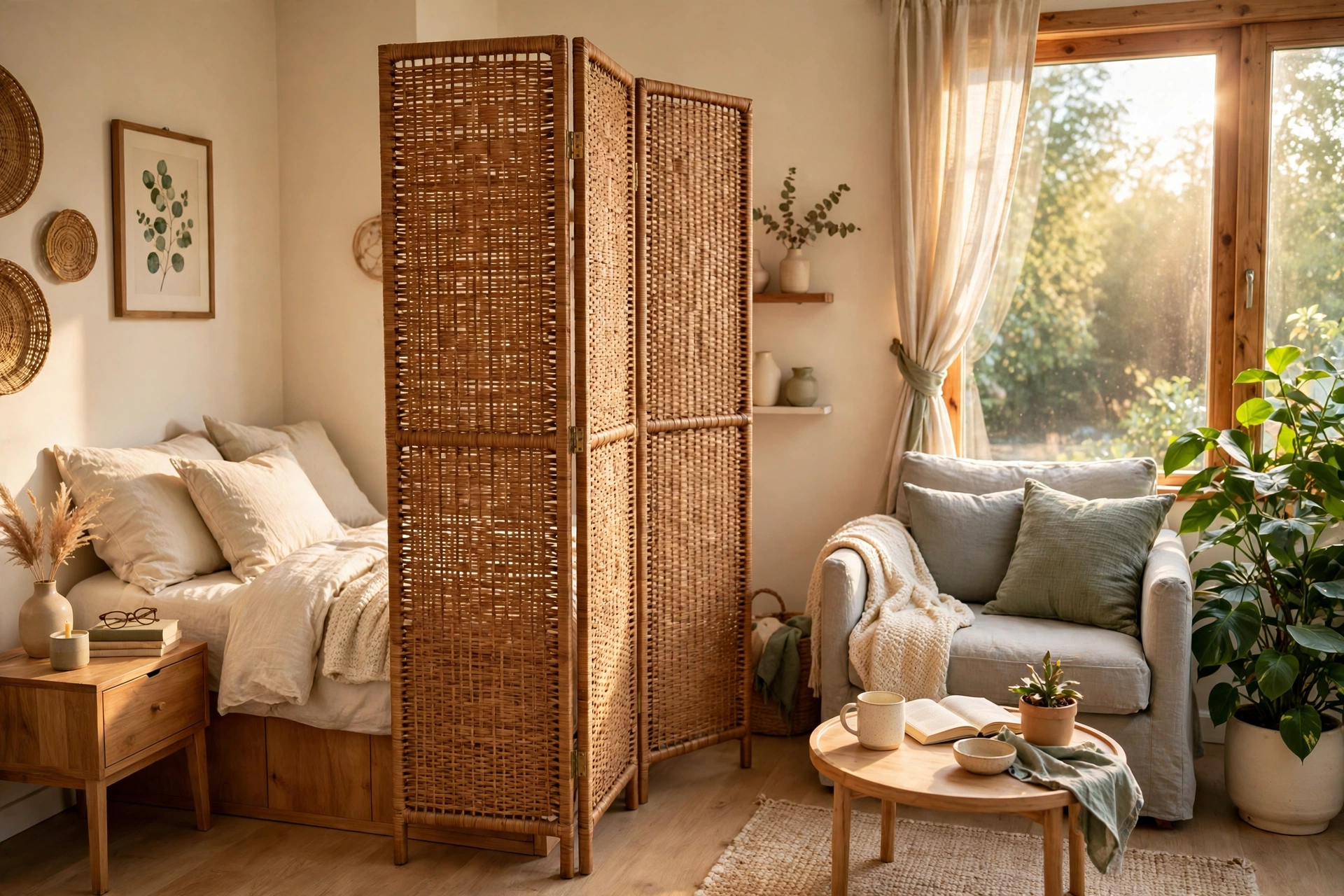
1. Asnefeli 3-Panel Hand-Woven Rattan Room Divider
If you want full-height privacy that still breathes, start here. This is a tall woven rattan screen on a solid wood frame, standing 70.8 inches high and 45.6 inches wide across three panels. The weave blocks the direct view of the bed or desk behind it, but air and some light still pass through, so the divided side does not turn into a dark box. Two-way hinges let the panels fold in either direction, and the whole screen folds flat when you do not need it.
Best for: hiding a bed in a studio, or closing off a dressing corner. The 70.8-inch height is close to eye level and above for most people, so it reads as a real boundary, not a suggestion. Measure your span first: at 45.6 inches wide it covers a sleeping nook or a partial boundary, not a full wall-to-wall span. If your span is wider, you need two screens or a curtain system instead.
Asnefeli 3-Panel Hand-Woven Rattan Room Divider
Check the current price on Amazon
2. HALLYBEE Small 3-Panel Rattan Divider
Sometimes you do not need privacy. You need the room to make sense. This short rattan divider stands 46 inches high and 48 inches wide, which is exactly the height that defines a zone without closing it off. From a chair you can still see over it, daylight still crosses the room, and the space still feels like one apartment. It is freestanding, lightweight, and double-hinged, so it folds away in seconds.
Best for: separating a reading corner from a living area, marking the edge of a dining spot, or giving a work-from-home corner a boundary without building a wall around yourself. The honest limit is the height: at 46 inches it will not hide a bed from a standing guest. Buy it for zoning, not for changing behind.
HALLYBEE Small 3-Panel Rattan Divider
Check the current price on Amazon
3. Legacy Decor 3-Panel Shoji Screen
This is the light-lover’s divider. A wood frame with translucent rice-paper-style inserts stands 71 inches high and 52 inches wide, and it glows rather than blocks. Daylight filters through the panels, so the sleeping side stays bright while the bed itself disappears from view. It arrives fully assembled, needs no drilling and no tools, and folds flat for storage.
Best for: studios with one window, where a solid screen would steal the light. The tradeoff is real: translucent panels give privacy from a normal viewing distance, but a strong light behind them will show a silhouette. If you need total visual blackout for changing clothes, pair this with a curtain, or choose a blackout curtain system instead. If you want daylight and a calmer-looking room, this is the pick.
Legacy Decor 3-Panel Shoji Screen
Check the current price on Amazon
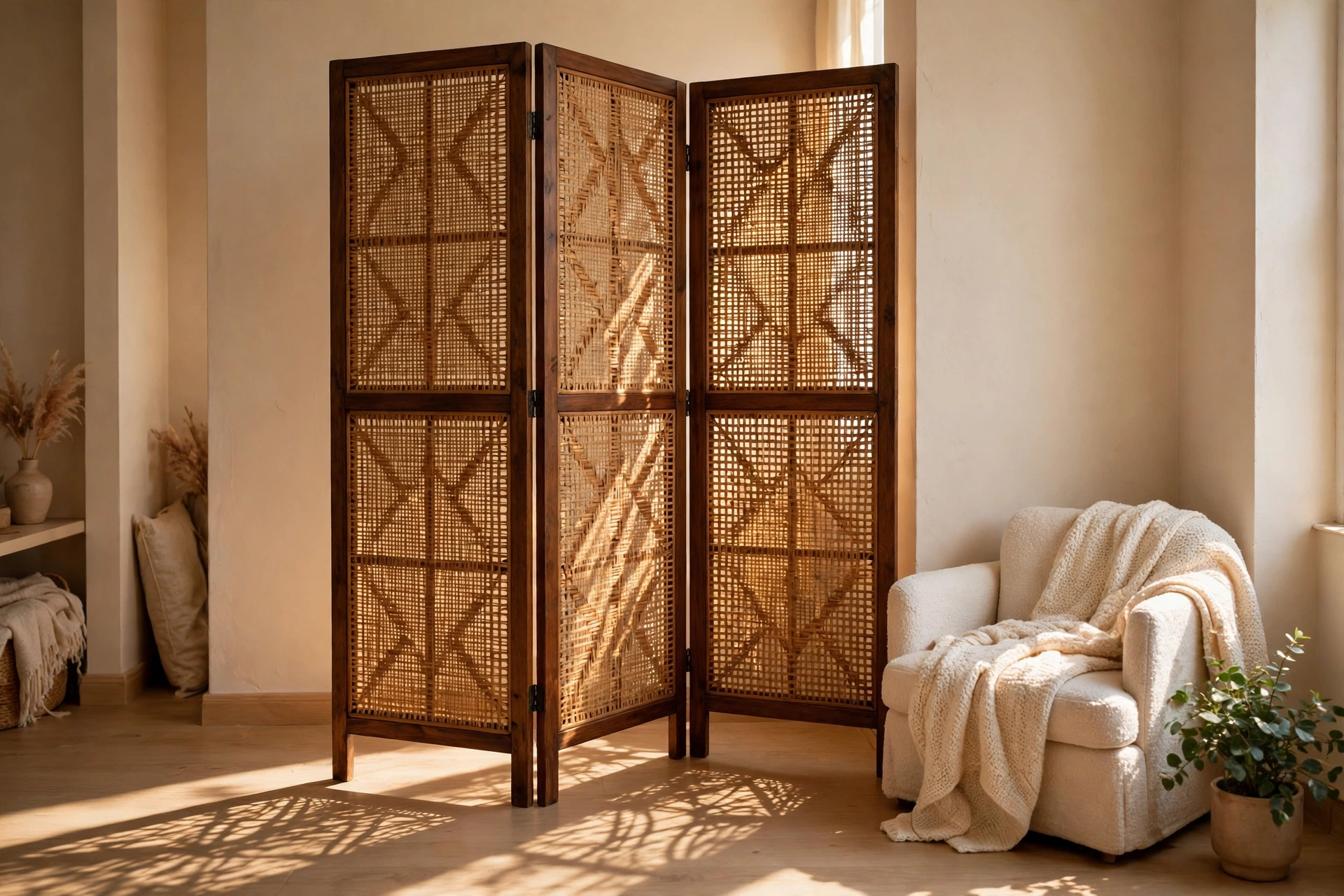
4. HORSE SECRET No-Drill Room Divider Curtain Rod Frame
This is the most renter-friendly way to get a full curtain wall, and it is also the pick most people buy wrong, so read this one carefully. What you get is a stainless steel tension frame: vertical poles that press floor to ceiling, plus a horizontal rod to hang curtains from. It adjusts from 4 to 10 feet high and from 28 to 171 inches wide, and each horizontal rod holds up to 45 pounds without sagging. No drilling, no holes, no landlord conversation. It goes up and comes down in minutes.
What you do not get is curtains. The listing states clearly that curtains are sold separately, and this is the mistake to avoid: order your curtain panels at the same time, in a fabric weight the frame can hold, or you will own a bare frame for a week. Best for: a full bed wall in a studio, an L-shaped corner nook, or a wide span that no folding screen can cover. If you are building a sleeping zone in a studio, this pairs naturally with the layout ideas in our studio apartment guide, where the bed zone is the first thing to get right.
HORSE SECRET No-Drill Room Divider Curtain Rod Frame
Check the current price on Amazon
5. Hoeflife Blackout Room Divider Curtain with Flexible Ceiling Track
If you want the curtain to slide like a real wall, this is the system: a blackout curtain plus a flexible, bendable ceiling track, with hooks, pulleys, end caps, and brackets included. The largest size spans 180 inches wide and 120 inches long, so it covers spans a tension frame cannot reach cleanly, and it bends around corners for L-shaped layouts. Closed, it gives full visual privacy. Open, it stacks to one side and the room is whole again.
The honest label on this one is drilling. A ceiling track screws into the ceiling, so this is not a no-drill pick. Check your lease and get landlord permission before you order, and confirm your ceiling type first, because popcorn and textured ceilings need different fixings. Best for: owners, or renters whose landlord allows small patchable screw holes. If drilling is off the table, pick 4 above instead and accept a straight span.
Hoeflife Blackout Room Divider Curtain with Flexible Ceiling Track
Check the current price on Amazon
6. VEVOR Panel Track Blinds
Sliding panels are the neatest solution for a wide opening, because they stack flat instead of bunching like a curtain. This set extends its track from 45.8 to 86 inches wide, and the blackout polyester panels trim to 96 inches high, so you can fit both standard ceilings and taller spans. The panels glide on the track, which means you open only as much as you need: half open for airflow, fully closed for privacy.
Best for: covering a wide studio opening, a patio door that doubles as a room boundary, or a work zone you want to close during calls and open the rest of the day. Like pick 5, this is a mounted track system, so confirm mounting permission and measure your span at the track height, not at the floor, because walls are rarely perfectly straight. For a home office corner that needs closing off, this is the cleanest-looking option on the list, and it sits well with the chair-first layout in our small home office corner guide.
VEVOR Panel Track Blinds
Check the current price on Amazon
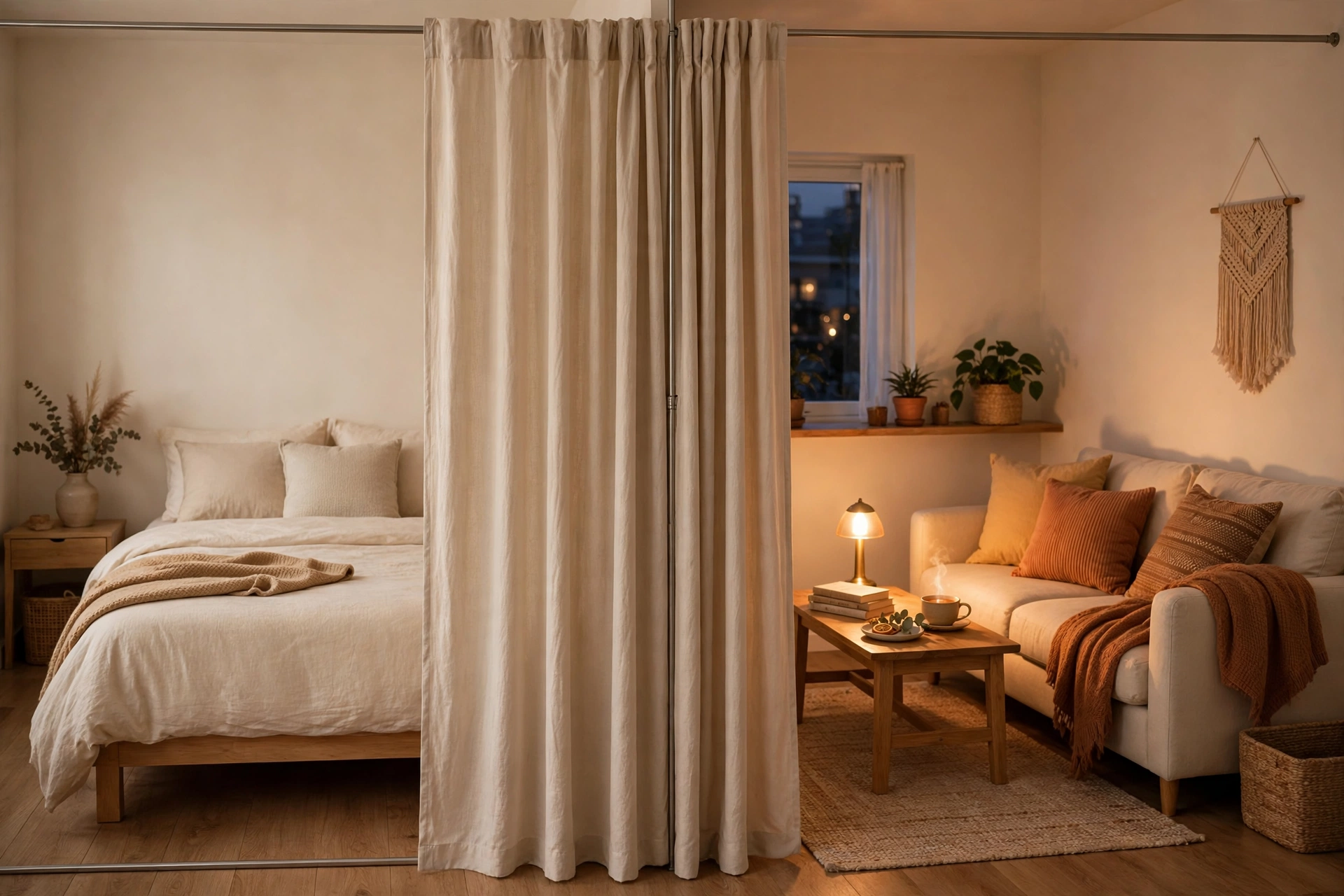
7. Furinno 6-Cube Open Back Organizer
This is the divider that pays rent twice: it divides the room and stores your life. The open-back cube unit measures 43.8 inches wide, 14.6 inches deep, and 30 inches high, with six open compartments you can fill with books, baskets, and plants. Because the back is open, light still passes through, which is the whole reason an open shelf beats a solid bookcase as a divider. It also reverses to stand horizontally or vertically, so the same unit can be a low boundary or a taller one.
Best for: splitting a living area from a sleeping area while gaining storage you were going to buy anyway. At 30 inches high it zones rather than hides, so pair it with a taller screen or curtain if you need real bedroom privacy. Keep the heaviest items in the bottom cubes to keep the center of gravity low, and if you stand it vertically, follow the anchoring instructions, because tall furniture tips. A renter guide to studio dividers makes the same point about cube units: measure the finished depth, then check the walkway that remains, before you buy.
Furinno 6-Cube Open Back Organizer
Check the current price on Amazon
8. Giantex 47-Inch Geometric Bookshelf
If floor space is your scarcest resource, this is the thinnest divider on the list. The geometric bookshelf is 27.5 inches wide, 47 inches high, and only 8 inches deep, with 11 open shelves and anti-tip kits included. Eight inches is barely more than a hardback book, which means this divider costs you almost no walkway at all, and it still breaks the sightline between zones because of its height and its staggered shelf pattern.
Best for: narrow studios and tight passages where a 14-inch cube unit would block the route. At 27.5 inches wide it covers a partial boundary, not a full span, so use it where the goal is to interrupt the view, not to close a room. Think foot of the bed, side of a desk, or the edge of a reading chair. The anti-tip kits matter here: a tall, narrow unit is the easiest thing in this guide to knock over, so anchor it or keep it somewhere nobody brushes past in the dark.
Giantex 47-Inch Geometric Bookshelf
Check the current price on Amazon
9. SageNest 8-Cube Low Storage Organizer
A low divider is an underrated move in a small apartment, because it defines zones without ever making the room feel smaller. This 8-cube unit is 47.68 inches wide, 11.61 inches deep, and only 24 inches high, which puts it below eye level from any seat in the room. You get eight open compartments for books, baskets, and everyday clutter, a surface on top for a lamp or a plant, and a clear boundary between the sofa side and the bed side.
Best for: open-plan studios where the problem is not privacy but order: the bed area bleeding into the living area with no edge between them. It also works as a room boundary behind a sofa, which is the same trick our small living room layout guide uses to give a seating area a back wall without building one. The limit is honest: at 24 inches high, this hides nothing. It organizes. If you need to hide the bed, combine it with a screen or curtain from earlier in this list.
SageNest 8-Cube Low Storage Organizer
Check the current price on Amazon
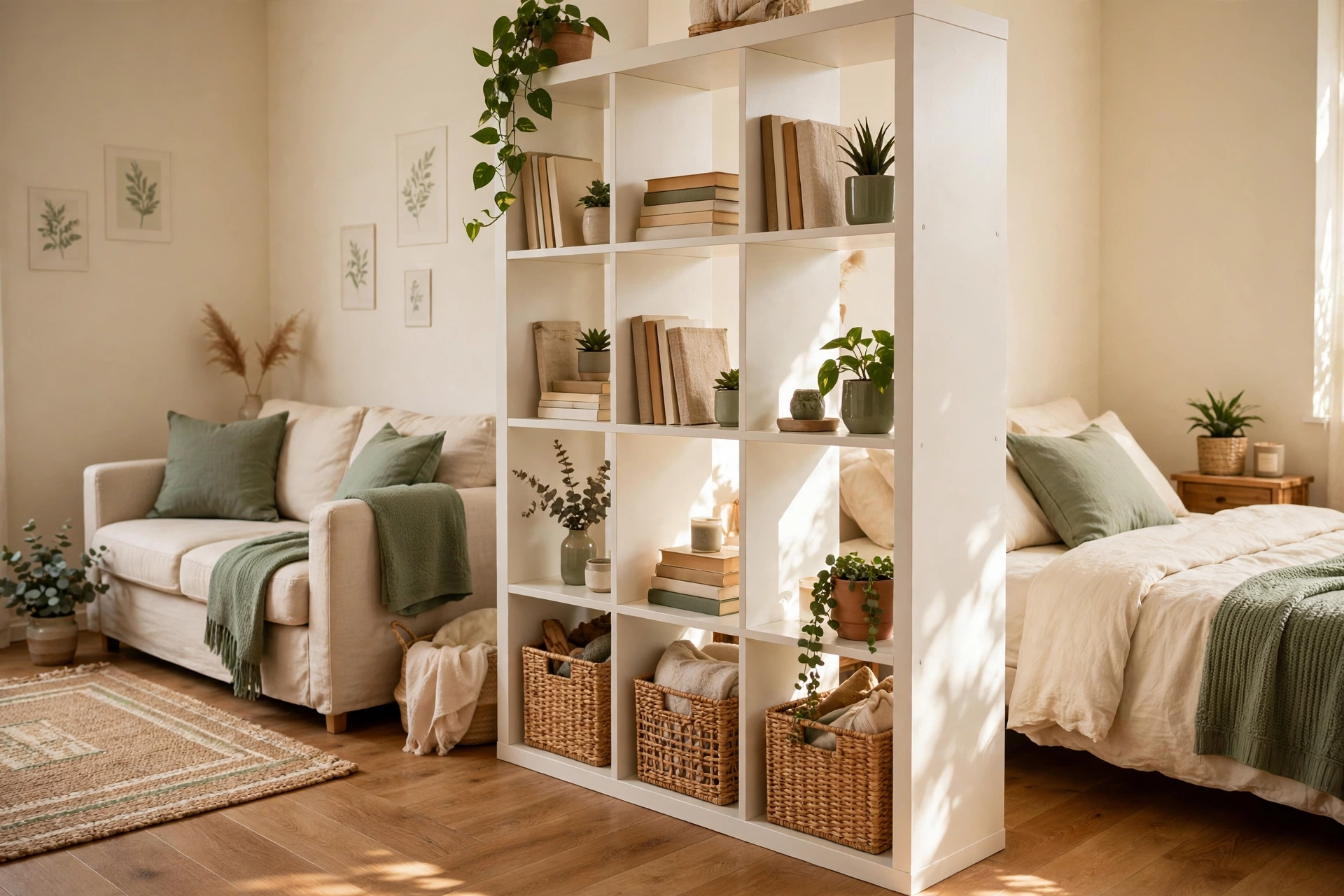
10. XDOPIRRS Floor-to-Ceiling Wood Room Divider with Storage Cabinet
Some dividers look like furniture. This one looks like architecture. A floor-to-ceiling wood column screen, 79.5 inches high and only 9.4 inches deep, with a built-in storage cabinet, available in widths from 31.5 to 55.1 inches. The modular construction needs no drilling, and a raised base keeps the bottom clear of damp floors while adding stability. It reads as a deliberate wall segment rather than a temporary screen, which is exactly what an open-plan room needs when it feels unfinished.
Best for: defining an entrance zone, splitting a long living room, or giving a studio a permanent-looking boundary you can still take with you when you move. At 79.5 inches it reaches near most ceilings without touching them, so check your ceiling height before ordering: in a room with a low ceiling it can look oversized, and in a room with a very high ceiling it leaves a gap that breaks the illusion. Measure floor to ceiling, not just wall to wall, for this one.
XDOPIRRS Floor-to-Ceiling Wood Room Divider with Storage Cabinet
Check the current price on Amazon
11. QJHK Slatted Partition Column with Shelves
Vertical slats are the divider trend that refuses to go away, because they solve the small-apartment problem better than most solid options: they block the direct view while letting light and air straight through. This freestanding column stands 78.7 inches high and 9.4 inches deep, in widths from 31.5 to 55.1 inches, with open shelves built in for books and decor and a choice of seven finishes. Seen from the side it reads as a wall. Seen straight on, light passes between the slats and the room stays bright.
Best for: entryways and living areas where you want structure without darkness. The listing positions it as an entrance hall partition, and that is a smart use: a slatted column at the door gives guests a finished first view instead of a straight sightline into the bedroom, which is the same problem our small entryway organization guide solves with storage. Keep the shelves light on top and heavier below, and treat it as furniture that needs a level floor, not as a wall you can lean on.
QJHK Slatted Partition Column with Shelves
Check the current price on Amazon
12. VECELO Freestanding Garment Rack
Not every studio has a closet, and a garment rack used as a divider is the cheapest honest fix for that. This freestanding rack is 35.4 inches wide, 11.6 inches deep, and 55 inches high, with five shelves and a hanging rod, holding up to 350 pounds. Place it perpendicular to the wall at the edge of the sleeping zone, hang your everyday clothes on it, and the bed area instantly reads as a dressing area instead of a bed in the middle of the living room.
Best for: studios with no closet, guest corners, and anyone whose wardrobe is currently living on a chair. Hang a simple curtain over the front and it becomes a closed closet wall for guests, which pairs well with the closet systems in our small closet organization guide. The honest limit is the same as any open storage: it only looks like a divider if the clothes on it are curated. An overloaded rack reads as clutter, not as a wall, so keep it to what you actually wear this week.
VECELO Freestanding Garment Rack
Check the current price on Amazon
Room Dividers for Small Apartments at a Glance
Use this table after you have run the four measurements, because room dividers for small apartments are bought on numbers first and looks second.
| Pick | Type | Width | Height | Floor depth | Drilling? |
|---|---|---|---|---|---|
| Asnefeli rattan screen | Folding screen | 45.6 in | 70.8 in | Zigzag footprint | No |
| HALLYBEE short rattan screen | Folding screen | 48 in | 46 in | Zigzag footprint | No |
| Legacy Decor shoji screen | Folding screen | 52 in | 71 in | Zigzag footprint | No |
| HORSE SECRET tension frame | Curtain frame | 28 to 171 in | 4 to 10 ft | Almost none | No |
| Hoeflife blackout ceiling track | Curtain system | Up to 180 in | Up to 120 in | Almost none | Yes, ceiling screws |
| VEVOR panel track blinds | Sliding panels | 45.8 to 86 in | Up to 96 in | Almost none | Yes, mounted track |
| Furinno 6-cube organizer | Furniture divider | 43.8 in | 30 in | 14.6 in | No |
| Giantex geometric bookshelf | Furniture divider | 27.5 in | 47 in | 8 in | Anchor kit included |
| SageNest 8-cube low organizer | Furniture divider | 47.68 in | 24 in | 11.61 in | No |
| XDOPIRRS floor-to-ceiling column | Column divider | 31.5 to 55.1 in | 79.5 in | 9.4 in | No |
| QJHK slatted column | Column divider | 31.5 to 55.1 in | 78.7 in | 9.4 in | No |
| VECELO garment rack | Closet divider | 35.4 in | 55 in | 11.6 in | No |
5 Mistakes That Make a Divider Shrink Your Room
1. Buying by photo instead of by span. A screen that covers 45 inches in a 70-inch opening leaves a gap at the side, and a gap at the side kills the whole illusion. The bed is still visible, the room still reads as one space, and you paid for nothing. Measure the span, then buy the width that covers it.
2. Forgetting the open footprint. A folding screen looks slim in its product photo and takes real floor once you zigzag it. A bookshelf costs its full depth, every single day. Mark the footprint on your floor with painter’s tape, live with the outline for a day, and walk every route through it before you order. One studio divider guide recommends exactly this tape test, and it catches more bad buys than any review ever will. You can read that guide’s full checklist in this studio divider guide from Apartment Notes.
3. Choosing blackout when you have one window. Blackout feels like maximum privacy, but in a one-window apartment it creates a dark side of the room that you will hate by the second week. Unless you specifically need to block light for sleep, choose woven, translucent, or sheer options and keep your daylight.
4. Ordering a tension frame without curtains. The frame is not the divider. The curtain is. The HORSE SECRET frame above states that curtains are sold separately, and every week someone discovers that on delivery day. Order frame and panels together, and check the frame’s weight limit against your fabric choice before checkout.
5. Skipping anchoring and blocking the exit route. Tall furniture tips, especially the narrow kind, and a divider that sits across your path to the front door is a safety problem, not a style choice. Use the included anti-tip kits, keep heavy items low, and never let a divider block doors, ventilation, or your route out of the apartment.
Frequently Asked Questions
Do room dividers block sound?
No, not in any meaningful way. Room dividers for small apartments are visual tools, not acoustic ones. A rattan screen, a curtain, or a bookshelf will hide the bed and soften the look of a room, but conversation and television sound pass around and through them easily. Thick blackout curtains take a small edge off echo, but no fabric divider on this list soundproofs a space. If noise is the actual problem, you need a different solution, like a white noise machine or a rearranged layout that puts distance between the noisy zone and the quiet one.
Can I put up a room divider without drilling?
Yes, for 10 of the 12 picks here. Folding screens, tension frames, furniture dividers, columns, and the garment rack are all freestanding and need no holes at all. Only the two track systems, the Hoeflife ceiling track curtain and the VEVOR panel track, need mounting screws. If your lease bans drilling, skip those two and you still have ten good options.
How tall should a room divider be?
Match the height to the job. Around 46 inches zones a space while keeping sightlines open. Around 71 inches gives real visual privacy for a bed or dressing area. Floor-to-ceiling columns near 79 inches give the most architectural look but demand an exact ceiling measurement. Taller is not automatically better: a 71-inch solid screen in a one-window studio can darken half the room, while a 46-inch screen in the same room keeps it bright.
Will a room divider make my small apartment feel smaller?
It will if it blocks light or eats the walkway, and it will not if it does neither. That is the whole test in one sentence. Room dividers for small apartments feel generous when they filter light instead of blocking it, when their floor depth is measured and taped out first, and when they leave 24 inches of clear path at minimum. A divider that passes those three checks almost always makes a small room feel more organized, not smaller.
How much floor space does a room divider need?
It depends entirely on the type. A curtain needs almost none, because it hangs in a line. A folding screen needs its zigzag footprint, which is wider than its folded width, so measure it opened at the angle you will use. A furniture divider needs its published depth: 8 inches for the Giantex bookshelf, 11.6 inches for the SageNest and VECELO units, 14.6 inches for the Furinno cubes. Columns need 9.4 inches. Whatever the number, subtract it from your room width before you buy, then check the walkway that remains.
Are tall room dividers safe with kids or pets?
They can be, with two precautions. First, anchor anything tall and narrow, using the included anti-tip kits, and keep the heaviest items on the lowest shelves so the center of gravity stays low. Second, choose folding screens over tall shelves in rooms where kids or large dogs run through, because a screen folds away and a shelf does not. A renter-focused divider guide makes the same point: check the exact product’s anchoring requirement before purchase, never after, and you can read its full safety checklist in this studio divider guide for renters.
Can a room divider turn a studio into a one-bedroom?
Visually, yes. Legally and practically, no. A divider gives you a sleeping zone that looks and feels separate, which is what most studio renters actually want. It does not create a legal bedroom, it does not add ventilation or a second exit, and it does not block sound. Keep the divider clear of doors, windows, heaters, and your route to the front door, and treat it as a room within a room, not as a wall.
Final Thoughts
The best room dividers for small apartments are not the prettiest ones in the photos. They are the ones whose four measurements match your room: a span that covers the gap, a footprint your floor can spare, a walkway that stays open, and a height and fabric that protect your daylight. Run the tape test tonight, order the pick that fits your numbers tomorrow, and your studio will feel like it gained a room without losing a single inch that mattered.